

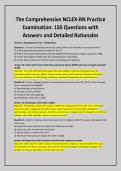
The Comprehensive NCLEX-RN Practice
Examination: 150 Questions with
Answers and Detailed Rationales
Section 1: Management of Care - 40 Questions
Question 1: A nurse is prioritizing care for four clients. Which client should the nurse assess first?
A) A client with pneumonia who has a fever of 101.2°F
B) A client with chronic obstructive pulmonary disease (COPD) who has an oxygen saturation of 88%
C) A client with diabetes mellitus who has a blood glucose of 140 mg/dL
D) A client with a urinary tract infection who is requesting pain medication
Answer: B) A client with chronic obstructive pulmonary disease (COPD) who has an oxygen saturation
of 88%
Rationale: The client with COPD and oxygen saturation of 88% is experiencing hypoxia and is at
immediate risk for respiratory failure. Oxygen saturation below 90% requires immediate intervention.
The nurse should use the ABC (airway, breathing, circulation) framework when prioritizing care.
Question 2: A nurse is delegating tasks to unlicensed assistive personnel (UAP). Which of the following
tasks is appropriate to delegate?
A) Administering oral medications
B) Inserting a urinary catheter
C) Feeding a client with dysphagia
D) Ambulating a client with a walker
Answer: D) Ambulating a client with a walker
Rationale: Ambulating a client with a walker is within the scope of practice for UAP. The nurse should
ensure the client is stable and the UAP has been trained to perform the task safely. Medication
administration and sterile procedures (catheter insertion) are not appropriate for delegation to UAP, and
feeding a client with dysphagia requires nursing assessment.
Question 3: A client is refusing a blood transfusion due to religious beliefs. The nurse's most appropriate
action is to:
A) Respect the client's decision and inform the healthcare provider
B) Explain the risks of refusing the transfusion
C) Ask the family to convince the client
D) Administer the transfusion despite the client's refusal
Answer: A) Respect the client's decision and inform the healthcare provider
Rationale: Clients have the right to refuse treatment based on religious or personal beliefs. The nurse
should respect the client's autonomy, document the refusal, and notify the healthcare provider. The
provider can discuss alternatives and risks with the client.
,Question 4: A charge nurse is making assignments for the shift. Which client should be assigned to the
most experienced nurse?
A) A client with a hip fracture who needs assistance with bathing
B) A client with a newly placed tracheostomy
C) A client with a urinary tract infection who is stable
D) A client who is ambulatory and ready for discharge
Answer: B) A client with a newly placed tracheostomy
Rationale: A client with a newly placed tracheostomy requires complex care and assessment skills,
including airway management and suctioning. The most experienced nurse should be assigned to this
client. Stable clients with routine care needs can be assigned to less experienced staff.
Question 5: A nurse is admitting a client who is at risk for falls. Which of the following interventions
should the nurse implement?
A) Place the bed in the highest position
B) Keep the room lighting dim
C) Place the call bell within reach
D) Restrain the client for safety
Answer: C) Place the call bell within reach
Rationale: Placing the call bell within reach allows the client to call for assistance, reducing the risk of
falls. The bed should be in the lowest position, room lighting should be adequate, and restraints should
only be used as a last resort with a provider's order.
Question 6: A nurse is providing discharge teaching to a client with a new diagnosis of heart failure.
Which of the following statements by the client indicates a need for further teaching?
A) "I will weigh myself every morning"
B) "I will eat foods that are low in sodium"
C) "I will call my doctor if I gain 2 pounds in a day"
D) "I can stop taking my medications when I feel better"
Answer: D) "I can stop taking my medications when I feel better"
Rationale: Clients with heart failure must continue taking medications as prescribed even if they feel
better. Stopping medications can lead to worsening of heart failure. The nurse should teach the client
about the importance of medication adherence.
Question 7: A nurse is caring for a client who is in isolation for a communicable disease. Which of the
following actions is appropriate for standard precautions?
A) Wearing a mask when entering the room
B) Wearing gloves when touching the client
C) Wearing a gown when entering the room
D) Wearing a face shield when entering the room
Answer: B) Wearing gloves when touching the client
Rationale: Standard precautions require gloves when touching blood, body fluids, mucous membranes,
or non-intact skin. Additional precautions (contact, droplet, airborne) may require masks, gowns, and
eye protection depending on the disease.
,Question 8: A nurse is preparing a client for surgery. Which of the following actions is essential for
ensuring the client receives the correct procedure?
A) Confirm the client's identity and verify the surgical site
B) Ask the client to confirm the procedure
C) Check the operative consent form only
D) Review the client's laboratory results
Answer: A) Confirm the client's identity and verify the surgical site
Rationale: The nurse must verify the client's identity using two identifiers and confirm the correct surgical
site with the client and informed consent. This is part of the surgical safety checklist and prevents wrong-
site, wrong-procedure, and wrong-patient errors.
Question 9: A client's family member asks the nurse about the client's prognosis. Which of the following
responses is most appropriate?
A) "I will have the healthcare provider discuss that with you"
B) "The prognosis is good, don't worry"
C) "I'm not allowed to tell you that"
D) "The client will be fine"
Answer: A) "I will have the healthcare provider discuss that with you"
Rationale: The nurse should not disclose prognostic information without the client's consent. The
healthcare provider is responsible for discussing prognosis with the client and family. The nurse should
support the family while maintaining confidentiality.
Question 10: A nurse is caring for a client who has a prescription for restraints. Which of the following
actions is appropriate?
A) Apply restraints securely to the bed frame
B) Check the client's circulation every 4 hours
C) Keep restraints on at all times
D) Apply restraints to the side rails
Answer: A) Apply restraints securely to the bed frame
Rationale: Restraints should be tied to the bed frame (not side rails) with a quick-release knot. The nurse
must assess the client's circulation and skin integrity every 2 hours and release restraints for range of
motion exercises. Restraints require a provider's order and periodic reassessment.
Question 11: A nurse is documenting a client's care. Which of the following is an example of proper
documentation?
A) "Client is in a good mood"
B) "Client appears to be in pain"
C) "Client reports pain rated 6/10"
D) "Client seems confused"
Answer: C) "Client reports pain rated 6/10"
Rationale: Documentation should be objective, specific, and factual. Quoting the client's statement is
appropriate. Subjective descriptions like "in a good mood," "appears," and "seems" are not objective
documentation and should be avoided.
, Question 12: A nurse is providing education to a client about advance directives. The nurse should
include which of the following information?
A) "Advance directives are legally binding documents"
B) "Advance directives only apply in terminal situations"
C) "Once created, advance directives cannot be changed"
D) "Advance directives are only for older adults"
Answer: A) "Advance directives are legally binding documents"
Rationale: Advance directives are legally binding documents that allow clients to specify their healthcare
preferences. They can be changed at any time by the client and are applicable to all adults, not just older
adults.
Question 13: A client is experiencing a medical emergency. Which of the following actions should the
nurse take first?
A) Call the healthcare provider
B) Call the rapid response team
C) Assess the client's airway, breathing, and circulation
D) Administer oxygen immediately
Answer: C) Assess the client's airway, breathing, and circulation
Rationale: The nurse should first assess the client's airway, breathing, and circulation (ABCs) to
determine the client's immediate needs. This assessment guides all subsequent interventions.
Question 14: A nurse is evaluating a client's understanding of dietary restrictions. Which of the following
indicates the client understands a low-sodium diet?
A) "I can eat as much bacon as I want for breakfast"
B) "I should avoid adding salt to my food at the table"
C) "Canned vegetables are a good choice"
D) "I can eat processed cheese"
Answer: B) "I should avoid adding salt to my food at the table"
Rationale: Clients on low-sodium diets should avoid adding salt to their food, limit processed foods, and
choose fresh or frozen vegetables. Bacon, canned vegetables, and processed cheese are high in sodium.
Question 15: A nurse is discharging a client who speaks a different language. Which of the following is
the most appropriate way to provide discharge instructions?
A) Use a family member to interpret
B) Use a professional medical interpreter
C) Provide written instructions in English
D) Use hand gestures to communicate
Answer: B) Use a professional medical interpreter
Rationale: Professional medical interpreters should be used to ensure accurate communication with
clients who speak a different language. Family members may introduce errors and are not appropriate
for medical interpretation. Written instructions should be in the client's preferred language.
Question 16: A nurse is caring for a client who has a living will. Which of the following should the nurse
understand about a living will?
Examination: 150 Questions with
Answers and Detailed Rationales
Section 1: Management of Care - 40 Questions
Question 1: A nurse is prioritizing care for four clients. Which client should the nurse assess first?
A) A client with pneumonia who has a fever of 101.2°F
B) A client with chronic obstructive pulmonary disease (COPD) who has an oxygen saturation of 88%
C) A client with diabetes mellitus who has a blood glucose of 140 mg/dL
D) A client with a urinary tract infection who is requesting pain medication
Answer: B) A client with chronic obstructive pulmonary disease (COPD) who has an oxygen saturation
of 88%
Rationale: The client with COPD and oxygen saturation of 88% is experiencing hypoxia and is at
immediate risk for respiratory failure. Oxygen saturation below 90% requires immediate intervention.
The nurse should use the ABC (airway, breathing, circulation) framework when prioritizing care.
Question 2: A nurse is delegating tasks to unlicensed assistive personnel (UAP). Which of the following
tasks is appropriate to delegate?
A) Administering oral medications
B) Inserting a urinary catheter
C) Feeding a client with dysphagia
D) Ambulating a client with a walker
Answer: D) Ambulating a client with a walker
Rationale: Ambulating a client with a walker is within the scope of practice for UAP. The nurse should
ensure the client is stable and the UAP has been trained to perform the task safely. Medication
administration and sterile procedures (catheter insertion) are not appropriate for delegation to UAP, and
feeding a client with dysphagia requires nursing assessment.
Question 3: A client is refusing a blood transfusion due to religious beliefs. The nurse's most appropriate
action is to:
A) Respect the client's decision and inform the healthcare provider
B) Explain the risks of refusing the transfusion
C) Ask the family to convince the client
D) Administer the transfusion despite the client's refusal
Answer: A) Respect the client's decision and inform the healthcare provider
Rationale: Clients have the right to refuse treatment based on religious or personal beliefs. The nurse
should respect the client's autonomy, document the refusal, and notify the healthcare provider. The
provider can discuss alternatives and risks with the client.
,Question 4: A charge nurse is making assignments for the shift. Which client should be assigned to the
most experienced nurse?
A) A client with a hip fracture who needs assistance with bathing
B) A client with a newly placed tracheostomy
C) A client with a urinary tract infection who is stable
D) A client who is ambulatory and ready for discharge
Answer: B) A client with a newly placed tracheostomy
Rationale: A client with a newly placed tracheostomy requires complex care and assessment skills,
including airway management and suctioning. The most experienced nurse should be assigned to this
client. Stable clients with routine care needs can be assigned to less experienced staff.
Question 5: A nurse is admitting a client who is at risk for falls. Which of the following interventions
should the nurse implement?
A) Place the bed in the highest position
B) Keep the room lighting dim
C) Place the call bell within reach
D) Restrain the client for safety
Answer: C) Place the call bell within reach
Rationale: Placing the call bell within reach allows the client to call for assistance, reducing the risk of
falls. The bed should be in the lowest position, room lighting should be adequate, and restraints should
only be used as a last resort with a provider's order.
Question 6: A nurse is providing discharge teaching to a client with a new diagnosis of heart failure.
Which of the following statements by the client indicates a need for further teaching?
A) "I will weigh myself every morning"
B) "I will eat foods that are low in sodium"
C) "I will call my doctor if I gain 2 pounds in a day"
D) "I can stop taking my medications when I feel better"
Answer: D) "I can stop taking my medications when I feel better"
Rationale: Clients with heart failure must continue taking medications as prescribed even if they feel
better. Stopping medications can lead to worsening of heart failure. The nurse should teach the client
about the importance of medication adherence.
Question 7: A nurse is caring for a client who is in isolation for a communicable disease. Which of the
following actions is appropriate for standard precautions?
A) Wearing a mask when entering the room
B) Wearing gloves when touching the client
C) Wearing a gown when entering the room
D) Wearing a face shield when entering the room
Answer: B) Wearing gloves when touching the client
Rationale: Standard precautions require gloves when touching blood, body fluids, mucous membranes,
or non-intact skin. Additional precautions (contact, droplet, airborne) may require masks, gowns, and
eye protection depending on the disease.
,Question 8: A nurse is preparing a client for surgery. Which of the following actions is essential for
ensuring the client receives the correct procedure?
A) Confirm the client's identity and verify the surgical site
B) Ask the client to confirm the procedure
C) Check the operative consent form only
D) Review the client's laboratory results
Answer: A) Confirm the client's identity and verify the surgical site
Rationale: The nurse must verify the client's identity using two identifiers and confirm the correct surgical
site with the client and informed consent. This is part of the surgical safety checklist and prevents wrong-
site, wrong-procedure, and wrong-patient errors.
Question 9: A client's family member asks the nurse about the client's prognosis. Which of the following
responses is most appropriate?
A) "I will have the healthcare provider discuss that with you"
B) "The prognosis is good, don't worry"
C) "I'm not allowed to tell you that"
D) "The client will be fine"
Answer: A) "I will have the healthcare provider discuss that with you"
Rationale: The nurse should not disclose prognostic information without the client's consent. The
healthcare provider is responsible for discussing prognosis with the client and family. The nurse should
support the family while maintaining confidentiality.
Question 10: A nurse is caring for a client who has a prescription for restraints. Which of the following
actions is appropriate?
A) Apply restraints securely to the bed frame
B) Check the client's circulation every 4 hours
C) Keep restraints on at all times
D) Apply restraints to the side rails
Answer: A) Apply restraints securely to the bed frame
Rationale: Restraints should be tied to the bed frame (not side rails) with a quick-release knot. The nurse
must assess the client's circulation and skin integrity every 2 hours and release restraints for range of
motion exercises. Restraints require a provider's order and periodic reassessment.
Question 11: A nurse is documenting a client's care. Which of the following is an example of proper
documentation?
A) "Client is in a good mood"
B) "Client appears to be in pain"
C) "Client reports pain rated 6/10"
D) "Client seems confused"
Answer: C) "Client reports pain rated 6/10"
Rationale: Documentation should be objective, specific, and factual. Quoting the client's statement is
appropriate. Subjective descriptions like "in a good mood," "appears," and "seems" are not objective
documentation and should be avoided.
, Question 12: A nurse is providing education to a client about advance directives. The nurse should
include which of the following information?
A) "Advance directives are legally binding documents"
B) "Advance directives only apply in terminal situations"
C) "Once created, advance directives cannot be changed"
D) "Advance directives are only for older adults"
Answer: A) "Advance directives are legally binding documents"
Rationale: Advance directives are legally binding documents that allow clients to specify their healthcare
preferences. They can be changed at any time by the client and are applicable to all adults, not just older
adults.
Question 13: A client is experiencing a medical emergency. Which of the following actions should the
nurse take first?
A) Call the healthcare provider
B) Call the rapid response team
C) Assess the client's airway, breathing, and circulation
D) Administer oxygen immediately
Answer: C) Assess the client's airway, breathing, and circulation
Rationale: The nurse should first assess the client's airway, breathing, and circulation (ABCs) to
determine the client's immediate needs. This assessment guides all subsequent interventions.
Question 14: A nurse is evaluating a client's understanding of dietary restrictions. Which of the following
indicates the client understands a low-sodium diet?
A) "I can eat as much bacon as I want for breakfast"
B) "I should avoid adding salt to my food at the table"
C) "Canned vegetables are a good choice"
D) "I can eat processed cheese"
Answer: B) "I should avoid adding salt to my food at the table"
Rationale: Clients on low-sodium diets should avoid adding salt to their food, limit processed foods, and
choose fresh or frozen vegetables. Bacon, canned vegetables, and processed cheese are high in sodium.
Question 15: A nurse is discharging a client who speaks a different language. Which of the following is
the most appropriate way to provide discharge instructions?
A) Use a family member to interpret
B) Use a professional medical interpreter
C) Provide written instructions in English
D) Use hand gestures to communicate
Answer: B) Use a professional medical interpreter
Rationale: Professional medical interpreters should be used to ensure accurate communication with
clients who speak a different language. Family members may introduce errors and are not appropriate
for medical interpretation. Written instructions should be in the client's preferred language.
Question 16: A nurse is caring for a client who has a living will. Which of the following should the nurse
understand about a living will?


