

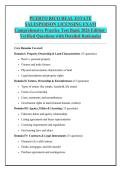
PUERTO RICO REAL ESTATE
SALESPERSON LICENSING EXAM
Comprehensive Practice Test Bank 2026 Edition |
Verified Questions with Detailed Rationales
Core Domains Covered:
Domain I: Property Ownership & Land Characteristics (15 questions)
• Real vs. personal property
• Fixtures and trade fixtures
• Physical and economic characteristics of land
• Legal descriptions and property rights
Domain II: Estates, Ownership & Encumbrances (15 questions)
• Types of estates (fee simple, leasehold, life estate)
• Forms of co-ownership
• Liens, easements, and encumbrances
• Government rights in land (eminent domain, escheat)
Domain III: Agency, Ethics & Licensing (15 questions)
• Fiduciary duties and agency relationships
• Listing agreements and buyer representation
• Licensing requirements and regulations
• Fair housing laws and ethics
Domain IV: Contracts & Legal Instruments (15 questions)
• Elements of a valid contract
• Deeds, mortgages, and title transfer
• Purchase agreements and contingencies
, • Contract law and enforcement
Domain V: Real Estate Finance (10 questions)
• Types of loans and financing
• Mortgage concepts and terminology
• Interest rates and calculations
• Foreclosure and defaults
Domain VI: Valuation & Appraisal (10 questions)
• Appraisal approaches (sales comparison, cost, income)
• Market value and assessment
• CMA and BPO
Domain VII: Puerto Rico-Specific Laws & Regulations (10 questions)
• Ley 139 and Reglamento 9404
• Registry of Property recording
• Act No. 10 of 1994
• Local real estate practices
Domain VIII: Property Management, Leasing & Mathematics (5 questions)
• Landlord-tenant law
• Lease agreements
• Real estate calculations and prorations
Domain I: Property Ownership & Land Characteristics
1. Which term best defines real estate?
Answer: B. Land and everything permanently attached to it
Rationale: Real estate is defined as land and any permanent attachments
to it, such as buildings, fences, and trees. Movable items are classified as
personal property.
,A. Movable personal property
B. Land and everything permanently attached to it
C. Intangible assets like stocks
D. Personal belongings
2. The fact that an individual must go to the land describes what physical
characteristic of land?
Answer: B. Immobility
Rationale: Land is physically immobile; its location cannot be changed.
This is one of the three physical characteristics of land, along with
indestructibility and uniqueness (non-homogeneity).
A. Indestructibility
B. Immobility
C. Uniqueness
D. Scarcity
3. Which of the following is NOT a physical characteristic of land?
Answer: D. Transferability
Rationale: The three physical characteristics of land are immobility,
indestructibility, and uniqueness (non-homogeneity). Transferability is an
economic characteristic.
A. Indestructibility
B. Immobility
C. Uniqueness
D. Transferability
4. What distinguishes personal property from real property in a real estate
transaction?
Answer: B. Personal property is movable and not permanently attached
Rationale: Personal property (chattel) is movable and not permanently
, affixed to land or structures. Examples include furniture, appliances that are
not built-in, and vehicles. Real property includes land and fixtures.
A. Personal property is immovable
B. Personal property is movable and not permanently attached
C. Personal property includes land
D. Personal property cannot be transferred
5. Which of the following is legally considered a fixture in Puerto Rico?
Answer: B. Built-in kitchen cabinets
Rationale: Built-in kitchen cabinets are attached to the property and
considered fixtures, which are part of the real estate that transfers with the
property upon sale. The legal test includes annexation, adaptation, and intent.
A. A freestanding refrigerator
B. Built-in kitchen cabinets
C. Removable wallpaper
D. A portable air conditioner
6. The bundle of legal rights associated with real property includes all of the
following EXCEPT:
Answer: D. Right of survivorship automatically
Rationale: The bundle of rights includes possession, control, enjoyment,
disposition (transfer), and exclusion. Right of survivorship is specific to joint
tenancy, not a universal right.
A. Right of possession
B. Right of control
C. Right of transfer
D. Right of survivorship automatically
7. How does a trade fixture differ from a regular fixture?
SALESPERSON LICENSING EXAM
Comprehensive Practice Test Bank 2026 Edition |
Verified Questions with Detailed Rationales
Core Domains Covered:
Domain I: Property Ownership & Land Characteristics (15 questions)
• Real vs. personal property
• Fixtures and trade fixtures
• Physical and economic characteristics of land
• Legal descriptions and property rights
Domain II: Estates, Ownership & Encumbrances (15 questions)
• Types of estates (fee simple, leasehold, life estate)
• Forms of co-ownership
• Liens, easements, and encumbrances
• Government rights in land (eminent domain, escheat)
Domain III: Agency, Ethics & Licensing (15 questions)
• Fiduciary duties and agency relationships
• Listing agreements and buyer representation
• Licensing requirements and regulations
• Fair housing laws and ethics
Domain IV: Contracts & Legal Instruments (15 questions)
• Elements of a valid contract
• Deeds, mortgages, and title transfer
• Purchase agreements and contingencies
, • Contract law and enforcement
Domain V: Real Estate Finance (10 questions)
• Types of loans and financing
• Mortgage concepts and terminology
• Interest rates and calculations
• Foreclosure and defaults
Domain VI: Valuation & Appraisal (10 questions)
• Appraisal approaches (sales comparison, cost, income)
• Market value and assessment
• CMA and BPO
Domain VII: Puerto Rico-Specific Laws & Regulations (10 questions)
• Ley 139 and Reglamento 9404
• Registry of Property recording
• Act No. 10 of 1994
• Local real estate practices
Domain VIII: Property Management, Leasing & Mathematics (5 questions)
• Landlord-tenant law
• Lease agreements
• Real estate calculations and prorations
Domain I: Property Ownership & Land Characteristics
1. Which term best defines real estate?
Answer: B. Land and everything permanently attached to it
Rationale: Real estate is defined as land and any permanent attachments
to it, such as buildings, fences, and trees. Movable items are classified as
personal property.
,A. Movable personal property
B. Land and everything permanently attached to it
C. Intangible assets like stocks
D. Personal belongings
2. The fact that an individual must go to the land describes what physical
characteristic of land?
Answer: B. Immobility
Rationale: Land is physically immobile; its location cannot be changed.
This is one of the three physical characteristics of land, along with
indestructibility and uniqueness (non-homogeneity).
A. Indestructibility
B. Immobility
C. Uniqueness
D. Scarcity
3. Which of the following is NOT a physical characteristic of land?
Answer: D. Transferability
Rationale: The three physical characteristics of land are immobility,
indestructibility, and uniqueness (non-homogeneity). Transferability is an
economic characteristic.
A. Indestructibility
B. Immobility
C. Uniqueness
D. Transferability
4. What distinguishes personal property from real property in a real estate
transaction?
Answer: B. Personal property is movable and not permanently attached
Rationale: Personal property (chattel) is movable and not permanently
, affixed to land or structures. Examples include furniture, appliances that are
not built-in, and vehicles. Real property includes land and fixtures.
A. Personal property is immovable
B. Personal property is movable and not permanently attached
C. Personal property includes land
D. Personal property cannot be transferred
5. Which of the following is legally considered a fixture in Puerto Rico?
Answer: B. Built-in kitchen cabinets
Rationale: Built-in kitchen cabinets are attached to the property and
considered fixtures, which are part of the real estate that transfers with the
property upon sale. The legal test includes annexation, adaptation, and intent.
A. A freestanding refrigerator
B. Built-in kitchen cabinets
C. Removable wallpaper
D. A portable air conditioner
6. The bundle of legal rights associated with real property includes all of the
following EXCEPT:
Answer: D. Right of survivorship automatically
Rationale: The bundle of rights includes possession, control, enjoyment,
disposition (transfer), and exclusion. Right of survivorship is specific to joint
tenancy, not a universal right.
A. Right of possession
B. Right of control
C. Right of transfer
D. Right of survivorship automatically
7. How does a trade fixture differ from a regular fixture?


