

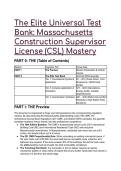
The Elite Universal Test
Bank: Massachusetts
Construction Supervisor
License (CSL) Mastery
PART 0: THE (Table of Contents)
Section Cognitive Tier Focus Area
PART I The Preview Mission Parameters & Critical
Axioms
PART II The Elite Test Bank 30-Point MCQ Gauntlet
- Tier 1: Foundational Syntax & Q1 – Q10 (Code Admin, Core
Application Dimensions, OSHA Hard
Decks)
- Tier 2: Complex Application & Q11 – Q20 (Calculations,
Simulation Energy Audits, Variable
Dependencies)
- Tier 3: Grandmaster Synthesis Q21 – Q30 (Multi-Code Conflict
Resolution, High-Stakes Field
Decisions)
PART I: THE Preview
This document is engineered to forge your field experience into uncompromising regulatory
mastery. By deconstructing the Massachusetts State Building Code (780 CMR), the
Architectural Access Board regulations (521 CMR), and federal OSHA mandates, this gauntlet
translates academic theory directly into elite professional competence.
● The 10th Edition Baseline: 780 CMR is fundamentally driven by the 2021 International
Building Code (IBC) and International Residential Code (IRC) with exclusive
Massachusetts amendments. In Massachusetts, residential stair risers max out at 8¼
inches, and treads bottom out at 9 inches.
● The 521 CMR Proportionality Rule: When renovating an existing commercial space, if
the work costs over $100,000, the work itself plus an accessible route, entrance, and
bathroom are required. If the work exceeds 30% of the building's full and fair cash value,
the entire building must be brought into total accessibility compliance.
● The Trenching Hard Deck: Any excavation 4 feet or deeper requires an egress
mechanism (ladder or ramp) within 25 lateral feet of any worker. Spoil piles must remain a
minimum of 2 feet from the trench edge.
, ● The Structural Void Limits: For sawn lumber joists, holes are capped at one-third the
member's depth and must be 2 inches from the edges. Notches are capped at one-sixth
the depth and are strictly forbidden in the middle third of the span.
● The Stretch Energy Threshold: Under the 2025 Stretch Code (225 CMR 22/23), a new
residential build must achieve a blower door test result of \le 3.0 ACH50. Specialized
opt-in codes drive this down to \le 2.0 ACH50 for mixed-fuel dwellings.
PART II: THE ELITE TEST BANK
Tier 1 - Foundational Syntax & Application
Q1: A 22-year-old carpentry apprentice applies to take the Massachusetts Unrestricted
Construction Supervisor License (CSL) exam. He submits W-2 tax forms proving two years of
full-time employment framing residential homes, plus a diploma from an accredited four-year
vocational high school in building construction. Based on the administrative principles of 780
CMR 110.R5, which conclusion regarding his eligibility is the MOST ACCURATE? A) The
candidate is ineligible because vocational high school education does not count toward the
required 36 months of field experience. B) The candidate is eligible because his two years of
W-2 experience combined with his four-year vocational high school diploma satisfies the
36-month requirement. C) The candidate is ineligible because all 36 months of required
experience must be strictly documented via W-2s or a licensed engineer's attestation,
prohibiting educational transcripts. D) The candidate is eligible because any construction
experience combined with being over the age of 18 automatically qualifies him for the restricted
examination, but not the unrestricted.
● The Answer: B (The candidate is eligible because his two years of W-2 experience
combined with his four-year vocational high school diploma satisfies the 36-month
requirement.)
● Distractor Analysis:
○ A is incorrect: The administrative code explicitly allows the successful completion of
a three- or four-year vocational high school program in building construction to be
deemed equivalent to one year of work experience.
○ C is incorrect: Educational documentation, such as a diploma or degree, is a legally
valid substitute for up to two years of the total required field experience.
○ D is incorrect: Age 18 is a mandatory baseline, but there is no automatic
qualification based on partial experience; both the unrestricted and restricted exams
demand 36 months of verifiable, equivalent experience.
The Mentor's Analysis: The Board of Building Regulations and Standards (BBRS) strictly
enforces a requirement of 3 years (36 months) of full-time experience within the past ten years.
However, formal construction education serves as a direct legal multiplier to offset raw field time.
A vocational high school diploma equals one year; a relevant bachelor's degree in architecture
or engineering equals two. By providing two years of W-2s alongside a vocational diploma, the
apprentice meets the 36-month hard deck. Professional/Academic Intuition: Education
mitigates, but does not eliminate, the field time requirement. Maximize educational
credits up to the absolute two-year ceiling.
Q2: A contractor in Worcester is framing a new two-story, single-family dwelling under the
Massachusetts 10th Edition of the State Building Code (780 CMR 51.00). When constructing
the main interior staircase, the framer must cut the stringers. Based on the specific
, Massachusetts residential amendments to the 2021 IRC, which set of maximum riser height and
minimum tread depth is the MOST ACCURATE? A) Maximum riser height of 7¾ inches and a
minimum tread depth of 10 inches. B) Maximum riser height of 7 inches and a minimum tread
depth of 11 inches. C) Maximum riser height of 8¼ inches and a minimum tread depth of 9
inches. D) Maximum riser height of 8 inches and a minimum tread depth of 10 inches.
● The Answer: C (Maximum riser height of 8¼ inches and a minimum tread depth of 9
inches.)
● Distractor Analysis:
○ A is incorrect: This is the standard national baseline found in the 2021 International
Residential Code (IRC). Massachusetts explicitly overrides this dimension in its
state-specific amendments.
○ B is incorrect: This reflects the standard commercial base code requirement found
in the IBC, which is entirely inapplicable to a single-family dwelling regulated under
780 CMR 51.00.
○ D is incorrect: This is a localized legacy metric often passed down by veteran
framers, but it holds no legal weight under the current 10th Edition code.
The Mentor's Analysis: Standard model codes like the IRC set a foundational baseline, but
state amendments always supersede them. The 2021 IRC mandates a 7¾-inch riser and a
10-inch tread to maximize general egress safety. However, Massachusetts historically and
currently amends this under 780 CMR Chapter 51 (R311.7.5) to allow for steeper, tighter
residential stairs, preserving floor space in older, compact New England footprints. The statutory
boundary is explicitly 8¼-inch risers and 9-inch treads. Professional/Academic Intuition:
Model codes are generic guidelines; state amendments are the law. In Massachusetts
residential framing, 8¼ inches by 9 inches is the unyielding statutory boundary.
Q3: A plumbing contractor is trenching a site in Springfield to tie into the municipal water main.
The trench reaches a depth of 4.5 feet and a width of 3 feet. The soil has been classified as
Type B. Based on OSHA 29 CFR 1926 Subpart P, what is the FIRST immediate requirement the
competent person must verify regarding egress? A) A protective shielding system (trench box)
must be installed before anyone enters the excavation. B) A stairway, ladder, or ramp must be
located so as to require no more than 25 feet of lateral travel for the employees in the trench. C)
The spoil pile must be moved back a minimum of 4.5 feet from the edge to symmetrically match
the depth of the trench. D) Continuous atmospheric testing must be initiated because the trench
exceeds 4 feet in depth.
● The Answer: B (A stairway, ladder, or ramp must be located so as to require no more
than 25 feet of lateral travel for the employees in the trench.)
● Distractor Analysis:
○ A is incorrect: Protective systems for cave-in protection (shoring, shielding, or
sloping) are legally mandated at a depth of 5 feet, not 4.5 feet, unless the
competent person identifies an explicit anomaly indicating a cave-in is imminent.
○ C is incorrect: The OSHA standard for spoil piles dictates that they must be set
back a minimum of 2 feet from the edge, regardless of whether the trench is 4 feet
deep or 10 feet deep.
○ D is incorrect: Atmospheric testing is only required in excavations deeper than 4
feet where an oxygen deficiency or hazardous atmosphere exists or could
reasonably be expected to exist (e.g., landfills, refineries, or near hazardous
storage), not as a blanket rule for standard water main trenches.
The Mentor's Analysis: OSHA draws distinct operational thresholds based entirely on
excavation depth. At 4 feet, the immediate physiological hazard becomes egress; workers can
Bank: Massachusetts
Construction Supervisor
License (CSL) Mastery
PART 0: THE (Table of Contents)
Section Cognitive Tier Focus Area
PART I The Preview Mission Parameters & Critical
Axioms
PART II The Elite Test Bank 30-Point MCQ Gauntlet
- Tier 1: Foundational Syntax & Q1 – Q10 (Code Admin, Core
Application Dimensions, OSHA Hard
Decks)
- Tier 2: Complex Application & Q11 – Q20 (Calculations,
Simulation Energy Audits, Variable
Dependencies)
- Tier 3: Grandmaster Synthesis Q21 – Q30 (Multi-Code Conflict
Resolution, High-Stakes Field
Decisions)
PART I: THE Preview
This document is engineered to forge your field experience into uncompromising regulatory
mastery. By deconstructing the Massachusetts State Building Code (780 CMR), the
Architectural Access Board regulations (521 CMR), and federal OSHA mandates, this gauntlet
translates academic theory directly into elite professional competence.
● The 10th Edition Baseline: 780 CMR is fundamentally driven by the 2021 International
Building Code (IBC) and International Residential Code (IRC) with exclusive
Massachusetts amendments. In Massachusetts, residential stair risers max out at 8¼
inches, and treads bottom out at 9 inches.
● The 521 CMR Proportionality Rule: When renovating an existing commercial space, if
the work costs over $100,000, the work itself plus an accessible route, entrance, and
bathroom are required. If the work exceeds 30% of the building's full and fair cash value,
the entire building must be brought into total accessibility compliance.
● The Trenching Hard Deck: Any excavation 4 feet or deeper requires an egress
mechanism (ladder or ramp) within 25 lateral feet of any worker. Spoil piles must remain a
minimum of 2 feet from the trench edge.
, ● The Structural Void Limits: For sawn lumber joists, holes are capped at one-third the
member's depth and must be 2 inches from the edges. Notches are capped at one-sixth
the depth and are strictly forbidden in the middle third of the span.
● The Stretch Energy Threshold: Under the 2025 Stretch Code (225 CMR 22/23), a new
residential build must achieve a blower door test result of \le 3.0 ACH50. Specialized
opt-in codes drive this down to \le 2.0 ACH50 for mixed-fuel dwellings.
PART II: THE ELITE TEST BANK
Tier 1 - Foundational Syntax & Application
Q1: A 22-year-old carpentry apprentice applies to take the Massachusetts Unrestricted
Construction Supervisor License (CSL) exam. He submits W-2 tax forms proving two years of
full-time employment framing residential homes, plus a diploma from an accredited four-year
vocational high school in building construction. Based on the administrative principles of 780
CMR 110.R5, which conclusion regarding his eligibility is the MOST ACCURATE? A) The
candidate is ineligible because vocational high school education does not count toward the
required 36 months of field experience. B) The candidate is eligible because his two years of
W-2 experience combined with his four-year vocational high school diploma satisfies the
36-month requirement. C) The candidate is ineligible because all 36 months of required
experience must be strictly documented via W-2s or a licensed engineer's attestation,
prohibiting educational transcripts. D) The candidate is eligible because any construction
experience combined with being over the age of 18 automatically qualifies him for the restricted
examination, but not the unrestricted.
● The Answer: B (The candidate is eligible because his two years of W-2 experience
combined with his four-year vocational high school diploma satisfies the 36-month
requirement.)
● Distractor Analysis:
○ A is incorrect: The administrative code explicitly allows the successful completion of
a three- or four-year vocational high school program in building construction to be
deemed equivalent to one year of work experience.
○ C is incorrect: Educational documentation, such as a diploma or degree, is a legally
valid substitute for up to two years of the total required field experience.
○ D is incorrect: Age 18 is a mandatory baseline, but there is no automatic
qualification based on partial experience; both the unrestricted and restricted exams
demand 36 months of verifiable, equivalent experience.
The Mentor's Analysis: The Board of Building Regulations and Standards (BBRS) strictly
enforces a requirement of 3 years (36 months) of full-time experience within the past ten years.
However, formal construction education serves as a direct legal multiplier to offset raw field time.
A vocational high school diploma equals one year; a relevant bachelor's degree in architecture
or engineering equals two. By providing two years of W-2s alongside a vocational diploma, the
apprentice meets the 36-month hard deck. Professional/Academic Intuition: Education
mitigates, but does not eliminate, the field time requirement. Maximize educational
credits up to the absolute two-year ceiling.
Q2: A contractor in Worcester is framing a new two-story, single-family dwelling under the
Massachusetts 10th Edition of the State Building Code (780 CMR 51.00). When constructing
the main interior staircase, the framer must cut the stringers. Based on the specific
, Massachusetts residential amendments to the 2021 IRC, which set of maximum riser height and
minimum tread depth is the MOST ACCURATE? A) Maximum riser height of 7¾ inches and a
minimum tread depth of 10 inches. B) Maximum riser height of 7 inches and a minimum tread
depth of 11 inches. C) Maximum riser height of 8¼ inches and a minimum tread depth of 9
inches. D) Maximum riser height of 8 inches and a minimum tread depth of 10 inches.
● The Answer: C (Maximum riser height of 8¼ inches and a minimum tread depth of 9
inches.)
● Distractor Analysis:
○ A is incorrect: This is the standard national baseline found in the 2021 International
Residential Code (IRC). Massachusetts explicitly overrides this dimension in its
state-specific amendments.
○ B is incorrect: This reflects the standard commercial base code requirement found
in the IBC, which is entirely inapplicable to a single-family dwelling regulated under
780 CMR 51.00.
○ D is incorrect: This is a localized legacy metric often passed down by veteran
framers, but it holds no legal weight under the current 10th Edition code.
The Mentor's Analysis: Standard model codes like the IRC set a foundational baseline, but
state amendments always supersede them. The 2021 IRC mandates a 7¾-inch riser and a
10-inch tread to maximize general egress safety. However, Massachusetts historically and
currently amends this under 780 CMR Chapter 51 (R311.7.5) to allow for steeper, tighter
residential stairs, preserving floor space in older, compact New England footprints. The statutory
boundary is explicitly 8¼-inch risers and 9-inch treads. Professional/Academic Intuition:
Model codes are generic guidelines; state amendments are the law. In Massachusetts
residential framing, 8¼ inches by 9 inches is the unyielding statutory boundary.
Q3: A plumbing contractor is trenching a site in Springfield to tie into the municipal water main.
The trench reaches a depth of 4.5 feet and a width of 3 feet. The soil has been classified as
Type B. Based on OSHA 29 CFR 1926 Subpart P, what is the FIRST immediate requirement the
competent person must verify regarding egress? A) A protective shielding system (trench box)
must be installed before anyone enters the excavation. B) A stairway, ladder, or ramp must be
located so as to require no more than 25 feet of lateral travel for the employees in the trench. C)
The spoil pile must be moved back a minimum of 4.5 feet from the edge to symmetrically match
the depth of the trench. D) Continuous atmospheric testing must be initiated because the trench
exceeds 4 feet in depth.
● The Answer: B (A stairway, ladder, or ramp must be located so as to require no more
than 25 feet of lateral travel for the employees in the trench.)
● Distractor Analysis:
○ A is incorrect: Protective systems for cave-in protection (shoring, shielding, or
sloping) are legally mandated at a depth of 5 feet, not 4.5 feet, unless the
competent person identifies an explicit anomaly indicating a cave-in is imminent.
○ C is incorrect: The OSHA standard for spoil piles dictates that they must be set
back a minimum of 2 feet from the edge, regardless of whether the trench is 4 feet
deep or 10 feet deep.
○ D is incorrect: Atmospheric testing is only required in excavations deeper than 4
feet where an oxygen deficiency or hazardous atmosphere exists or could
reasonably be expected to exist (e.g., landfills, refineries, or near hazardous
storage), not as a blanket rule for standard water main trenches.
The Mentor's Analysis: OSHA draws distinct operational thresholds based entirely on
excavation depth. At 4 feet, the immediate physiological hazard becomes egress; workers can


