Maternity Exam 1 Chap 1-5 practice Questions and Answers with
Cmplete Solutions UPDATED!!!.
Correct
Incorrect
Answer: D
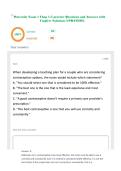
Rationale: For a contraceptive to be most effective, the client must be able to use it
correctly and consistently. Even if a method is considered 100% effective, it is not the
best choice if the couple does not use it correctly or consistently. Cost is a
, consideration, but the least expensive method is not necessarily the best choice. The
need for a prescription is not relevant to the couple's choice.
Answer: B
Rationale: Chlamydial symptoms include dysuria, mucopurulent vaginal discharge, and
dysfunctional uterine bleeding. It can cause inflammation of the rectum and conjunctiva.
Syphilis starts with a chancre on vulva or vagina but can develop in other parts of the body.
Secondary infection is maculopapular rash on hands and feet with a sore throat. Genital
herpes symptoms include itching, tingling, and pain in genital area followed by small pustules
and blister-like genital lesions. Gonorrhea vaginal discharge is yellowish color and very foul
smelling.
Answer: A
Rationale: For the client treated for primary or secondary syphilis, retesting needs to occur at
6 months and at 12 months. If the client was treated for latent syphilis, then testing needs to
be done at 6 months, 12 months, and 24 months. For latent syphilis, the testing also needs to
include testing for HIV. The client does not to be retested if there is a new sexual partner, but
the client should be instructed in safer sex methods to prevent a sexually transmitted
infection.
Answer: C
Rationale: The only certain method of diagnosing endometriosis is by seeing it. Therefore, the
nurse would expect to prepare the client for a laparoscopy to confirm the diagnosis. A pelvic
examination and transvaginal ultrasound are done to assess for endometriosis but do not
confirm its presence. Hysterosalpingography aids in identifying tubal problems resulting in
infertility.
Don't know?
2 of 63
,
,
Cmplete Solutions UPDATED!!!.
Correct
Incorrect
Answer: D
Rationale: For a contraceptive to be most effective, the client must be able to use it
correctly and consistently. Even if a method is considered 100% effective, it is not the
best choice if the couple does not use it correctly or consistently. Cost is a
, consideration, but the least expensive method is not necessarily the best choice. The
need for a prescription is not relevant to the couple's choice.
Answer: B
Rationale: Chlamydial symptoms include dysuria, mucopurulent vaginal discharge, and
dysfunctional uterine bleeding. It can cause inflammation of the rectum and conjunctiva.
Syphilis starts with a chancre on vulva or vagina but can develop in other parts of the body.
Secondary infection is maculopapular rash on hands and feet with a sore throat. Genital
herpes symptoms include itching, tingling, and pain in genital area followed by small pustules
and blister-like genital lesions. Gonorrhea vaginal discharge is yellowish color and very foul
smelling.
Answer: A
Rationale: For the client treated for primary or secondary syphilis, retesting needs to occur at
6 months and at 12 months. If the client was treated for latent syphilis, then testing needs to
be done at 6 months, 12 months, and 24 months. For latent syphilis, the testing also needs to
include testing for HIV. The client does not to be retested if there is a new sexual partner, but
the client should be instructed in safer sex methods to prevent a sexually transmitted
infection.
Answer: C
Rationale: The only certain method of diagnosing endometriosis is by seeing it. Therefore, the
nurse would expect to prepare the client for a laparoscopy to confirm the diagnosis. A pelvic
examination and transvaginal ultrasound are done to assess for endometriosis but do not
confirm its presence. Hysterosalpingography aids in identifying tubal problems resulting in
infertility.
Don't know?
2 of 63
,
,