
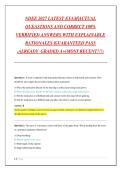
NDEE 2027 LATEST EXAM|ACTUAL
QUEASTIONS AND CORRECT 100%
VERRIFIED ANSWERS WITH EXPLAINABLE
RATIONALES |GUARANTEED PASS
,ALREADY GRADED A+(MOST RECENT!!!)
Question 1: A client is admitted with deep partial-thickness burns to both hands and forearms. How
should the nurse apply the prescribed antimicrobial medication?
A) Place the medication directly on the dressing in a thick layer using clean gloves.
B) Place the medication directly on the burn wound in a thin layer using sterile gloves.
C) Put the medication in a Hubbard tank and saturate sterile dressings before applying.
D) Put the medication in a Hubbard tank and allow the client to soak for several minutes.
Answer: B
Sterile aseptic technique is necessary for an open wound; a thin layer of ointment is applied directly to
the affected area using sterile gloves.
Question 2: The nurse is evaluating a client with burns of the upper body. Which finding alerts the nurse
to a potential respiratory obstruction?
A) Deep breathing
B) Hoarse quality to the voice
C) Pink-tinged, frothy sputum
D) Rapid abdominal breathing
1|Page
,Answer: B
Hoarseness is a sign of potential respiratory insufficiency due to inhalation injury, which causes edema
in the surrounding tissues, including the vocal cords.
Question 3: The nurse should identify that which medication is contraindicated during pregnancy and
classified as pregnancy risk category X?
A) Omeprazole
B) Misoprostol
C) Bismuth subsalicylate
D) Sucralfate
Answer: B
Misoprostol is contraindicated during pregnancy and is classified as pregnancy risk category X by the
FDA.
Question 4: Which medication can assist in eliminating the bacteria Helicobacter pylori, which can cause
peptic ulcer disease (PUD)?
A) Omeprazole
B) Ranitidine
C) Bismuth subsalicylate
D) Misoprostol
Answer: C
Bismuth subsalicylate can assist by eliminating H. pylori, which can cause PUD.
Question 5: A client experiencing perforation of a peptic ulcer would most likely exhibit which
manifestation?
A) Board-like abdomen and severe pain radiating to the right shoulder
B) Intermittent cramping pain and diarrhea
C) Nausea and vomiting without pain
D) Constipation and abdominal distention
2|Page
,Answer: A
Perforation of a peptic ulcer manifests as a board-like abdomen, severe pain in the abdomen or back
radiating to the right shoulder, and possible vomiting of blood and shock.
Question 6: A client is diagnosed with intussusception. Which intervention is most likely to correct this
condition?
A) Surgical resection
B) Barium enema
C) Nasogastric decompression
D) Antibiotic therapy
Answer: B
Intussusception is a form of bowel obstruction in which one segment of intestine telescopes inside
another. It is a mechanical obstruction and is corrected with a barium enema.
Question 7: Which characteristic is most consistent with Crohn's disease?
A) Continuous involvement of the colon only
B) Patchy involvement with "cobblestone" appearance
C) Limited to the rectum and sigmoid colon
D) Bloody diarrhea as the primary symptom
Answer: B
Crohn's disease has patchy involvement, a "cobblestone appearance," and can affect from mouth to anus,
with complications including obstruction and fistula formation.
Question 8: A client with inflammatory bowel disease (IBD) should be counseled to avoid which dietary
component?
A) High-calorie, high-protein foods
B) High-fiber foods
C) Low-residue foods
D) Liquid supplements
3|Page
, Answer: B
Fiber intake should be limited in IBD because fiber worsens symptoms including bloating, cramping, and
diarrhea. A low-fiber/low-residue diet is often ordered.
Question 9: Which nutrient deficiency is most concerning in a client with Crohn's disease due to
malabsorption?
A) Vitamin C
B) Vitamin B12
C) Vitamin D
D) Iron
Answer: B
Crohn's disease can cause anemia (vitamin B12 deficiency) due to malabsorption and nutritional deficits.
Question 10: The nurse knows to monitor for which abnormal laboratory values in a client with
inflammatory bowel disease?
A) Calcium, potassium, and CBC
B) Sodium, chloride, and magnesium
C) BUN, creatinine, and glucose
D) Albumin, total protein, and bilirubin
Answer: A
The nurse should monitor calcium, potassium, and CBC in clients with IBD.
Question 11: What is the primary function of the hypothalamic-pituitary-adrenal (HPA) axis in endocrine
regulation?
A) Regulating blood calcium levels
B) Controlling metabolic rate
C) Managing stress response and cortisol secretion
D) Stimulating thyroid hormone production
4|Page
QUEASTIONS AND CORRECT 100%
VERRIFIED ANSWERS WITH EXPLAINABLE
RATIONALES |GUARANTEED PASS
,ALREADY GRADED A+(MOST RECENT!!!)
Question 1: A client is admitted with deep partial-thickness burns to both hands and forearms. How
should the nurse apply the prescribed antimicrobial medication?
A) Place the medication directly on the dressing in a thick layer using clean gloves.
B) Place the medication directly on the burn wound in a thin layer using sterile gloves.
C) Put the medication in a Hubbard tank and saturate sterile dressings before applying.
D) Put the medication in a Hubbard tank and allow the client to soak for several minutes.
Answer: B
Sterile aseptic technique is necessary for an open wound; a thin layer of ointment is applied directly to
the affected area using sterile gloves.
Question 2: The nurse is evaluating a client with burns of the upper body. Which finding alerts the nurse
to a potential respiratory obstruction?
A) Deep breathing
B) Hoarse quality to the voice
C) Pink-tinged, frothy sputum
D) Rapid abdominal breathing
1|Page
,Answer: B
Hoarseness is a sign of potential respiratory insufficiency due to inhalation injury, which causes edema
in the surrounding tissues, including the vocal cords.
Question 3: The nurse should identify that which medication is contraindicated during pregnancy and
classified as pregnancy risk category X?
A) Omeprazole
B) Misoprostol
C) Bismuth subsalicylate
D) Sucralfate
Answer: B
Misoprostol is contraindicated during pregnancy and is classified as pregnancy risk category X by the
FDA.
Question 4: Which medication can assist in eliminating the bacteria Helicobacter pylori, which can cause
peptic ulcer disease (PUD)?
A) Omeprazole
B) Ranitidine
C) Bismuth subsalicylate
D) Misoprostol
Answer: C
Bismuth subsalicylate can assist by eliminating H. pylori, which can cause PUD.
Question 5: A client experiencing perforation of a peptic ulcer would most likely exhibit which
manifestation?
A) Board-like abdomen and severe pain radiating to the right shoulder
B) Intermittent cramping pain and diarrhea
C) Nausea and vomiting without pain
D) Constipation and abdominal distention
2|Page
,Answer: A
Perforation of a peptic ulcer manifests as a board-like abdomen, severe pain in the abdomen or back
radiating to the right shoulder, and possible vomiting of blood and shock.
Question 6: A client is diagnosed with intussusception. Which intervention is most likely to correct this
condition?
A) Surgical resection
B) Barium enema
C) Nasogastric decompression
D) Antibiotic therapy
Answer: B
Intussusception is a form of bowel obstruction in which one segment of intestine telescopes inside
another. It is a mechanical obstruction and is corrected with a barium enema.
Question 7: Which characteristic is most consistent with Crohn's disease?
A) Continuous involvement of the colon only
B) Patchy involvement with "cobblestone" appearance
C) Limited to the rectum and sigmoid colon
D) Bloody diarrhea as the primary symptom
Answer: B
Crohn's disease has patchy involvement, a "cobblestone appearance," and can affect from mouth to anus,
with complications including obstruction and fistula formation.
Question 8: A client with inflammatory bowel disease (IBD) should be counseled to avoid which dietary
component?
A) High-calorie, high-protein foods
B) High-fiber foods
C) Low-residue foods
D) Liquid supplements
3|Page
, Answer: B
Fiber intake should be limited in IBD because fiber worsens symptoms including bloating, cramping, and
diarrhea. A low-fiber/low-residue diet is often ordered.
Question 9: Which nutrient deficiency is most concerning in a client with Crohn's disease due to
malabsorption?
A) Vitamin C
B) Vitamin B12
C) Vitamin D
D) Iron
Answer: B
Crohn's disease can cause anemia (vitamin B12 deficiency) due to malabsorption and nutritional deficits.
Question 10: The nurse knows to monitor for which abnormal laboratory values in a client with
inflammatory bowel disease?
A) Calcium, potassium, and CBC
B) Sodium, chloride, and magnesium
C) BUN, creatinine, and glucose
D) Albumin, total protein, and bilirubin
Answer: A
The nurse should monitor calcium, potassium, and CBC in clients with IBD.
Question 11: What is the primary function of the hypothalamic-pituitary-adrenal (HPA) axis in endocrine
regulation?
A) Regulating blood calcium levels
B) Controlling metabolic rate
C) Managing stress response and cortisol secretion
D) Stimulating thyroid hormone production
4|Page


