

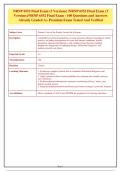
NRNP 6552 Final Exam (3 Versions) /NRNP 6552 Final Exam (3
Versions)/NRNP 6552 Final Exam - 100 Questions and Answers
Already Graded A+ Premium Exam Tested And Verified
Subject Area Primary Care of the Family Across the Lifespan
Description Comprehensive final examination covering advanced clinical reasoning in family
practice, including management of acute and chronic conditions, health
promotion, pharmacotherapeutics, and evidence-based decision-making.
Emphasizes integration of pathophysiology, differential diagnosis, and
patient-centered care plans.
Expected Grade A+
Total Questions 100
Duration 3 hours
Learning Outcomes 1. Synthesize complex clinical data to formulate differential diagnoses and
management plans.
2. Apply current evidence-based guidelines for common and complex primary
care conditions.
3. Evaluate pharmacotherapeutic regimens considering efficacy, safety, and
patient-specific factors.
4. Integrate health promotion and disease prevention strategies across the lifespan.
Accreditation Meets standards of AACN and NONPF for graduate-level nursing education.
Page 1
,1. In a patient with type 2 diabetes inadequately controlled on metformin and
lifestyle modifications, which of the following second-line agents is most likely to
reduce cardiovascular mortality in those with established atherosclerotic
cardiovascular disease?
A. Glipizide
B. Empagliflozin
C. Sitagliptin
D. Insulin glargine
Answer: B. Empagliflozin
Empagliflozin, an SGLT2 inhibitor, has demonstrated cardiovascular benefit in patients
with type 2 diabetes and established ASCVD in the EMPA-REG OUTCOME trial.
Glipizide and insulin have neutral effects; sitagliptin has no proven CV mortality
reduction.
2. A patient with a history of recurrent unprovoked venous thromboembolism on
warfarin has a subtherapeutic INR of 1.5 without bleeding. Which is the most
appropriate management?
A. Hold warfarin and restart at a higher dose after 3 days.
B. Administer a single dose of subcutaneous unfractionated heparin.
C. Increase warfarin dose and repeat INR in 1 week.
D. Administer oral vitamin K 5 mg and recheck INR in 24 hours.
Answer: C. Increase warfarin dose and repeat INR in 1 week.
In a patient with recurrent VTE, a subtherapeutic INR without bleeding typically
requires dose adjustment and close monitoring. Vitamin K is reserved for
supratherapeutic INR with bleeding risk. Heparin bridging is not indicated for a single
low INR without acute thrombosis.
Page 2
,3. Which of the following best explains the mechanism by which
angiotensin-converting enzyme inhibitors reduce proteinuria in chronic kidney
disease?
A. Decreased aldosterone secretion leading to sodium and water retention.
B. Vasodilation of afferent arterioles causing increased glomerular filtration.
C. Reduced intraglomerular pressure by efferent arteriolar vasodilation.
D. Inhibition of bradykinin degradation leading to increased vascular permeability.
Answer: C. Reduced intraglomerular pressure by efferent arteriolar vasodilation.
ACE inhibitors dilate efferent arterioles more than afferent, decreasing
intraglomerular pressure and reducing proteinuria. Choice A is incorrect because
aldosterone decreases, not increases, retention. Choice B would increase pressure.
Choice D is unrelated.
4. A patient with major depressive disorder has not responded to trials of two
different SSRIs and one SNRI. Which of the following augmentation strategies is
supported by the strongest evidence?
A. Adding bupropion to current therapy.
B. Adding aripiprazole to current therapy.
C. Switching to a monoamine oxidase inhibitor.
D. Adding lithium to current therapy.
Answer: B. Adding aripiprazole to current therapy.
Aripiprazole is FDA-approved for adjunctive treatment of major depressive disorder
and has robust evidence from randomized trials. Bupropion augmentation is commonly
used but less evidence. MAOIs and lithium are options but not first-line augmentation.
5. In a patient with acute gouty arthritis, which of the following is a contraindication
to the use of colchicine?
A. Concurrent use of atorvastatin.
B. Estimated glomerular filtration rate <30 mL/min.
C. History of peptic ulcer disease.
D. Concurrent use of allopurinol.
Answer: B. Estimated glomerular filtration rate <30 mL/min.
Colchicine is contraindicated in severe renal impairment (eGFR <30) due to risk of
accumulation and toxicity. Atorvastatin interaction is less severe; peptic ulcer disease is
not a contraindication. Allopurinol is often used concurrently.
Page 3
, 6. A patient with persistent asthma on low-dose inhaled corticosteroid (ICS) and
as-needed short-acting beta-agonist (SABA) continues to have daytime symptoms
more than twice a week. According to the latest GINA guidelines, what is the
preferred step-up therapy?
A. Increase ICS to medium dose.
B. Add a long-acting beta-agonist (LABA) to low-dose ICS.
C. Switch to as-needed low-dose ICS-formoterol.
D. Add a leukotriene receptor antagonist.
Answer: C. Switch to as-needed low-dose ICS-formoterol.
GINA 2023 recommends as-needed low-dose ICS-formoterol as the preferred reliever
for step 2 and above, and as step-up option for patients on low-dose ICS with SABA.
Adding LABA is an alternative, but as-needed ICS-formoterol is preferred for its
anti-inflammatory effect.
7. A patient with hypertension and stage 3 chronic kidney disease (eGFR 45 mL/min)
has a potassium level of 5.6 mEq/L. Which antihypertensive agent should be
avoided?
A. Amlodipine
B. Lisinopril
C. Metoprolol
D. Hydrochlorothiazide
Answer: B. Lisinopril
ACE inhibitors (like lisinopril) can increase potassium levels, especially in CKD, and
are contraindicated with hyperkalemia >5.5. Amlodipine, metoprolol, and thiazides do
not typically raise potassium.
Page 4
Versions)/NRNP 6552 Final Exam - 100 Questions and Answers
Already Graded A+ Premium Exam Tested And Verified
Subject Area Primary Care of the Family Across the Lifespan
Description Comprehensive final examination covering advanced clinical reasoning in family
practice, including management of acute and chronic conditions, health
promotion, pharmacotherapeutics, and evidence-based decision-making.
Emphasizes integration of pathophysiology, differential diagnosis, and
patient-centered care plans.
Expected Grade A+
Total Questions 100
Duration 3 hours
Learning Outcomes 1. Synthesize complex clinical data to formulate differential diagnoses and
management plans.
2. Apply current evidence-based guidelines for common and complex primary
care conditions.
3. Evaluate pharmacotherapeutic regimens considering efficacy, safety, and
patient-specific factors.
4. Integrate health promotion and disease prevention strategies across the lifespan.
Accreditation Meets standards of AACN and NONPF for graduate-level nursing education.
Page 1
,1. In a patient with type 2 diabetes inadequately controlled on metformin and
lifestyle modifications, which of the following second-line agents is most likely to
reduce cardiovascular mortality in those with established atherosclerotic
cardiovascular disease?
A. Glipizide
B. Empagliflozin
C. Sitagliptin
D. Insulin glargine
Answer: B. Empagliflozin
Empagliflozin, an SGLT2 inhibitor, has demonstrated cardiovascular benefit in patients
with type 2 diabetes and established ASCVD in the EMPA-REG OUTCOME trial.
Glipizide and insulin have neutral effects; sitagliptin has no proven CV mortality
reduction.
2. A patient with a history of recurrent unprovoked venous thromboembolism on
warfarin has a subtherapeutic INR of 1.5 without bleeding. Which is the most
appropriate management?
A. Hold warfarin and restart at a higher dose after 3 days.
B. Administer a single dose of subcutaneous unfractionated heparin.
C. Increase warfarin dose and repeat INR in 1 week.
D. Administer oral vitamin K 5 mg and recheck INR in 24 hours.
Answer: C. Increase warfarin dose and repeat INR in 1 week.
In a patient with recurrent VTE, a subtherapeutic INR without bleeding typically
requires dose adjustment and close monitoring. Vitamin K is reserved for
supratherapeutic INR with bleeding risk. Heparin bridging is not indicated for a single
low INR without acute thrombosis.
Page 2
,3. Which of the following best explains the mechanism by which
angiotensin-converting enzyme inhibitors reduce proteinuria in chronic kidney
disease?
A. Decreased aldosterone secretion leading to sodium and water retention.
B. Vasodilation of afferent arterioles causing increased glomerular filtration.
C. Reduced intraglomerular pressure by efferent arteriolar vasodilation.
D. Inhibition of bradykinin degradation leading to increased vascular permeability.
Answer: C. Reduced intraglomerular pressure by efferent arteriolar vasodilation.
ACE inhibitors dilate efferent arterioles more than afferent, decreasing
intraglomerular pressure and reducing proteinuria. Choice A is incorrect because
aldosterone decreases, not increases, retention. Choice B would increase pressure.
Choice D is unrelated.
4. A patient with major depressive disorder has not responded to trials of two
different SSRIs and one SNRI. Which of the following augmentation strategies is
supported by the strongest evidence?
A. Adding bupropion to current therapy.
B. Adding aripiprazole to current therapy.
C. Switching to a monoamine oxidase inhibitor.
D. Adding lithium to current therapy.
Answer: B. Adding aripiprazole to current therapy.
Aripiprazole is FDA-approved for adjunctive treatment of major depressive disorder
and has robust evidence from randomized trials. Bupropion augmentation is commonly
used but less evidence. MAOIs and lithium are options but not first-line augmentation.
5. In a patient with acute gouty arthritis, which of the following is a contraindication
to the use of colchicine?
A. Concurrent use of atorvastatin.
B. Estimated glomerular filtration rate <30 mL/min.
C. History of peptic ulcer disease.
D. Concurrent use of allopurinol.
Answer: B. Estimated glomerular filtration rate <30 mL/min.
Colchicine is contraindicated in severe renal impairment (eGFR <30) due to risk of
accumulation and toxicity. Atorvastatin interaction is less severe; peptic ulcer disease is
not a contraindication. Allopurinol is often used concurrently.
Page 3
, 6. A patient with persistent asthma on low-dose inhaled corticosteroid (ICS) and
as-needed short-acting beta-agonist (SABA) continues to have daytime symptoms
more than twice a week. According to the latest GINA guidelines, what is the
preferred step-up therapy?
A. Increase ICS to medium dose.
B. Add a long-acting beta-agonist (LABA) to low-dose ICS.
C. Switch to as-needed low-dose ICS-formoterol.
D. Add a leukotriene receptor antagonist.
Answer: C. Switch to as-needed low-dose ICS-formoterol.
GINA 2023 recommends as-needed low-dose ICS-formoterol as the preferred reliever
for step 2 and above, and as step-up option for patients on low-dose ICS with SABA.
Adding LABA is an alternative, but as-needed ICS-formoterol is preferred for its
anti-inflammatory effect.
7. A patient with hypertension and stage 3 chronic kidney disease (eGFR 45 mL/min)
has a potassium level of 5.6 mEq/L. Which antihypertensive agent should be
avoided?
A. Amlodipine
B. Lisinopril
C. Metoprolol
D. Hydrochlorothiazide
Answer: B. Lisinopril
ACE inhibitors (like lisinopril) can increase potassium levels, especially in CKD, and
are contraindicated with hyperkalemia >5.5. Amlodipine, metoprolol, and thiazides do
not typically raise potassium.
Page 4


