

Pathophysiology Exam 3 Rasmussen
University Questions and Answers with
Verified Solutions | Latest Updated 2026
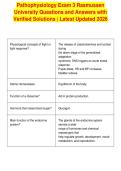
Physiological concepts of flight or The release of catecholamines and cortisol
fight response? during
the alarm stage of the generalized
adaptation
syndrome. SNS triggers an acute stress
response.
Pupils dilate, HR and BP increases,
bladder relaxes.
Define Homeostasis. Equilibrium of the body.
Function of a ribosome? Aid in protein production.
Hormone that raises blood sugar? Glucagon
Main function of the endocrine The glands of the endocrine system
system? secrete a wide
range of hormones and chemical
messengers that
help regulate growth, development, mood
metabolism, and reproduction.
,Function of plasma protein? Albumin, globulins, and fibrinogen.
Maintains
osmotic pressure, coagulation factors,
transports
antibodies, hormones, lipids, vitamins, and
minerals.
Intracellular contain a high ____- Potassium, magnesium and phosphate
note
which electrolytes
Physiologic effect of Results from low serum sodium levels
hyponatremia? (<135 mEq/L).
As sodium levels decrease, water shifts
into cells.
This can cause unstable gait,
osteoporosis,
attention deficit, cells swell.
Define hypovolemia fluid deficit in the intravascular
compartment
This stores electrolytes and acts the kidneys
like
an electrolyte pool in the body
, Define "sign", "contraindication" Sign: something found during an exam, or
diagnosis testing that indicates something
Contraindication: Anything (including a
symptom or
medical condition) that is a reason for a
person to
not receive a particular treatment or
procedure
because it may be harmful
Normal range of sodium 135-145 mEq/L
Clinical manifestations of fluid Hypovolemia. C/M: swelling (edema) of the
volume overload feet,
ankles, wrists, face, high BP, headache,
and
bloating.
Know components of insensible The amount of body fluid lost daily that is
water loss not easily
measured, from the respiratory system,
skin, and
water in the excreted stool.
Define hypotonic, hypertonic, and Hypotonic: Lower concentration of
isotonic solutions sodium/solutes
in solution than the blood cells swell
Hypertonic: Higher concentration of
sodium/solutes in solution than the blood
cells
shrink
Isotonic: equal concentrations
University Questions and Answers with
Verified Solutions | Latest Updated 2026
Physiological concepts of flight or The release of catecholamines and cortisol
fight response? during
the alarm stage of the generalized
adaptation
syndrome. SNS triggers an acute stress
response.
Pupils dilate, HR and BP increases,
bladder relaxes.
Define Homeostasis. Equilibrium of the body.
Function of a ribosome? Aid in protein production.
Hormone that raises blood sugar? Glucagon
Main function of the endocrine The glands of the endocrine system
system? secrete a wide
range of hormones and chemical
messengers that
help regulate growth, development, mood
metabolism, and reproduction.
,Function of plasma protein? Albumin, globulins, and fibrinogen.
Maintains
osmotic pressure, coagulation factors,
transports
antibodies, hormones, lipids, vitamins, and
minerals.
Intracellular contain a high ____- Potassium, magnesium and phosphate
note
which electrolytes
Physiologic effect of Results from low serum sodium levels
hyponatremia? (<135 mEq/L).
As sodium levels decrease, water shifts
into cells.
This can cause unstable gait,
osteoporosis,
attention deficit, cells swell.
Define hypovolemia fluid deficit in the intravascular
compartment
This stores electrolytes and acts the kidneys
like
an electrolyte pool in the body
, Define "sign", "contraindication" Sign: something found during an exam, or
diagnosis testing that indicates something
Contraindication: Anything (including a
symptom or
medical condition) that is a reason for a
person to
not receive a particular treatment or
procedure
because it may be harmful
Normal range of sodium 135-145 mEq/L
Clinical manifestations of fluid Hypovolemia. C/M: swelling (edema) of the
volume overload feet,
ankles, wrists, face, high BP, headache,
and
bloating.
Know components of insensible The amount of body fluid lost daily that is
water loss not easily
measured, from the respiratory system,
skin, and
water in the excreted stool.
Define hypotonic, hypertonic, and Hypotonic: Lower concentration of
isotonic solutions sodium/solutes
in solution than the blood cells swell
Hypertonic: Higher concentration of
sodium/solutes in solution than the blood
cells
shrink
Isotonic: equal concentrations


