

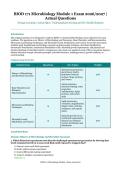
BIOD 171 Microbiology Module 1 Exam 2026/2027 |
Actual Questions
Portage Learning | Actual Q&A | Undergraduate Nursing and Pre-Health Students
Introduction
This original question set is designed to reinforce BIOD 171 Essential Microbiology course objectives for exam
readiness. The questions cover History of Microbiology and Taxonomy, Basic Chemistry and Macromolecules,
Microscopy and Staining Techniques, and Microbial Growth, Metabolism, and Control. Across the assessment,
students apply foundational microbiology concepts involving aseptic technique, microbial classification,
microscopic visualization, biochemical foundations of life, microbial growth requirements, and physical and
chemical methods of microbial control. A uniqueness cross-check was applied so each of the 50 questions targets a
distinct historical concept, chemistry principle, microbial structure, staining protocol, growth condition, or
control method.
Content Area Overview
Content Area Questions Key Topics Weight
Spontaneous generation;
germ theory; Koch's
History of Microbiology
10 postulates; bacteria, 20%
and Microbial Taxonomy
archaea, fungi, protozoa,
and viruses
Atomic structure;
chemical bonding; water
Basic Chemistry and
properties;
Biological 10 20%
carbohydrates, lipids,
Macromolecules
proteins, and nucleic
acids
Light microscopy;
resolution; magnification;
Microscopy and Staining
15 simple, Gram, acid-fast, 30%
Techniques
endospore, and capsule
stains
Bacterial growth curves;
nutritional requirements;
Microbial Growth,
15 physical and chemical 30%
Metabolism, and Control
control; sterilization and
disinfection
Actual Questions
Domain: History of Microbiology and Microbial Taxonomy
1. Which historical experiment most directly challenged spontaneous generation by showing that
broth remained sterile in a swan-neck flask until exposed to trapped dust?
A. Pasteur's swan-neck flask experiment
B. Koch's anthrax mouse experiment
C. Gram's differential staining experiment
D. Jenner's smallpox vaccination experiment
Answer: A
BIOD 171 Microbiology Module 1 Exam 2026/2027
, Rationale: Louis Pasteur's swan-neck flask experiment showed that microorganisms came from
contamination by existing microbes, not spontaneous generation. Bauman's Microbiology treats this as a
key turning point in the development of germ theory.
2. Which scientist is most closely associated with the early microscopic observation of bacteria
and protozoa that he called animalcules?
A. Antonie van Leeuwenhoek
B. Joseph Lister
C. Robert Koch
D. Ignaz Semmelweis
Answer: A
Rationale: Antonie van Leeuwenhoek used handcrafted microscopes to observe microorganisms, including
bacteria and protozoa. His observations helped launch the field of microbiology.
3. Koch's postulates were developed primarily to establish what?
A. A causal link between a specific microbe and a specific disease
B. The atomic structure of water
C. The classification of all viruses as cells
D. The best method for staining capsules
Answer: A
Rationale: Koch's postulates provide a framework for linking a specific microorganism to a specific
infectious disease, though modern exceptions exist for unculturable organisms, asymptomatic carriers, and
ethical limits.
4. Which discovery most directly supported the germ theory of disease in surgical practice by
reducing postoperative infections?
A. Joseph Lister's antiseptic surgery using chemical disinfectants
B. Spallanzani's sealed broth experiments only
C. The invention of the Bunsen burner
D. The discovery of ribosomes
Answer: A
Rationale: Joseph Lister applied antiseptic principles to surgery, reducing infection by targeting microbes.
This practical application helped validate germ theory in medicine.
5. Which domain contains prokaryotic organisms that often have peptidoglycan in their cell walls?
A. Bacteria
B. Archaea
C. Eukarya
D. Viruses
Answer: A
Rationale: Bacteria are prokaryotes and commonly have peptidoglycan-containing cell walls. Archaea lack
peptidoglycan and have distinct membrane and genetic features.
6. Which feature best distinguishes archaea from bacteria?
A. Archaea have unique membrane lipids and lack peptidoglycan cell walls.
B. Archaea are always multicellular animals.
C. Archaea contain nuclei and mitochondria.
D. Archaea are viruses with DNA capsids.
Answer: A
Rationale: Archaea are prokaryotic but differ from bacteria in membrane lipid chemistry, cell wall
composition, and genetic features. Many archaea live in extreme environments, though not all do.
7. Which group of microbes is eukaryotic and includes yeasts and molds?
A. Fungi
B. Bacteria
BIOD 171 Microbiology Module 1 Exam 2026/2027
Actual Questions
Portage Learning | Actual Q&A | Undergraduate Nursing and Pre-Health Students
Introduction
This original question set is designed to reinforce BIOD 171 Essential Microbiology course objectives for exam
readiness. The questions cover History of Microbiology and Taxonomy, Basic Chemistry and Macromolecules,
Microscopy and Staining Techniques, and Microbial Growth, Metabolism, and Control. Across the assessment,
students apply foundational microbiology concepts involving aseptic technique, microbial classification,
microscopic visualization, biochemical foundations of life, microbial growth requirements, and physical and
chemical methods of microbial control. A uniqueness cross-check was applied so each of the 50 questions targets a
distinct historical concept, chemistry principle, microbial structure, staining protocol, growth condition, or
control method.
Content Area Overview
Content Area Questions Key Topics Weight
Spontaneous generation;
germ theory; Koch's
History of Microbiology
10 postulates; bacteria, 20%
and Microbial Taxonomy
archaea, fungi, protozoa,
and viruses
Atomic structure;
chemical bonding; water
Basic Chemistry and
properties;
Biological 10 20%
carbohydrates, lipids,
Macromolecules
proteins, and nucleic
acids
Light microscopy;
resolution; magnification;
Microscopy and Staining
15 simple, Gram, acid-fast, 30%
Techniques
endospore, and capsule
stains
Bacterial growth curves;
nutritional requirements;
Microbial Growth,
15 physical and chemical 30%
Metabolism, and Control
control; sterilization and
disinfection
Actual Questions
Domain: History of Microbiology and Microbial Taxonomy
1. Which historical experiment most directly challenged spontaneous generation by showing that
broth remained sterile in a swan-neck flask until exposed to trapped dust?
A. Pasteur's swan-neck flask experiment
B. Koch's anthrax mouse experiment
C. Gram's differential staining experiment
D. Jenner's smallpox vaccination experiment
Answer: A
BIOD 171 Microbiology Module 1 Exam 2026/2027
, Rationale: Louis Pasteur's swan-neck flask experiment showed that microorganisms came from
contamination by existing microbes, not spontaneous generation. Bauman's Microbiology treats this as a
key turning point in the development of germ theory.
2. Which scientist is most closely associated with the early microscopic observation of bacteria
and protozoa that he called animalcules?
A. Antonie van Leeuwenhoek
B. Joseph Lister
C. Robert Koch
D. Ignaz Semmelweis
Answer: A
Rationale: Antonie van Leeuwenhoek used handcrafted microscopes to observe microorganisms, including
bacteria and protozoa. His observations helped launch the field of microbiology.
3. Koch's postulates were developed primarily to establish what?
A. A causal link between a specific microbe and a specific disease
B. The atomic structure of water
C. The classification of all viruses as cells
D. The best method for staining capsules
Answer: A
Rationale: Koch's postulates provide a framework for linking a specific microorganism to a specific
infectious disease, though modern exceptions exist for unculturable organisms, asymptomatic carriers, and
ethical limits.
4. Which discovery most directly supported the germ theory of disease in surgical practice by
reducing postoperative infections?
A. Joseph Lister's antiseptic surgery using chemical disinfectants
B. Spallanzani's sealed broth experiments only
C. The invention of the Bunsen burner
D. The discovery of ribosomes
Answer: A
Rationale: Joseph Lister applied antiseptic principles to surgery, reducing infection by targeting microbes.
This practical application helped validate germ theory in medicine.
5. Which domain contains prokaryotic organisms that often have peptidoglycan in their cell walls?
A. Bacteria
B. Archaea
C. Eukarya
D. Viruses
Answer: A
Rationale: Bacteria are prokaryotes and commonly have peptidoglycan-containing cell walls. Archaea lack
peptidoglycan and have distinct membrane and genetic features.
6. Which feature best distinguishes archaea from bacteria?
A. Archaea have unique membrane lipids and lack peptidoglycan cell walls.
B. Archaea are always multicellular animals.
C. Archaea contain nuclei and mitochondria.
D. Archaea are viruses with DNA capsids.
Answer: A
Rationale: Archaea are prokaryotic but differ from bacteria in membrane lipid chemistry, cell wall
composition, and genetic features. Many archaea live in extreme environments, though not all do.
7. Which group of microbes is eukaryotic and includes yeasts and molds?
A. Fungi
B. Bacteria
BIOD 171 Microbiology Module 1 Exam 2026/2027


