

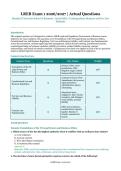
LREB Exam 1 2026/2027 | Actual Questions
Standard University School of Business | Actual Q&A | Undergraduate Business and Pre-Law
Students
Introduction
This original question set is designed to reinforce LREB Legal and Regulatory Environment of Business course
objectives for exam readiness. The questions cover Foundations of the US Legal System and Business Ethics,
Constitutional Law and Business Regulation, Tort Law and Business Liability, and Contract Law Fundamentals.
Across the assessment, students apply legal risk management, ethical decision-making, jurisdictional analysis,
constitutional limits on business regulation, liability prevention, product liability reasoning, contract
enforceability, and breach-of-contract remedies. A uniqueness cross-check was applied so each of the 50 questions
targets a distinct legal fact, business-law scenario, doctrinal rule, or risk-management application.
Content Area Overview
Content Area Questions Key Topics Weight
Sources of law; court
Foundations of the US
jurisdiction; ADR;
Legal System and 13 25%
litigation stages; ethical
Business Ethics
frameworks in business
Commerce Clause; First
Amendment; due process;
Constitutional Law and
12 equal protection; 25%
Business Regulation
administrative agency
rulemaking
Intentional torts;
negligence; duty, breach,
Tort Law and Business
13 causation, and damages; 25%
Liability
strict liability; product
liability
Offer and acceptance;
consideration; capacity;
Contract Law
12 legality; Statute of 25%
Fundamentals
Frauds; remedies for
breach
Actual Questions
Domain: Foundations of the US Legal System and Business Ethics
1. Which source of law has the highest authority when it conflicts with an ordinary state statute?
A. A city ordinance
B. A private contract
C. The United States Constitution
D. A corporate policy manual
Answer: C
Rationale: Miller and Cross emphasize the hierarchy of law: constitutional law is supreme over conflicting
statutes, administrative rules, ordinances, and private arrangements.
2. The doctrine of stare decisis primarily requires courts to do which of the following?
LREB Exam 1 2026/2027
, A. Follow relevant precedent unless there is a strong reason to distinguish or overturn it
B. Ignore earlier cases whenever a new judge is assigned
C. Decide every dispute by public vote
D. Apply only criminal statutes to civil lawsuits
Answer: A
Rationale: Stare decisis promotes stability and predictability by encouraging courts to follow prior
decisions with similar facts and legal issues, especially within the same jurisdiction.
3. Which statement best distinguishes civil law from criminal law in the US legal system?
A. Civil law involves disputes between parties seeking remedies, while criminal law involves government
prosecution for offenses against society.
B. Civil law always results in imprisonment, while criminal law always results in money damages only.
C. Civil law applies only to federal courts, while criminal law applies only to arbitration.
D. Civil law cannot involve businesses, while criminal law cannot involve individuals.
Answer: A
Rationale: Civil cases typically involve private rights and remedies such as damages or injunctions, while
criminal cases involve public wrongs prosecuted by the government and may result in fines, probation, or
imprisonment.
4. A court's power to hear a particular type of dispute is called what?
A. Venue
B. Subject-matter jurisdiction
C. Discovery
D. Voir dire
Answer: B
Rationale: Subject-matter jurisdiction concerns a court's authority over the category of case, such as federal
question cases, bankruptcy, family law, or small claims matters.
5. A business headquartered in Oregon regularly sells products to customers in Illinois through
targeted advertising and shipping. An Illinois court's authority over that business would most
likely depend on which concept?
A. Minimum contacts
B. Double jeopardy
C. Strict scrutiny
D. Sovereign immunity only
Answer: A
Rationale: Personal jurisdiction over an out-of-state defendant often depends on whether the defendant has
sufficient minimum contacts with the forum state so that jurisdiction is fair and foreseeable.
6. A federal trial court hears a dispute between citizens of different states where the amount in
controversy exceeds the statutory threshold. Which basis of federal jurisdiction is most likely?
A. Diversity jurisdiction
B. Appellate mediation
C. Administrative exhaustion
D. Small-claims jurisdiction
Answer: A
Rationale: Diversity jurisdiction allows federal courts to hear certain civil disputes between citizens of
different states when the amount in controversy requirement is satisfied.
7. Venue rules primarily determine what?
A. Which geographic location is appropriate for a trial within a court system
B. Whether a contract contains consideration
C. Whether a product defect caused injury
D. Which ethical theory is morally correct
LREB Exam 1 2026/2027
Standard University School of Business | Actual Q&A | Undergraduate Business and Pre-Law
Students
Introduction
This original question set is designed to reinforce LREB Legal and Regulatory Environment of Business course
objectives for exam readiness. The questions cover Foundations of the US Legal System and Business Ethics,
Constitutional Law and Business Regulation, Tort Law and Business Liability, and Contract Law Fundamentals.
Across the assessment, students apply legal risk management, ethical decision-making, jurisdictional analysis,
constitutional limits on business regulation, liability prevention, product liability reasoning, contract
enforceability, and breach-of-contract remedies. A uniqueness cross-check was applied so each of the 50 questions
targets a distinct legal fact, business-law scenario, doctrinal rule, or risk-management application.
Content Area Overview
Content Area Questions Key Topics Weight
Sources of law; court
Foundations of the US
jurisdiction; ADR;
Legal System and 13 25%
litigation stages; ethical
Business Ethics
frameworks in business
Commerce Clause; First
Amendment; due process;
Constitutional Law and
12 equal protection; 25%
Business Regulation
administrative agency
rulemaking
Intentional torts;
negligence; duty, breach,
Tort Law and Business
13 causation, and damages; 25%
Liability
strict liability; product
liability
Offer and acceptance;
consideration; capacity;
Contract Law
12 legality; Statute of 25%
Fundamentals
Frauds; remedies for
breach
Actual Questions
Domain: Foundations of the US Legal System and Business Ethics
1. Which source of law has the highest authority when it conflicts with an ordinary state statute?
A. A city ordinance
B. A private contract
C. The United States Constitution
D. A corporate policy manual
Answer: C
Rationale: Miller and Cross emphasize the hierarchy of law: constitutional law is supreme over conflicting
statutes, administrative rules, ordinances, and private arrangements.
2. The doctrine of stare decisis primarily requires courts to do which of the following?
LREB Exam 1 2026/2027
, A. Follow relevant precedent unless there is a strong reason to distinguish or overturn it
B. Ignore earlier cases whenever a new judge is assigned
C. Decide every dispute by public vote
D. Apply only criminal statutes to civil lawsuits
Answer: A
Rationale: Stare decisis promotes stability and predictability by encouraging courts to follow prior
decisions with similar facts and legal issues, especially within the same jurisdiction.
3. Which statement best distinguishes civil law from criminal law in the US legal system?
A. Civil law involves disputes between parties seeking remedies, while criminal law involves government
prosecution for offenses against society.
B. Civil law always results in imprisonment, while criminal law always results in money damages only.
C. Civil law applies only to federal courts, while criminal law applies only to arbitration.
D. Civil law cannot involve businesses, while criminal law cannot involve individuals.
Answer: A
Rationale: Civil cases typically involve private rights and remedies such as damages or injunctions, while
criminal cases involve public wrongs prosecuted by the government and may result in fines, probation, or
imprisonment.
4. A court's power to hear a particular type of dispute is called what?
A. Venue
B. Subject-matter jurisdiction
C. Discovery
D. Voir dire
Answer: B
Rationale: Subject-matter jurisdiction concerns a court's authority over the category of case, such as federal
question cases, bankruptcy, family law, or small claims matters.
5. A business headquartered in Oregon regularly sells products to customers in Illinois through
targeted advertising and shipping. An Illinois court's authority over that business would most
likely depend on which concept?
A. Minimum contacts
B. Double jeopardy
C. Strict scrutiny
D. Sovereign immunity only
Answer: A
Rationale: Personal jurisdiction over an out-of-state defendant often depends on whether the defendant has
sufficient minimum contacts with the forum state so that jurisdiction is fair and foreseeable.
6. A federal trial court hears a dispute between citizens of different states where the amount in
controversy exceeds the statutory threshold. Which basis of federal jurisdiction is most likely?
A. Diversity jurisdiction
B. Appellate mediation
C. Administrative exhaustion
D. Small-claims jurisdiction
Answer: A
Rationale: Diversity jurisdiction allows federal courts to hear certain civil disputes between citizens of
different states when the amount in controversy requirement is satisfied.
7. Venue rules primarily determine what?
A. Which geographic location is appropriate for a trial within a court system
B. Whether a contract contains consideration
C. Whether a product defect caused injury
D. Which ethical theory is morally correct
LREB Exam 1 2026/2027


