

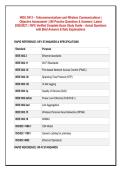
WGU D413 – Telecommunications and Wireless Communications |
Objective Assessment | 200 Practice Questions & Answers | Latest
2026/2027 | 100% Verified Complete Exam Study Guide – Actual Questions
with Bold Answers & Italic Explanations
RAPID REFERENCE: KEY STANDARDS & SPECIFICATIONS
Standard Purpose
IEEE 802.3 Ethernet standards
IEEE 802.11 Wi-Fi Standards
IEEE 802.1X Port-based Network Access Control (PNAC)
IEEE 802.1D Spanning Tree Protocol (STP)
IEEE 802.1Q VLAN tagging
IEEE 802.1p Quality of Service (QoS)
IEEE 802.3af/at Power over Ethernet (PoE/PoE+)
IEEE 802.3ad Link Aggregation
IEEE 802.15 Wireless Personal Area Networks (WPAN)
IEEE 802.16 WiMAX
ISO/IEC 7498-1 OSI Model
ISO/IEC 11801 Generic cabling for premises
ISO/IEC 8802 Ethernet Standards
RAPID REFERENCE: WI-FI STANDARDS
, Standard Frequency Max Data Rate Key Features
802.11a 5 GHz 54 Mbps 20 MHz channels
802.11b 2.4 GHz 11 Mbps 20 MHz channels
802.11g 2.4 GHz 54 Mbps 20 MHz channels
802.11n 2.4 & 5 GHz 600 Mbps 4 SU-MIMO, 20/40/80 MHz
802.11ac 5 GHz 1.3 Gbps 8 DL MU-MIMO, 20-160 MHz
802.11ax 2.4 & 5 GHz 9.6 Gbps 8 DL/UL MU-MIMO, 20-160 MHz
SECTION 1: NETWORK FUNDAMENTALS & ARCHITECTURE (Questions 1–25)
1. What is the primary purpose of a network switch?
A) To broadcast data to all connected devices
B) To connect multiple devices and forward data only to the intended recipient using
MAC addresses
C) To convert digital signals into analog signals
D) To amplify and regenerate signals over long distances
Answer: B
Switches operate at Layer 2 of the OSI model and use MAC addresses to forward frames
intelligently, reducing collisions and improving network efficiency compared to hubs.
,2. Which OSI layer is responsible for reliable data delivery, error detection, and
retransmission?
A) Network Layer
B) Data Link Layer
C) Transport Layer
D) Physical Layer
Answer: C
The Transport Layer (Layer 4) manages end-to-end communication, error recovery, flow
control, and segmentation. Protocols like TCP operate at this layer to ensure reliable data
delivery.
3. Which component converts digital signals into analog signals for transmission
over traditional phone lines?
A) Router
B) Switch
C) Modem
D) Repeater
Answer: C
A modem (modulator-demodulator) converts digital data to analog for transmission over
analog lines and back again for reception.
4. What is the primary function of a router in a network?
, A) Connect multiple devices within the same LAN
B) Forward data between different networks based on IP addresses
C) Amplify signals to extend network reach
D) Assign IP addresses automatically
Answer: B
Routers operate at Layer 3 of the OSI model and use IP addresses to determine the best
path for forwarding data between different networks.
5. Which topology provides redundancy because each node has a dedicated point-to-
point connection to every other node?
A) Star topology
B) Bus topology
C) Ring topology
D) Mesh topology
Answer: D
In a mesh topology, each node has a dedicated point-to-point connection to every other
node, providing redundancy and fault tolerance but requiring many connections.
6. What is the main advantage of a star topology?
A) Redundancy of connections
B) Easy fault isolation because each device connects to a central hub
C) Minimal cabling requirements
D) High tolerance to cable breaks
Objective Assessment | 200 Practice Questions & Answers | Latest
2026/2027 | 100% Verified Complete Exam Study Guide – Actual Questions
with Bold Answers & Italic Explanations
RAPID REFERENCE: KEY STANDARDS & SPECIFICATIONS
Standard Purpose
IEEE 802.3 Ethernet standards
IEEE 802.11 Wi-Fi Standards
IEEE 802.1X Port-based Network Access Control (PNAC)
IEEE 802.1D Spanning Tree Protocol (STP)
IEEE 802.1Q VLAN tagging
IEEE 802.1p Quality of Service (QoS)
IEEE 802.3af/at Power over Ethernet (PoE/PoE+)
IEEE 802.3ad Link Aggregation
IEEE 802.15 Wireless Personal Area Networks (WPAN)
IEEE 802.16 WiMAX
ISO/IEC 7498-1 OSI Model
ISO/IEC 11801 Generic cabling for premises
ISO/IEC 8802 Ethernet Standards
RAPID REFERENCE: WI-FI STANDARDS
, Standard Frequency Max Data Rate Key Features
802.11a 5 GHz 54 Mbps 20 MHz channels
802.11b 2.4 GHz 11 Mbps 20 MHz channels
802.11g 2.4 GHz 54 Mbps 20 MHz channels
802.11n 2.4 & 5 GHz 600 Mbps 4 SU-MIMO, 20/40/80 MHz
802.11ac 5 GHz 1.3 Gbps 8 DL MU-MIMO, 20-160 MHz
802.11ax 2.4 & 5 GHz 9.6 Gbps 8 DL/UL MU-MIMO, 20-160 MHz
SECTION 1: NETWORK FUNDAMENTALS & ARCHITECTURE (Questions 1–25)
1. What is the primary purpose of a network switch?
A) To broadcast data to all connected devices
B) To connect multiple devices and forward data only to the intended recipient using
MAC addresses
C) To convert digital signals into analog signals
D) To amplify and regenerate signals over long distances
Answer: B
Switches operate at Layer 2 of the OSI model and use MAC addresses to forward frames
intelligently, reducing collisions and improving network efficiency compared to hubs.
,2. Which OSI layer is responsible for reliable data delivery, error detection, and
retransmission?
A) Network Layer
B) Data Link Layer
C) Transport Layer
D) Physical Layer
Answer: C
The Transport Layer (Layer 4) manages end-to-end communication, error recovery, flow
control, and segmentation. Protocols like TCP operate at this layer to ensure reliable data
delivery.
3. Which component converts digital signals into analog signals for transmission
over traditional phone lines?
A) Router
B) Switch
C) Modem
D) Repeater
Answer: C
A modem (modulator-demodulator) converts digital data to analog for transmission over
analog lines and back again for reception.
4. What is the primary function of a router in a network?
, A) Connect multiple devices within the same LAN
B) Forward data between different networks based on IP addresses
C) Amplify signals to extend network reach
D) Assign IP addresses automatically
Answer: B
Routers operate at Layer 3 of the OSI model and use IP addresses to determine the best
path for forwarding data between different networks.
5. Which topology provides redundancy because each node has a dedicated point-to-
point connection to every other node?
A) Star topology
B) Bus topology
C) Ring topology
D) Mesh topology
Answer: D
In a mesh topology, each node has a dedicated point-to-point connection to every other
node, providing redundancy and fault tolerance but requiring many connections.
6. What is the main advantage of a star topology?
A) Redundancy of connections
B) Easy fault isolation because each device connects to a central hub
C) Minimal cabling requirements
D) High tolerance to cable breaks


