

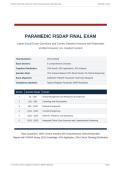
FISDAP Paramedic Final Exam | 200 Verified Questions with Rationales 2026/2027 Edition
PARAMEDIC FISDAP FINAL EXAM
Latest Actual Exam Questions and Correct Detailed Answers with Rationales
Verified Answers | A+ Graded Content
Total Questions: 200 (Verified)
Exam Sections: 6 Comprehensive Domains
Cognitive Distribution: 25% Recall | 55% Application | 20% Analysis
Question Style: 75% Scenario-Based | 20% Direct Recall | 5% Clinical Reasoning
Exam Alignment: 2026/2027 FISDAP Paramedic Final Exam Blueprint
Competency Standard: National Registry Paramedic (NRP) Readiness
Section Question Range Domain
1 Q1 - Q40 Airway Management and Respiratory Emergencies
2 Q41 - Q80 Cardiology and Resuscitation
3 Q81 - Q120 Medical Emergencies
4 Q121 - Q160 Trauma Emergencies
5 Q161 - Q190 OB/GYN, Pediatrics, and Operations
6 Q191 - Q200 Integrated Clinical Case Scenarios and Comprehensive Reasoning
Pass Guarantee | 100% Correct Answers with Comprehensive Clinical Rationales
Aligned with FISDAP Airway (31% Knowledge, 41% Application, 28% Critical Thinking) Distribution
A+ Verified Content | Aligned to FISDAP & NREMT Blueprint Page 1
,FISDAP Paramedic Final Exam | 200 Verified Questions with Rationales 2026/2027 Edition
SECTION 1: AIRWAY MANAGEMENT AND RESPIRATORY
EMERGENCIES
Questions 1-40 | FISDAP Airway Domain | Knowledge, Application, and Critical Thinking
Q1. A 34-year-old male skier is evacuated from an altitude of 11,500 feet after a rapid ascent two
days prior. He presents with severe dyspnea, anxiety, productive cough with pink frothy sputum,
and rales bilaterally in all lung fields. His SpO2 is 74% on room air. Which intervention represents
the definitive treatment for this condition?
A. Administer high-flow oxygen via non-rebreather mask and monitor for improvement at altitude
B. Apply CPAP at 10 cmH2O and continue administration of furosemide 40 mg IV
C. Initiate immediate descent to lower altitude combined with high-flow oxygen administration
[CORRECT]
D. Administer acetazolamide 500 mg IV and maintain the patient at current altitude
Correct Answer: C
Rationale:
Immediate descent combined with high-flow oxygen is the definitive treatment for High-Altitude Pulmonary Edema
(HAPE). HAPE is caused by hypoxic pulmonary vasoconstriction leading to uneven capillary stress failure and
noncardiogenic pulmonary edema. CPAP alone may temporize oxygenation but does not address the underlying
pathophysiology, and furosemide is inappropriate because HAPE is noncardiogenic. Acetazolamide prevents acute
mountain sickness but is not the definitive treatment for established HAPE.
Q2. Paramedics arrive to find an unresponsive 68-year-old male with gurgling respirations and
audible secretions in the oropharynx. Which is the FIRST action the paramedic should take before
placing any airway adjunct?
A. Insert an oropharyngeal airway to maintain airway patency
B. Suction the oropharynx to clear secretions before any airway adjunct placement [CORRECT]
C. Position the patient in the left lateral recumbent position to drain secretions
D. Preoxygenate the patient with a bag-valve mask for 30 seconds
Correct Answer: B
Rationale:
Suctioning the oropharynx BEFORE placement of any airway adjunct is the correct first action. Gurgling respirations
indicate liquid secretions or vomitus in the airway; inserting an OPA or NPA without suctioning would push secretions
distally and increase aspiration risk. The patient must be suctioned rapidly (no more than 10-15 seconds per pass in
adults), then an airway adjunct can be placed. Preoxygenation with BVM before suctioning would force secretions
deeper into the tracheobronchial tree.
A+ Verified Content | Aligned to FISDAP & NREMT Blueprint Page 2
,FISDAP Paramedic Final Exam | 200 Verified Questions with Rationales 2026/2027 Edition
Q3. A 16-year-old female with a history of asthma presents with severe respiratory distress.
Initially she had audible wheezing, but on your arrival the wheezing has stopped and breath
sounds are absent bilaterally with minimal chest movement. SpO2 is 82%. What does this
presentation indicate, and what is the appropriate intervention?
A. The patient is improving because wheezing has resolved; continue albuterol nebulizer
B. The patient has developed a tension pneumothorax requiring immediate needle decompression
C. The patient has impending respiratory failure requiring immediate bag-valve mask ventilation
[CORRECT]
D. The patient has fatigued and requires BiPAP to reduce the work of breathing
Correct Answer: C
Rationale:
Disappearance of wheezing with silent breath sounds in asthma indicates impending respiratory failure, not
improvement. This 'silent chest' occurs because airflow is so severely restricted that wheezing can no longer be
produced. Immediate bag-valve mask ventilation with 100% oxygen is required, often necessitating positive pressure
to overcome severe bronchoconstriction. Tension pneumothorax would present with unilateral findings (unilateral
absent breath sounds, tracheal deviation, hypotension), not bilateral silent chest.
Q4. After successful endotracheal intubation of a 55-year-old cardiac arrest patient, what is the
GOLD STANDARD method for continuous confirmation of endotracheal tube placement
throughout transport?
A. Auscultation of bilateral breath sounds and epigastric sounds every 5 minutes
B. Continuous waveform capnography with quantitative EtCO2 monitoring [CORRECT]
C. Continuous pulse oximetry and observation of chest wall movement
D. Esophageal detector device (bulb syringe) verification every 10 minutes
Correct Answer: B
Rationale:
Continuous waveform capnography is the gold standard for confirming and monitoring endotracheal tube placement.
Quantitative waveform capnography detects exhaled CO2 from the trachea and immediately indicates tube
displacement, with a characteristic rectangular waveform during ventilation. Auscultation and chest observation are
unreliable and intermittent. Pulse oximetry does not confirm tube placement because SpO2 may remain normal for
several minutes after esophageal intubation. Esophageal detector devices are useful as adjuncts but cannot provide
continuous monitoring.
Q5. A 72-year-old female is being ventilated via bag-valve mask by a paramedic after suffering
respiratory arrest. At what rate should ventilations be delivered to this adult patient to avoid
gastric distention and hyperventilation?
A. 8-10 breaths per minute (one breath every 6-8 seconds)
B. 10-12 breaths per minute (one breath every 5-6 seconds) [CORRECT]
C. 12-15 breaths per minute (one breath every 4-5 seconds)
D. 15-20 breaths per minute (one breath every 3-4 seconds)
Correct Answer: B
Rationale:
Adult bag-valve mask ventilations should be delivered at 10-12 breaths per minute, or one breath every 5-6 seconds.
This rate provides adequate oxygenation and ventilation without causing gastric distention (which occurs with rapid
insufflation), hyperventilation (which causes cerebral vasoconstriction and worsens outcomes in cardiac arrest and
head injury), or increased intrathoracic pressure that diminishes cardiac output. In cardiac arrest with an advanced
airway in place, the rate is 10 breaths/minute (one every 6 seconds).
A+ Verified Content | Aligned to FISDAP & NREMT Blueprint Page 3
, FISDAP Paramedic Final Exam | 200 Verified Questions with Rationales 2026/2027 Edition
Q6. A 28-year-old male presents with severe respiratory distress, hypotension (BP 84/52), JVD,
tracheal deviation to the right, and absent breath sounds on the left side after a stab wound to the
left chest. Which intervention is indicated, and at what anatomical location?
A. Needle decompression at the 2nd intercostal space, midclavicular line on the left side [CORRECT]
B. Needle decompression at the 4th-5th intercostal space, midaxillary line on the left side
C. Tube thoracostomy at the 5th intercostal space, midaxillary line on the left side
D. Occlusive dressing taped on three sides over the stab wound
Correct Answer: A
Rationale:
Tension pneumothorax presents with the classic triad of decreased breath sounds on the affected side, tracheal
deviation AWAY from the affected side, and hypotension with JVD. The traditional decompression site is the 2nd
intercostal space at the midclavicular line on the affected (left) side using a 14-gauge or larger needle. While the
4th-5th ICS midaxillary (the 'TAC' site) is increasingly recommended by TCCC/NTMB guidelines for trauma patients,
the FISDAP/NREMT standard for paramedic examination remains the 2nd ICS midclavicular approach. Occlusive
dressing is for an open pneumothorax without tension physiology.
Q7. A 42-year-old female is extubated in the ICU after a 5-day course of mechanical ventilation.
Within 30 minutes she develops stridor, suprasternal retractions, and difficulty moving air. What
does stridor following extubation indicate?
A. Laryngospasm at the vocal cords requiring immediate positive pressure ventilation
B. Upper airway obstruction at the level of the vocal cords, a post-extubation emergency [CORRECT]
C. Lower airway bronchospasm requiring nebulized albuterol
D. Bilateral vocal cord paralysis requiring permanent tracheostomy
Correct Answer: B
Rationale:
Post-extubation stridor indicates upper airway obstruction at the level of the vocal cords, often due to glottic edema or
vocal cord dysfunction from prolonged intubation. This is a post-extubation emergency that may require nebulized
racemic epinephrine (to reduce edema), IV corticosteroids (dexamethasone), and re-intubation if obstruction is
severe. Laryngospasm is a different entity occurring immediately at extubation from reflex closure of the vocal cords.
Lower airway bronchospasm produces wheezing, not stridor.
Q8. A 50-year-old male with a crush injury to the lower extremities sustained 60 hours ago requires
rapid sequence intubation for severe hypoxia. Which paralytic agent is CONTRAINDICATED in this
patient?
A. Rocuronium 1.0 mg/kg IV
B. Succinylcholine 1.5 mg/kg IV [CORRECT]
C. Vecuronium 0.1 mg/kg IV
D. Cisatracurium 0.15 mg/kg IV
Correct Answer: B
Rationale:
Succinylcholine is contraindicated in patients with crush injury greater than 24-48 hours, burns >24 hours old,
paralysis/immobility, or known hyperkalemia. Succinylcholine causes potassium release from muscle cells via
depolarization; in denervated or injured muscle, this response is upregulated and can cause life-threatening
hyperkalemia leading to cardiac arrest. Rocuronium (a non-depolarizing paralytic) at 1.0-1.2 mg/kg is the
recommended alternative when succinylcholine is contraindicated, providing similar intubating conditions within 60-90
seconds.
A+ Verified Content | Aligned to FISDAP & NREMT Blueprint Page 4
PARAMEDIC FISDAP FINAL EXAM
Latest Actual Exam Questions and Correct Detailed Answers with Rationales
Verified Answers | A+ Graded Content
Total Questions: 200 (Verified)
Exam Sections: 6 Comprehensive Domains
Cognitive Distribution: 25% Recall | 55% Application | 20% Analysis
Question Style: 75% Scenario-Based | 20% Direct Recall | 5% Clinical Reasoning
Exam Alignment: 2026/2027 FISDAP Paramedic Final Exam Blueprint
Competency Standard: National Registry Paramedic (NRP) Readiness
Section Question Range Domain
1 Q1 - Q40 Airway Management and Respiratory Emergencies
2 Q41 - Q80 Cardiology and Resuscitation
3 Q81 - Q120 Medical Emergencies
4 Q121 - Q160 Trauma Emergencies
5 Q161 - Q190 OB/GYN, Pediatrics, and Operations
6 Q191 - Q200 Integrated Clinical Case Scenarios and Comprehensive Reasoning
Pass Guarantee | 100% Correct Answers with Comprehensive Clinical Rationales
Aligned with FISDAP Airway (31% Knowledge, 41% Application, 28% Critical Thinking) Distribution
A+ Verified Content | Aligned to FISDAP & NREMT Blueprint Page 1
,FISDAP Paramedic Final Exam | 200 Verified Questions with Rationales 2026/2027 Edition
SECTION 1: AIRWAY MANAGEMENT AND RESPIRATORY
EMERGENCIES
Questions 1-40 | FISDAP Airway Domain | Knowledge, Application, and Critical Thinking
Q1. A 34-year-old male skier is evacuated from an altitude of 11,500 feet after a rapid ascent two
days prior. He presents with severe dyspnea, anxiety, productive cough with pink frothy sputum,
and rales bilaterally in all lung fields. His SpO2 is 74% on room air. Which intervention represents
the definitive treatment for this condition?
A. Administer high-flow oxygen via non-rebreather mask and monitor for improvement at altitude
B. Apply CPAP at 10 cmH2O and continue administration of furosemide 40 mg IV
C. Initiate immediate descent to lower altitude combined with high-flow oxygen administration
[CORRECT]
D. Administer acetazolamide 500 mg IV and maintain the patient at current altitude
Correct Answer: C
Rationale:
Immediate descent combined with high-flow oxygen is the definitive treatment for High-Altitude Pulmonary Edema
(HAPE). HAPE is caused by hypoxic pulmonary vasoconstriction leading to uneven capillary stress failure and
noncardiogenic pulmonary edema. CPAP alone may temporize oxygenation but does not address the underlying
pathophysiology, and furosemide is inappropriate because HAPE is noncardiogenic. Acetazolamide prevents acute
mountain sickness but is not the definitive treatment for established HAPE.
Q2. Paramedics arrive to find an unresponsive 68-year-old male with gurgling respirations and
audible secretions in the oropharynx. Which is the FIRST action the paramedic should take before
placing any airway adjunct?
A. Insert an oropharyngeal airway to maintain airway patency
B. Suction the oropharynx to clear secretions before any airway adjunct placement [CORRECT]
C. Position the patient in the left lateral recumbent position to drain secretions
D. Preoxygenate the patient with a bag-valve mask for 30 seconds
Correct Answer: B
Rationale:
Suctioning the oropharynx BEFORE placement of any airway adjunct is the correct first action. Gurgling respirations
indicate liquid secretions or vomitus in the airway; inserting an OPA or NPA without suctioning would push secretions
distally and increase aspiration risk. The patient must be suctioned rapidly (no more than 10-15 seconds per pass in
adults), then an airway adjunct can be placed. Preoxygenation with BVM before suctioning would force secretions
deeper into the tracheobronchial tree.
A+ Verified Content | Aligned to FISDAP & NREMT Blueprint Page 2
,FISDAP Paramedic Final Exam | 200 Verified Questions with Rationales 2026/2027 Edition
Q3. A 16-year-old female with a history of asthma presents with severe respiratory distress.
Initially she had audible wheezing, but on your arrival the wheezing has stopped and breath
sounds are absent bilaterally with minimal chest movement. SpO2 is 82%. What does this
presentation indicate, and what is the appropriate intervention?
A. The patient is improving because wheezing has resolved; continue albuterol nebulizer
B. The patient has developed a tension pneumothorax requiring immediate needle decompression
C. The patient has impending respiratory failure requiring immediate bag-valve mask ventilation
[CORRECT]
D. The patient has fatigued and requires BiPAP to reduce the work of breathing
Correct Answer: C
Rationale:
Disappearance of wheezing with silent breath sounds in asthma indicates impending respiratory failure, not
improvement. This 'silent chest' occurs because airflow is so severely restricted that wheezing can no longer be
produced. Immediate bag-valve mask ventilation with 100% oxygen is required, often necessitating positive pressure
to overcome severe bronchoconstriction. Tension pneumothorax would present with unilateral findings (unilateral
absent breath sounds, tracheal deviation, hypotension), not bilateral silent chest.
Q4. After successful endotracheal intubation of a 55-year-old cardiac arrest patient, what is the
GOLD STANDARD method for continuous confirmation of endotracheal tube placement
throughout transport?
A. Auscultation of bilateral breath sounds and epigastric sounds every 5 minutes
B. Continuous waveform capnography with quantitative EtCO2 monitoring [CORRECT]
C. Continuous pulse oximetry and observation of chest wall movement
D. Esophageal detector device (bulb syringe) verification every 10 minutes
Correct Answer: B
Rationale:
Continuous waveform capnography is the gold standard for confirming and monitoring endotracheal tube placement.
Quantitative waveform capnography detects exhaled CO2 from the trachea and immediately indicates tube
displacement, with a characteristic rectangular waveform during ventilation. Auscultation and chest observation are
unreliable and intermittent. Pulse oximetry does not confirm tube placement because SpO2 may remain normal for
several minutes after esophageal intubation. Esophageal detector devices are useful as adjuncts but cannot provide
continuous monitoring.
Q5. A 72-year-old female is being ventilated via bag-valve mask by a paramedic after suffering
respiratory arrest. At what rate should ventilations be delivered to this adult patient to avoid
gastric distention and hyperventilation?
A. 8-10 breaths per minute (one breath every 6-8 seconds)
B. 10-12 breaths per minute (one breath every 5-6 seconds) [CORRECT]
C. 12-15 breaths per minute (one breath every 4-5 seconds)
D. 15-20 breaths per minute (one breath every 3-4 seconds)
Correct Answer: B
Rationale:
Adult bag-valve mask ventilations should be delivered at 10-12 breaths per minute, or one breath every 5-6 seconds.
This rate provides adequate oxygenation and ventilation without causing gastric distention (which occurs with rapid
insufflation), hyperventilation (which causes cerebral vasoconstriction and worsens outcomes in cardiac arrest and
head injury), or increased intrathoracic pressure that diminishes cardiac output. In cardiac arrest with an advanced
airway in place, the rate is 10 breaths/minute (one every 6 seconds).
A+ Verified Content | Aligned to FISDAP & NREMT Blueprint Page 3
, FISDAP Paramedic Final Exam | 200 Verified Questions with Rationales 2026/2027 Edition
Q6. A 28-year-old male presents with severe respiratory distress, hypotension (BP 84/52), JVD,
tracheal deviation to the right, and absent breath sounds on the left side after a stab wound to the
left chest. Which intervention is indicated, and at what anatomical location?
A. Needle decompression at the 2nd intercostal space, midclavicular line on the left side [CORRECT]
B. Needle decompression at the 4th-5th intercostal space, midaxillary line on the left side
C. Tube thoracostomy at the 5th intercostal space, midaxillary line on the left side
D. Occlusive dressing taped on three sides over the stab wound
Correct Answer: A
Rationale:
Tension pneumothorax presents with the classic triad of decreased breath sounds on the affected side, tracheal
deviation AWAY from the affected side, and hypotension with JVD. The traditional decompression site is the 2nd
intercostal space at the midclavicular line on the affected (left) side using a 14-gauge or larger needle. While the
4th-5th ICS midaxillary (the 'TAC' site) is increasingly recommended by TCCC/NTMB guidelines for trauma patients,
the FISDAP/NREMT standard for paramedic examination remains the 2nd ICS midclavicular approach. Occlusive
dressing is for an open pneumothorax without tension physiology.
Q7. A 42-year-old female is extubated in the ICU after a 5-day course of mechanical ventilation.
Within 30 minutes she develops stridor, suprasternal retractions, and difficulty moving air. What
does stridor following extubation indicate?
A. Laryngospasm at the vocal cords requiring immediate positive pressure ventilation
B. Upper airway obstruction at the level of the vocal cords, a post-extubation emergency [CORRECT]
C. Lower airway bronchospasm requiring nebulized albuterol
D. Bilateral vocal cord paralysis requiring permanent tracheostomy
Correct Answer: B
Rationale:
Post-extubation stridor indicates upper airway obstruction at the level of the vocal cords, often due to glottic edema or
vocal cord dysfunction from prolonged intubation. This is a post-extubation emergency that may require nebulized
racemic epinephrine (to reduce edema), IV corticosteroids (dexamethasone), and re-intubation if obstruction is
severe. Laryngospasm is a different entity occurring immediately at extubation from reflex closure of the vocal cords.
Lower airway bronchospasm produces wheezing, not stridor.
Q8. A 50-year-old male with a crush injury to the lower extremities sustained 60 hours ago requires
rapid sequence intubation for severe hypoxia. Which paralytic agent is CONTRAINDICATED in this
patient?
A. Rocuronium 1.0 mg/kg IV
B. Succinylcholine 1.5 mg/kg IV [CORRECT]
C. Vecuronium 0.1 mg/kg IV
D. Cisatracurium 0.15 mg/kg IV
Correct Answer: B
Rationale:
Succinylcholine is contraindicated in patients with crush injury greater than 24-48 hours, burns >24 hours old,
paralysis/immobility, or known hyperkalemia. Succinylcholine causes potassium release from muscle cells via
depolarization; in denervated or injured muscle, this response is upregulated and can cause life-threatening
hyperkalemia leading to cardiac arrest. Rocuronium (a non-depolarizing paralytic) at 1.0-1.2 mg/kg is the
recommended alternative when succinylcholine is contraindicated, providing similar intubating conditions within 60-90
seconds.
A+ Verified Content | Aligned to FISDAP & NREMT Blueprint Page 4


