

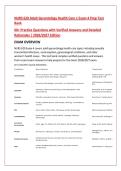
NURS 620 Adult Gerontology Health Care 1 Exam 4 Prep Test
Bank
60+ Practice Questions with Verified Answers and Detailed
Rationales | 2026/2027 Edition
EXAM OVERVIEW
NURS 620 Exam 4 covers adult-gerontology health care topics including sexually
transmitted infections, contraception, gynecological conditions, and other
women's health issues . This test bank compiles verified questions and answers
from recent exam reviews to help prepare for the latest 2026/2027 exam.
KEY CONCEPTS QUICK REFERENCE
Condition Key Features Treatment
Most common STI; often asymptomatic; Azithromycin 1g PO x1 OR Doxy
Chlamydia
mucopurulent discharge; dysuria 100mg BID x7d
Ceftriaxone 250mg IM + Azithro
Gonorrhea Purulent discharge; cervicitis; co-infection common
PO
Painless chancre (primary); maculopapular rash Penicillin G 2.4 million units IM
Syphilis
(secondary) (primary/secondary)
Herpes Painful vesicular lesions; chronic, life-long infection Acyclovir, Valacyclovir, or Famc
Frothy yellow-green discharge; itching; "strawberry
Trichomoniasis Metronidazole 2g PO x1 OR 500
cervix"
BV Clue cells; fishy odor; thin gray-white discharge Metronidazole 500mg BID x7d
Hyphae; pruritus; thick white "cottage cheese"
Candidiasis Fluconazole 150mg PO x1
discharge
Cervical
Start age 21; Q3yrs 21-29; Q5yrs 30-65 with neg paps Stop at 65 with adequate negat
Screening
Weight loss, OCPs, metformin,
PCOS Hirsutism, obesity, insulin resistance, anovulation
changes
Endometrial tissue outside uterus; dysmenorrhea,
Endometriosis NSAIDs, OCPs, GnRH agonists, s
dyspareunia
Lower abdominal pain, fever, cervical motion
PID Ceftriaxone + Doxycycline ± Me
tenderness
,SECTION 1: SEXUALLY TRANSMITTED INFECTIONS – GENERAL
Questions 1-35
Q1. Which of the following is a sexually transmitted infection?
A) Candida vaginitis
B) Trichomonal vaginitis
C) Atrophic vaginitis
D) Lactobacilli vaginitis
Answer: B) Trichomonal vaginitis
Rationale: Trichomoniasis is a sexually transmitted infection caused by the
protozoan Trichomonas vaginalis. Candida vaginitis (A) is a fungal infection that is
not strictly classified as an STI. Atrophic vaginitis (C) is related to estrogen
deficiency, not an STI. Lactobacilli (D) are normal vaginal flora .
Q2. A 24-year-old female with complaints of dysuria, pain with sex, and
mucopurulent vaginal discharge. Her boyfriend was recently treated for
nongonococcal urethritis. What STI has she most likely been exposed to?
A) HPV
B) Chlamydia
C) Trichomoniasis
D) Syphilis
Answer: B) Chlamydia
Rationale: Chlamydia trachomatis is the most common bacterial STI in the United
States. Symptoms in women include dysuria, mucopurulent discharge, and
cervicitis. A partner with nongonococcal urethritis suggests chlamydia exposure.
The treatment is azithromycin 1 gram PO or doxycycline 100 mg BID for 7 days .
, Q3. A 24-year-old female comes in with complaints of dysuria, pain with sex,
and mucopurulent vaginal discharge. Her boyfriend was recently treated for
nongonococcal urethritis. What medication would you treat her with?
A) Flagyl
B) Acyclovir
C) Azithromycin
D) Ceftriaxone
Answer: C) Azithromycin
Rationale: Chlamydia infection is treated with azithromycin 1 gram PO as a single
dose OR doxycycline 100 mg BID for 7 days. Ceftriaxone (D) is used for gonorrhea.
Flagyl (A) is for trichomoniasis or bacterial vaginosis. Acyclovir (B) is for herpes .
Q4. 20-year-old, sexually active female seen in the clinic because her boyfriend
was diagnosed with gonorrhea. What is the treatment of choice for gonorrhea?
A) Flagyl
B) Acyclovir
C) Ceftriaxone
D) Azithromycin
Answer: C) Ceftriaxone
Rationale: The treatment of choice for gonorrhea is ceftriaxone 250 mg IM as a
single dose, PLUS azithromycin 1 gram PO for dual coverage. This dual therapy
addresses the high prevalence of co-infection with chlamydia .
Q5. In a patient diagnosed with cervical gonococcal infection, you would also
suspect a co-infection with:
A) Candidiasis
B) Syphilis
C) Trichomoniasis
D) Chlamydia
Answer: D) Chlamydia
Bank
60+ Practice Questions with Verified Answers and Detailed
Rationales | 2026/2027 Edition
EXAM OVERVIEW
NURS 620 Exam 4 covers adult-gerontology health care topics including sexually
transmitted infections, contraception, gynecological conditions, and other
women's health issues . This test bank compiles verified questions and answers
from recent exam reviews to help prepare for the latest 2026/2027 exam.
KEY CONCEPTS QUICK REFERENCE
Condition Key Features Treatment
Most common STI; often asymptomatic; Azithromycin 1g PO x1 OR Doxy
Chlamydia
mucopurulent discharge; dysuria 100mg BID x7d
Ceftriaxone 250mg IM + Azithro
Gonorrhea Purulent discharge; cervicitis; co-infection common
PO
Painless chancre (primary); maculopapular rash Penicillin G 2.4 million units IM
Syphilis
(secondary) (primary/secondary)
Herpes Painful vesicular lesions; chronic, life-long infection Acyclovir, Valacyclovir, or Famc
Frothy yellow-green discharge; itching; "strawberry
Trichomoniasis Metronidazole 2g PO x1 OR 500
cervix"
BV Clue cells; fishy odor; thin gray-white discharge Metronidazole 500mg BID x7d
Hyphae; pruritus; thick white "cottage cheese"
Candidiasis Fluconazole 150mg PO x1
discharge
Cervical
Start age 21; Q3yrs 21-29; Q5yrs 30-65 with neg paps Stop at 65 with adequate negat
Screening
Weight loss, OCPs, metformin,
PCOS Hirsutism, obesity, insulin resistance, anovulation
changes
Endometrial tissue outside uterus; dysmenorrhea,
Endometriosis NSAIDs, OCPs, GnRH agonists, s
dyspareunia
Lower abdominal pain, fever, cervical motion
PID Ceftriaxone + Doxycycline ± Me
tenderness
,SECTION 1: SEXUALLY TRANSMITTED INFECTIONS – GENERAL
Questions 1-35
Q1. Which of the following is a sexually transmitted infection?
A) Candida vaginitis
B) Trichomonal vaginitis
C) Atrophic vaginitis
D) Lactobacilli vaginitis
Answer: B) Trichomonal vaginitis
Rationale: Trichomoniasis is a sexually transmitted infection caused by the
protozoan Trichomonas vaginalis. Candida vaginitis (A) is a fungal infection that is
not strictly classified as an STI. Atrophic vaginitis (C) is related to estrogen
deficiency, not an STI. Lactobacilli (D) are normal vaginal flora .
Q2. A 24-year-old female with complaints of dysuria, pain with sex, and
mucopurulent vaginal discharge. Her boyfriend was recently treated for
nongonococcal urethritis. What STI has she most likely been exposed to?
A) HPV
B) Chlamydia
C) Trichomoniasis
D) Syphilis
Answer: B) Chlamydia
Rationale: Chlamydia trachomatis is the most common bacterial STI in the United
States. Symptoms in women include dysuria, mucopurulent discharge, and
cervicitis. A partner with nongonococcal urethritis suggests chlamydia exposure.
The treatment is azithromycin 1 gram PO or doxycycline 100 mg BID for 7 days .
, Q3. A 24-year-old female comes in with complaints of dysuria, pain with sex,
and mucopurulent vaginal discharge. Her boyfriend was recently treated for
nongonococcal urethritis. What medication would you treat her with?
A) Flagyl
B) Acyclovir
C) Azithromycin
D) Ceftriaxone
Answer: C) Azithromycin
Rationale: Chlamydia infection is treated with azithromycin 1 gram PO as a single
dose OR doxycycline 100 mg BID for 7 days. Ceftriaxone (D) is used for gonorrhea.
Flagyl (A) is for trichomoniasis or bacterial vaginosis. Acyclovir (B) is for herpes .
Q4. 20-year-old, sexually active female seen in the clinic because her boyfriend
was diagnosed with gonorrhea. What is the treatment of choice for gonorrhea?
A) Flagyl
B) Acyclovir
C) Ceftriaxone
D) Azithromycin
Answer: C) Ceftriaxone
Rationale: The treatment of choice for gonorrhea is ceftriaxone 250 mg IM as a
single dose, PLUS azithromycin 1 gram PO for dual coverage. This dual therapy
addresses the high prevalence of co-infection with chlamydia .
Q5. In a patient diagnosed with cervical gonococcal infection, you would also
suspect a co-infection with:
A) Candidiasis
B) Syphilis
C) Trichomoniasis
D) Chlamydia
Answer: D) Chlamydia


