

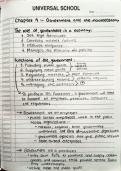
Cambridge IGCSE/O-Level Economics (0455) – Chapter 4: Government and the Macroeconomy | Handwritten Notes
Extensive handwritten notes covering the full "Government and the Macroeconomy" unit for Cambridge IGCSE/O-Level Economics (0455) — one of the largest and most exam-heavy topics on the syllabus. Clearly organized with headings, flow diagrams, comparison tables, and worked examples. Topics covered: Role and functions of government: legal framework, correcting market failure, redistributing income, managing the economy Government as employer, producer, consumer, regulator, and tax collector Current vs capital government expenditure Macroeconomic objectives: economic growth, low unemployment, low & stable inflation, balance of payments stability, redistribution of income, environmental protection Conflicts between macroeconomic aims (growth vs environment, growth vs BoP, growth vs inflation, redistribution vs efficiency, unemployment vs inflation) Fiscal policy: government budget, budget surplus/deficit/balanced budget, expansionary vs contractionary fiscal policy Reasons for government spending and taxation Principles of a good tax system Types of taxes: progressive, regressive, proportional (with worked numerical examples and graph) Direct vs indirect taxes Monetary policy: interest rates, money supply, exchange rate; expansionary vs contractionary; quantitative easing Supply-side policy: tax incentives, subsidies, education/training, labour market reform, competition policy, trade liberalization, privatization, deregulation Economic growth: definition, PPC diagrams (actual vs potential growth), causes, advantages/disadvantages The business cycle: boom, recession, slump, recovery (with labelled diagram) Policies to promote economic growth (demand-side and supply-side) Employment & unemployment: labour force, dependent population, labour force participation rate Causes of unemployment: frictional, seasonal, demand-deficient/cyclical, structural, technological Labour market barriers: trade unions, minimum wage (with diagram), unemployment benefits, labour immobility, lack of information Policies to reduce unemployment Inflation: definition, measuring inflation (CPI, price indices), calculating a price index Uses of price indices, problems with price indices Causes of inflation: demand-pull, cost-push, increase in money supply; stagflation Benefits and costs of inflation (personal and economy-wide) Policies to control inflation; deflation (good vs bad) and its consequences Perfect for exam prep, essay planning, or filling gaps in your own notes. Diagrams, graphs, and tables are hand-drawn and clearly labelled
Document information
- School year
- 4
- Uploaded on
- July 13, 2026
- Number of pages
- 38
- Written in
- 2024/2025
- Type
- Class notes
- Professor(s)
- Sir michael
- Contains
- All classes


