

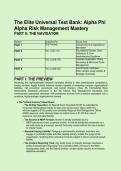
The Elite Universal Test Bank: Alpha Phi
Alpha Risk Management Mastery
PART 0: THE NAVIGATOR
Section CognitiveTier Focus Area
PART I The Preview Critical Axioms & Operational
Mandates
PART II Tier 1 (Q1–15) Foundational Syntax, Hard
Definitions & Core
Administrative Deadlines
PART II Tier 2 (Q16–35) Complex Application, Policy
Simulation & Mid-Level Crisis
Management
PART II Tier 3 (Q36–60) Grandmaster Synthesis,
Multi-Variable Legal Liability &
Strategic Overhauls
PART I: THE PREVIEW
Mastering this highlycalibrated testbank translates directly to elite administrative competence,
forging decisive, legally fortified fraternity leaders capable of navigating complex organizational
liabilities, risk prevention procedures, and human relations crises. By internalizing these
authoritative standards—anchored in the 8th Edition Risk Management Handbook and
contemporary operational directives—the practitioner evolves from a reactive participant into a
proactive, highly strategic organizational steward.
● The "Critical Axioms" Cheat Sheet:
○ The 30-Day Imperative: All Special Event Checklists MUST be submitted to
Corporate Headquarters exactly 30 days prior to the event; failure within this
window triggers a $100 penalty and mandates Regional Risk Management Officer
(RMO) approval, while absolute failure to submit incurs a $1,000 fine, loss of
insurance, and individual liability.
○ The Alcohol & IMDP Firewall: Alcohol is strictly prohibited at any
IMDP-sanctioned event; at general events, it must be distributed exclusively on a
per-drink basis by a licensed, insured third-party vendor without the use of pooled
or chapter funds.
○ Absolute Hazing Liability: Pledging is permanently abolished; members who
engage in prohibited intake activities operate entirely outside the scope of the
organization, rendering them individual criminals subject to direct, personal lawsuit
liability.
○ The Incident Reporting Triad: Any bodily injury or property damage mandates a
written Incident/Claim Reporting Form submitted within 24 hours to the RMO,
Headquarters Staff, and the District Director; severe injuries require an immediate
telephone escalation.
, ○ Youth & Vendor Safeguards: Unsupervised access to youth is strictly forbidden
without cleared state and federal background checks; all third-party vendors must
hold $1 Million in general liability and explicitly name Alpha Phi Alpha Fraternity, Inc.
as an additional insured.
PART II: THE ELITE TEST BANK
Tier 1 - Foundational Syntax & Application
Q1: A local chapter intends to host an off-campus social function. Based on the 2020 protocols of
the Alpha Phi Alpha Risk Management framework, what is the EXACT required timeframe for
submitting the Special Event Checklist to Corporate Headquarters to avoid any penalties? A) 14
days prior to the event date. B) 21 days prior to the event date. C) 30 days prior to the event date.
D) 45 days prior to the event date.
● The Answer: C (30 days prior to the event date.)
● Distractor Analysis:
○ A is incorrect: 14 days is an arbitrary deadline and well past the penalty threshold.
○ B is incorrect: 21 days was the legacy requirement prior to the January 2020
operational update.
○ D is incorrect: 45 days exceeds the mandatory baseline, though early submission is
encouraged, 30 days is the exact statutory requirement.
The Mentor's Analysis: The administrative calendar is unforgiving. When scheduling an
external event, the immediate priority is securing the Fraternity's liability shield. By utilizing the
30-day mandate, the practitioner bypasses the common trap of incurring late fees or triggering
specialized RMO reviews. Professional/Academic Intuition: The 30-day window is absolute;
inside it, operations are penalized, and coverage is jeopardized.
Q2: A chapter is preparing a budget for a sanctioned alumni mixer. Which of the following
methods of acquiring alcoholic beverages is MOST ACCURATE and compliant with the
fraternity's risk management policy? A) Passing a digital payment app code among brothers to
pool funds for bulk alcohol purchases. B) Using funds collected from guest admission fees at
the door to purchase kegs. C) Utilizing chapter treasury funds, provided the event is exclusive to
active members of legal drinking age. D) Hiring a licensed and insured third-party vendor to
provide and sell alcohol on a per-drink basis.
● The Answer: D (Hiring a licensed and insured third-party vendor to provide and sell
alcohol on a per-drink basis.)
● Distractor Analysis:
○ A is incorrect: The pooling of funds by brothers to purchase alcohol is strictly
prohibited.
○ B is incorrect: Using cover charges or admission fees to fund alcohol constitutes an
illegal, unapproved sale of alcohol under fraternal policy.
○ C is incorrect: Chapter funds can never be utilized for the purchase of alcohol,
regardless of the attendees' ages.
The Mentor's Analysis: Fraternal funds and alcohol are fundamentally incompatible. When
planning social engagements, the immediate priority is outsourcing risk. By utilizing licensed
third-party vendors, the practitioner bypasses the common trap of assuming direct legal liability
for alcohol distribution. Professional/Academic Intuition: If chapter money touches the alcohol,
the chapter assumes the liability. Always isolate the transaction.
,Q3: During an Initial Membership Development Process (IMDP) cycle, an alumnus offers to host
an "informal smoker" at his private residence and serve craft cocktails. Based on the rules
governing IMDP and alcohol, what is the MOST APPROPRIATE conclusion? A) The event is
permitted because it is hosted by an alumnus off-campus. B) The event is strictly prohibited as
alcohol is forbidden at all IMDP-related events, including smokers. C) The event is permitted
provided the candidates do not consume the alcohol. D) The event is permitted if a Special
Event Checklist is filed and approved.
● The Answer: B (The event is strictly prohibited as alcohol is forbidden at all IMDP-related
events, including smokers.)
● Distractor Analysis:
○ A is incorrect: Alumni status and off-campus locations do not grant exemptions from
core IMDP mandates.
○ C is incorrect: The mere presence of alcohol at an IMDP event violates the policy,
regardless of who consumes it.
○ D is incorrect: A Special Event Checklist cannot override the absolute prohibition of
alcohol at IMDP activities.
The Mentor's Analysis: The sanctity of the intake process requires absolute clarity. When
managing IMDP, the immediate priority is maintaining an environment devoid of intoxicants. By
utilizing the absolute IMDP alcohol prohibition, the practitioner bypasses the common trap of
blurring social events with candidate development. Professional/Academic Intuition: Intake
and alcohol do not mix; any intersection invalidates the legitimacy of the process and exposes
the chapter to severe sanctions.
Q4: A candidate for membership signs an agreement to endure "mild physical exertion" as a test
of loyalty, assuming it is an unofficial chapter tradition. Under Alpha Phi Alpha's hazing policy,
how is this agreement viewed? A) It is valid, provided the exertion does not result in bodily injury.
B) It is void, as candidates must not agree to submit to hazing, and pledging has been officially
abolished. C) It is valid only if an IMDP-certified Alpha Advisor supervises the activity. D) It is a
minor infraction subject only to a verbal warning from the District Director.
● The Answer: B (It is void, as candidates must not agree to submit to hazing, and
pledging has been officially abolished.)
● Distractor Analysis:
○ A is incorrect: Hazing is not measured merely by the outcome of injury; the act itself
is prohibited.
○ C is incorrect: Certified officers cannot authorize illicit acts; their presence would
constitute a gross supervisory violation.
○ D is incorrect: Hazing agreements are severe violations leading to expulsion and
potential criminal liability, not minor infractions.
The Mentor's Analysis: Consent is not a defense for illicit traditions. When vetting candidates,
the immediate priority is enforcing the Candidate Bill of Rights. By utilizing the abolishment of
pledging framework, the practitioner bypasses the common trap of rationalizing systemic abuse
as tradition. Professional/Academic Intuition: A candidate cannot consent to their own abuse;
the organization's policies supersede any private, illicit agreements.
Q5: An individual who engages in unauthorized, prohibited membership activities (hazing)
causes harm to a candidate. According to the fraternity's official stance, how will the national
organization address the offending individual's liability? A) The fraternity will provide legal
counsel to defend the brother under the national insurance policy. B) The fraternity considers
the individual a criminal who is individually and personally liable to the victim. C) The fraternity
will assume vicarious liability, provided the member was acting in the name of the chapter. D)
, The fraternity will shield the individual through the regional arbitration process.
● The Answer: B (The fraternity considers the individual a criminal who is individually and
personally liable to the victim.)
● Distractor Analysis:
○ A is incorrect: The national insurance policy explicitly excludes coverage for hazing
and criminal acts.
○ C is incorrect: The fraternity explicitly severs agency in these instances; individuals
who haze do not represent Alpha Phi Alpha.
○ D is incorrect: Hazing transcends internal arbitration and subjects the offender to
direct civil and criminal judicial processes.
The Mentor's Analysis: Institutional protection vanishes when fundamental rules are breached.
When acts of hazing occur, the immediate priority is organizational dissociation. By utilizing the
personal liability doctrine, the practitioner bypasses the common trap of assuming the fraternity
will shield rogue actors. Professional/Academic Intuition: The fraternity's insurance is a shield
for lawful operations, not a sanctuary for criminal behavior.
Q6: A chapter officer is reviewing the operational policies to ensure compliance with digital
communication standards. Which specific policy document governs expectations regarding the
use of communication tools, including social media platforms? A) The Candidate Bill of Rights
B) The Personal Conduct Policy C) The Electronic Media Usage Policy D) The General Office
Branding Directive
● The Answer: C (The Electronic Media Usage Policy)
● Distractor Analysis:
○ A is incorrect: This governs the rights and expectations of candidates during IMDP,
not media usage.
○ B is incorrect: While it governs general behavioral expectations, it is not the specific
document for digital communication protocols.
○ D is incorrect: Brand guidelines dictate logo usage, but the Electronic Media Usage
Policy governs the broader operational use of communication tools.
The Mentor's Analysis: Digital footprints carry immense organizational risk. When navigating
online platforms, the immediate priority is strict adherence to communication protocols. By
utilizing the Electronic Media Usage Policy, the practitioner bypasses the common trap of
treating official chapter communication as casual social interaction. Professional/Academic
Intuition: An organization's digital presence is an extension of its legal liability.
Q7: Under the fraternity's risk management framework, an effective, comprehensive risk
management policy must consist of three core components. What are they? A) Loss Prevention,
Loss Control, Risk Transfer B) Personal Responsibility, Education, Prevention C) Checks,
Balances, Sanctions D) Advisement, Compliance, Arbitration
● The Answer: B (Personal Responsibility, Education, Prevention)
● Distractor Analysis:
○ A is incorrect: While these are pillars of the insurance program's success , the
specific components of the behavioral risk management policy are different.
○ C is incorrect: Checks and balances are elements of a viable policy, but not the
three defined core components.
○ D is incorrect: These are administrative functions, not the foundational triad of the
risk management policy.
The Mentor's Analysis: Systems fail without human accountability. When evaluating a risk
policy, the immediate priority is behavioral alignment. By utilizing the
Responsibility-Education-Prevention triad, the practitioner bypasses the common trap of relying
Alpha Risk Management Mastery
PART 0: THE NAVIGATOR
Section CognitiveTier Focus Area
PART I The Preview Critical Axioms & Operational
Mandates
PART II Tier 1 (Q1–15) Foundational Syntax, Hard
Definitions & Core
Administrative Deadlines
PART II Tier 2 (Q16–35) Complex Application, Policy
Simulation & Mid-Level Crisis
Management
PART II Tier 3 (Q36–60) Grandmaster Synthesis,
Multi-Variable Legal Liability &
Strategic Overhauls
PART I: THE PREVIEW
Mastering this highlycalibrated testbank translates directly to elite administrative competence,
forging decisive, legally fortified fraternity leaders capable of navigating complex organizational
liabilities, risk prevention procedures, and human relations crises. By internalizing these
authoritative standards—anchored in the 8th Edition Risk Management Handbook and
contemporary operational directives—the practitioner evolves from a reactive participant into a
proactive, highly strategic organizational steward.
● The "Critical Axioms" Cheat Sheet:
○ The 30-Day Imperative: All Special Event Checklists MUST be submitted to
Corporate Headquarters exactly 30 days prior to the event; failure within this
window triggers a $100 penalty and mandates Regional Risk Management Officer
(RMO) approval, while absolute failure to submit incurs a $1,000 fine, loss of
insurance, and individual liability.
○ The Alcohol & IMDP Firewall: Alcohol is strictly prohibited at any
IMDP-sanctioned event; at general events, it must be distributed exclusively on a
per-drink basis by a licensed, insured third-party vendor without the use of pooled
or chapter funds.
○ Absolute Hazing Liability: Pledging is permanently abolished; members who
engage in prohibited intake activities operate entirely outside the scope of the
organization, rendering them individual criminals subject to direct, personal lawsuit
liability.
○ The Incident Reporting Triad: Any bodily injury or property damage mandates a
written Incident/Claim Reporting Form submitted within 24 hours to the RMO,
Headquarters Staff, and the District Director; severe injuries require an immediate
telephone escalation.
, ○ Youth & Vendor Safeguards: Unsupervised access to youth is strictly forbidden
without cleared state and federal background checks; all third-party vendors must
hold $1 Million in general liability and explicitly name Alpha Phi Alpha Fraternity, Inc.
as an additional insured.
PART II: THE ELITE TEST BANK
Tier 1 - Foundational Syntax & Application
Q1: A local chapter intends to host an off-campus social function. Based on the 2020 protocols of
the Alpha Phi Alpha Risk Management framework, what is the EXACT required timeframe for
submitting the Special Event Checklist to Corporate Headquarters to avoid any penalties? A) 14
days prior to the event date. B) 21 days prior to the event date. C) 30 days prior to the event date.
D) 45 days prior to the event date.
● The Answer: C (30 days prior to the event date.)
● Distractor Analysis:
○ A is incorrect: 14 days is an arbitrary deadline and well past the penalty threshold.
○ B is incorrect: 21 days was the legacy requirement prior to the January 2020
operational update.
○ D is incorrect: 45 days exceeds the mandatory baseline, though early submission is
encouraged, 30 days is the exact statutory requirement.
The Mentor's Analysis: The administrative calendar is unforgiving. When scheduling an
external event, the immediate priority is securing the Fraternity's liability shield. By utilizing the
30-day mandate, the practitioner bypasses the common trap of incurring late fees or triggering
specialized RMO reviews. Professional/Academic Intuition: The 30-day window is absolute;
inside it, operations are penalized, and coverage is jeopardized.
Q2: A chapter is preparing a budget for a sanctioned alumni mixer. Which of the following
methods of acquiring alcoholic beverages is MOST ACCURATE and compliant with the
fraternity's risk management policy? A) Passing a digital payment app code among brothers to
pool funds for bulk alcohol purchases. B) Using funds collected from guest admission fees at
the door to purchase kegs. C) Utilizing chapter treasury funds, provided the event is exclusive to
active members of legal drinking age. D) Hiring a licensed and insured third-party vendor to
provide and sell alcohol on a per-drink basis.
● The Answer: D (Hiring a licensed and insured third-party vendor to provide and sell
alcohol on a per-drink basis.)
● Distractor Analysis:
○ A is incorrect: The pooling of funds by brothers to purchase alcohol is strictly
prohibited.
○ B is incorrect: Using cover charges or admission fees to fund alcohol constitutes an
illegal, unapproved sale of alcohol under fraternal policy.
○ C is incorrect: Chapter funds can never be utilized for the purchase of alcohol,
regardless of the attendees' ages.
The Mentor's Analysis: Fraternal funds and alcohol are fundamentally incompatible. When
planning social engagements, the immediate priority is outsourcing risk. By utilizing licensed
third-party vendors, the practitioner bypasses the common trap of assuming direct legal liability
for alcohol distribution. Professional/Academic Intuition: If chapter money touches the alcohol,
the chapter assumes the liability. Always isolate the transaction.
,Q3: During an Initial Membership Development Process (IMDP) cycle, an alumnus offers to host
an "informal smoker" at his private residence and serve craft cocktails. Based on the rules
governing IMDP and alcohol, what is the MOST APPROPRIATE conclusion? A) The event is
permitted because it is hosted by an alumnus off-campus. B) The event is strictly prohibited as
alcohol is forbidden at all IMDP-related events, including smokers. C) The event is permitted
provided the candidates do not consume the alcohol. D) The event is permitted if a Special
Event Checklist is filed and approved.
● The Answer: B (The event is strictly prohibited as alcohol is forbidden at all IMDP-related
events, including smokers.)
● Distractor Analysis:
○ A is incorrect: Alumni status and off-campus locations do not grant exemptions from
core IMDP mandates.
○ C is incorrect: The mere presence of alcohol at an IMDP event violates the policy,
regardless of who consumes it.
○ D is incorrect: A Special Event Checklist cannot override the absolute prohibition of
alcohol at IMDP activities.
The Mentor's Analysis: The sanctity of the intake process requires absolute clarity. When
managing IMDP, the immediate priority is maintaining an environment devoid of intoxicants. By
utilizing the absolute IMDP alcohol prohibition, the practitioner bypasses the common trap of
blurring social events with candidate development. Professional/Academic Intuition: Intake
and alcohol do not mix; any intersection invalidates the legitimacy of the process and exposes
the chapter to severe sanctions.
Q4: A candidate for membership signs an agreement to endure "mild physical exertion" as a test
of loyalty, assuming it is an unofficial chapter tradition. Under Alpha Phi Alpha's hazing policy,
how is this agreement viewed? A) It is valid, provided the exertion does not result in bodily injury.
B) It is void, as candidates must not agree to submit to hazing, and pledging has been officially
abolished. C) It is valid only if an IMDP-certified Alpha Advisor supervises the activity. D) It is a
minor infraction subject only to a verbal warning from the District Director.
● The Answer: B (It is void, as candidates must not agree to submit to hazing, and
pledging has been officially abolished.)
● Distractor Analysis:
○ A is incorrect: Hazing is not measured merely by the outcome of injury; the act itself
is prohibited.
○ C is incorrect: Certified officers cannot authorize illicit acts; their presence would
constitute a gross supervisory violation.
○ D is incorrect: Hazing agreements are severe violations leading to expulsion and
potential criminal liability, not minor infractions.
The Mentor's Analysis: Consent is not a defense for illicit traditions. When vetting candidates,
the immediate priority is enforcing the Candidate Bill of Rights. By utilizing the abolishment of
pledging framework, the practitioner bypasses the common trap of rationalizing systemic abuse
as tradition. Professional/Academic Intuition: A candidate cannot consent to their own abuse;
the organization's policies supersede any private, illicit agreements.
Q5: An individual who engages in unauthorized, prohibited membership activities (hazing)
causes harm to a candidate. According to the fraternity's official stance, how will the national
organization address the offending individual's liability? A) The fraternity will provide legal
counsel to defend the brother under the national insurance policy. B) The fraternity considers
the individual a criminal who is individually and personally liable to the victim. C) The fraternity
will assume vicarious liability, provided the member was acting in the name of the chapter. D)
, The fraternity will shield the individual through the regional arbitration process.
● The Answer: B (The fraternity considers the individual a criminal who is individually and
personally liable to the victim.)
● Distractor Analysis:
○ A is incorrect: The national insurance policy explicitly excludes coverage for hazing
and criminal acts.
○ C is incorrect: The fraternity explicitly severs agency in these instances; individuals
who haze do not represent Alpha Phi Alpha.
○ D is incorrect: Hazing transcends internal arbitration and subjects the offender to
direct civil and criminal judicial processes.
The Mentor's Analysis: Institutional protection vanishes when fundamental rules are breached.
When acts of hazing occur, the immediate priority is organizational dissociation. By utilizing the
personal liability doctrine, the practitioner bypasses the common trap of assuming the fraternity
will shield rogue actors. Professional/Academic Intuition: The fraternity's insurance is a shield
for lawful operations, not a sanctuary for criminal behavior.
Q6: A chapter officer is reviewing the operational policies to ensure compliance with digital
communication standards. Which specific policy document governs expectations regarding the
use of communication tools, including social media platforms? A) The Candidate Bill of Rights
B) The Personal Conduct Policy C) The Electronic Media Usage Policy D) The General Office
Branding Directive
● The Answer: C (The Electronic Media Usage Policy)
● Distractor Analysis:
○ A is incorrect: This governs the rights and expectations of candidates during IMDP,
not media usage.
○ B is incorrect: While it governs general behavioral expectations, it is not the specific
document for digital communication protocols.
○ D is incorrect: Brand guidelines dictate logo usage, but the Electronic Media Usage
Policy governs the broader operational use of communication tools.
The Mentor's Analysis: Digital footprints carry immense organizational risk. When navigating
online platforms, the immediate priority is strict adherence to communication protocols. By
utilizing the Electronic Media Usage Policy, the practitioner bypasses the common trap of
treating official chapter communication as casual social interaction. Professional/Academic
Intuition: An organization's digital presence is an extension of its legal liability.
Q7: Under the fraternity's risk management framework, an effective, comprehensive risk
management policy must consist of three core components. What are they? A) Loss Prevention,
Loss Control, Risk Transfer B) Personal Responsibility, Education, Prevention C) Checks,
Balances, Sanctions D) Advisement, Compliance, Arbitration
● The Answer: B (Personal Responsibility, Education, Prevention)
● Distractor Analysis:
○ A is incorrect: While these are pillars of the insurance program's success , the
specific components of the behavioral risk management policy are different.
○ C is incorrect: Checks and balances are elements of a viable policy, but not the
three defined core components.
○ D is incorrect: These are administrative functions, not the foundational triad of the
risk management policy.
The Mentor's Analysis: Systems fail without human accountability. When evaluating a risk
policy, the immediate priority is behavioral alignment. By utilizing the
Responsibility-Education-Prevention triad, the practitioner bypasses the common trap of relying


