

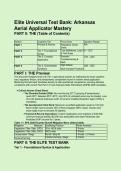
Elite Universal Test Bank: Arkansas
Aerial Applicator Mastery
PART 0: THE (Table of Contents)
Section Cognitive Tier Focus Area Question Range
PART I Preview & Axioms Regulatory Cheat N/A
Sheet
PART II Tier 1: Foundational Core Definitions, Laws Q1 – Q15
Syntax & FAA Rules
PART II Tier 2: Complex Scenario Q16 – Q35
Application Troubleshooting &
Math
PART II Tier 3: Grandmaster High-Stakes Q36 – Q60
Synthesis Multi-Variable Problems
PART I: THE Preview
This document forgesnovices into Tier-1 agricultural aviators by replicating the exact cognitive
load, regulatory friction, and aerodynamic complexities found in modern aerial application.
Mastering this test bank translates directly to elite operational competence, ensuring absolute
compliance with current FAA Part 137 and Arkansas State Plant Board (ASPB) 2026 mandates.
● Critical Axioms Cheat Sheet:
○ The Dicamba Dictate (2026): No over-the-top (OTT) spraying if temperatures
reach 95°F. Between 85°F–95°F, only 50% of untreated acres may be treated. June
30 is the absolute Arkansas cutoff. 40 oz/acre Volatility Reduction Agent (VRA) is
mandatory.
○ The Aerodynamic Hard Deck: Maximum unverified application speed is 145 mph.
Boom length cannot exceed 70% of fixed wingspan (80% rotary). Nozzle wind
shear angle must not exceed 30 degrees.
○ Financial & Record Imperatives: Custom Applicators must maintain a $100,000
minimum financial liability ($5,000 max deductible) and retain Restricted Use
Pesticide (RUP) records for 3 years.
Table 1.1: EPA 2026 Dicamba Runoff Mitigation Menu (Abbreviated)
Mitigation Measure Qualifying Practice Points Awarded
Vegetative Filter Strip (VFS) 30 to <60 ft wide 2 Points
Vegetative Filter Strip (VFS) ≥60 ft wide 3 Points
Conservation Tillage No-till / Strip-till 3 Points / 2 Points
ContourFarming Contour farming / tillage 2 Points
PART II: THE ELITE TEST BANK
Tier 1 - Foundational Syntax & Application
,Q1: An Arkansas aerial applicator firm is renewing its Firm Commercial Applicator License for
2026. Which financial responsibility configuration meets the MINIMUM acceptable standard
under Arkansas Code R. 013? A) A $50,000 surety bond with a zero-dollar deductible. B) A
$100,000 insurance policy with a $10,000 deductible. C) A $100,000 letter of credit from an
Arkansas Bank. D) A $250,000 liability policy specifically excluding 2,4-D applications.
● The Answer: C (A $100,000 letter of credit from an Arkansas Bank.)
● Distractor Analysis:
○ A is incorrect: The statutory minimum is $100,000.
○ B is incorrect: The maximum allowable deductible on an insurance policy is $5,000.
○ D is incorrect: Excluding specific restricted-use pesticides (like 2,4-D) invalidates
the comprehensive coverage required for Custom Applicators.
The Mentor's Analysis: Financial responsibility is the absolute gateway to operational legality.
When facing licensure renewal, the immediate priority is verifying the $100,000 baseline and the
$5,000 deductible limit. By utilizing acompliantletterofcreditorbondedinsurance,you bypass
thecommon trap of underinsured liabilityexposure. Professional/Academic Intuition:In
agricultural aviation, capital backing is as critical as aerodynamic lift; never exceed a $5K
deductible.
Q2: Under the2026EPA mandates, what is the REQUIRED volume of an approved Volatility
Reduction Agent (VRA) that must be added to every over-the-top (OTT) dicamba application?
A) 20 fluid ounces per acre. B) 24 fluid ounces per acre. C) 40 fluid ounces per acre. D) 60 fluid
ounces per acre.
● The Answer: C (40 fluid ounces per acre.)
● Distractor Analysis:
○ A is incorrect: 20 ounces was the legacy standard; the 2026 mandate doubled this
requirement.
○ B is incorrect: This is a fabricated volume common in older drift reduction adjuvants.
○ D is incorrect: This exceeds the federally mandated formulation limit, illegally
altering chemical efficacy.
The Mentor's Analysis: Volatility is the invisible enemy of the applicator. When facing OTT
dicamba application, the immediate priority is neutralizing vapor drift. By utilizing the 40 oz/acre
VRA mandate, you bypass the common trap of relying on outdated legacy ratios.
Professional/Academic Intuition: Double the VRA, halve the volatility risk.
Q3: According to FAA Part 137.71, where must a commercial agricultural aircraft operator
maintain their required operational records? A) Exclusively inside the aircraft cockpit during all
flights. B) At the local Flight Standards District Office (FSDO). C) At the home base of
operations designated in the application. D) Within a federally encrypted digital cloud server.
● The Answer: C (At the home base of operations designated in the application.)
● Distractor Analysis:
○ A is incorrect: Records must be accessible for inspection, not subject to the hazards
of the cockpit.
○ B is incorrect: The FAA inspects them; the FSDO does not store them.
○ D is incorrect: While digital records are permissible, the physical/accessible location
tied to the certificate must be the home base.
The Mentor's Analysis: Compliance demands geographic consistency. When facing FAA
record-keeping requirements, the immediate priority is centralization. By utilizing the designated
homebase, you bypass the common trap of scattering vital maintenance and operational logs
acrossfield outposts. Professional/Academic Intuition:Your certificate lives at your home
base; your records must live there too.
, Q4: A commercial firm wishes to aerially apply Class F products (such as 2,4-D) in Arkansas. In
addition to a Firm Commercial Applicator License, what FIRST specific credential must the firm
secure? A) A Private Applicator Authorization. B) A Firm’s Custom Applicator Permit designating
an Operator-in-Charge. C) A Class E Hazard Waiver from the EPA. D) An FAA Part 107
Unmanned Exemption.
● The Answer: B (A Firm’s Custom Applicator Permit designating an Operator-in-Charge.)
● Distractor Analysis:
○ A is incorrect: Private applicators spray their own land; this is a commercial for-hire
operation.
○ C is incorrect: The EPA does not issue "Hazard Waivers" for standard Class F
applications.
○ D is incorrect: Part 107 is for drones under 55 lbs, completely irrelevant to the
chemical classification.
The Mentor's Analysis: High-risk chemicals demand high-level accountability. When facing
Class E or F applications, the immediate priority is establishing a direct chain of command. By
utilizing anOperator-in-ChargeviaaCustomPermit, youbypass thecommon trapof assuming
abasic commerciallicense covers all Restricted Use Pesticides. Professional/Academic
Intuition: General licenses open the door; Custom Permits allow you to handle the heavy
artillery.
Q5: BasedonArkansasCode R. 013,whatisthemaximumpermissibleboomlengthfora
fixed-wingagriculturalaircraft relativetoitswingspan?A)60%B)70%C)80%D)85%
● The Answer: B (70%)
● Distractor Analysis:
○ A is incorrect: 60% is overlyrestrictiveand notmathematicallyalignedwithASPB
code.
○ C is incorrect: 80% is the maximum boom length strictly reserved for rotary-wing
(helicopter) aircraft.
○ D is incorrect: 85% introduces severe wingtip vortex entrainment, causing
catastrophic drift.
The Mentor's Analysis: Wingtip vortices are the primary vector for off-target drift. When facing
fixed-wing setup calibration, the immediate priority is restricting nozzle placement away from the
wingtips. By utilizing the 70% rule, you bypass the common trap of vortex entrainment that
destroys downwind crops. Professional/Academic Intuition: 70% for fixed wings keeps the
spray in the downwash; anything wider feeds the vortex.
Q6: Under the Arkansas dicamba regulations for 2026, which date represents the absolute
FINAL day over-the-top (OTT) in-crop dicamba can be legally applied? A) April 15 B) June 30
C) July 15 D) October 31
● The Answer: B (June 30)
● Distractor Analysis:
○ A is incorrect: April 15 is the day before the in-crop window opens (April 16).
○ C is incorrect: This is a generalized crop deadline, not the ASPB dicamba cutoff.
○ D is incorrect: October 31 is the end of the prohibition for agricultural use; spray
resumes Nov 1 for burndown, but June 30 is the in-crop cutoff.
The Mentor's Analysis: State cutoffs supersede federal leniency. When facing seasonal
planning, the immediate priority is knowing the hard regulatory wall. By utilizing the June 30
cutoff,you bypass thecommon trap of relying on more lenient federal EPAdates thatArkansas
explicitly overrides. Professional/Academic Intuition:In Arkansas, July 1 means the
dicamba valve is permanently shut.
Aerial Applicator Mastery
PART 0: THE (Table of Contents)
Section Cognitive Tier Focus Area Question Range
PART I Preview & Axioms Regulatory Cheat N/A
Sheet
PART II Tier 1: Foundational Core Definitions, Laws Q1 – Q15
Syntax & FAA Rules
PART II Tier 2: Complex Scenario Q16 – Q35
Application Troubleshooting &
Math
PART II Tier 3: Grandmaster High-Stakes Q36 – Q60
Synthesis Multi-Variable Problems
PART I: THE Preview
This document forgesnovices into Tier-1 agricultural aviators by replicating the exact cognitive
load, regulatory friction, and aerodynamic complexities found in modern aerial application.
Mastering this test bank translates directly to elite operational competence, ensuring absolute
compliance with current FAA Part 137 and Arkansas State Plant Board (ASPB) 2026 mandates.
● Critical Axioms Cheat Sheet:
○ The Dicamba Dictate (2026): No over-the-top (OTT) spraying if temperatures
reach 95°F. Between 85°F–95°F, only 50% of untreated acres may be treated. June
30 is the absolute Arkansas cutoff. 40 oz/acre Volatility Reduction Agent (VRA) is
mandatory.
○ The Aerodynamic Hard Deck: Maximum unverified application speed is 145 mph.
Boom length cannot exceed 70% of fixed wingspan (80% rotary). Nozzle wind
shear angle must not exceed 30 degrees.
○ Financial & Record Imperatives: Custom Applicators must maintain a $100,000
minimum financial liability ($5,000 max deductible) and retain Restricted Use
Pesticide (RUP) records for 3 years.
Table 1.1: EPA 2026 Dicamba Runoff Mitigation Menu (Abbreviated)
Mitigation Measure Qualifying Practice Points Awarded
Vegetative Filter Strip (VFS) 30 to <60 ft wide 2 Points
Vegetative Filter Strip (VFS) ≥60 ft wide 3 Points
Conservation Tillage No-till / Strip-till 3 Points / 2 Points
ContourFarming Contour farming / tillage 2 Points
PART II: THE ELITE TEST BANK
Tier 1 - Foundational Syntax & Application
,Q1: An Arkansas aerial applicator firm is renewing its Firm Commercial Applicator License for
2026. Which financial responsibility configuration meets the MINIMUM acceptable standard
under Arkansas Code R. 013? A) A $50,000 surety bond with a zero-dollar deductible. B) A
$100,000 insurance policy with a $10,000 deductible. C) A $100,000 letter of credit from an
Arkansas Bank. D) A $250,000 liability policy specifically excluding 2,4-D applications.
● The Answer: C (A $100,000 letter of credit from an Arkansas Bank.)
● Distractor Analysis:
○ A is incorrect: The statutory minimum is $100,000.
○ B is incorrect: The maximum allowable deductible on an insurance policy is $5,000.
○ D is incorrect: Excluding specific restricted-use pesticides (like 2,4-D) invalidates
the comprehensive coverage required for Custom Applicators.
The Mentor's Analysis: Financial responsibility is the absolute gateway to operational legality.
When facing licensure renewal, the immediate priority is verifying the $100,000 baseline and the
$5,000 deductible limit. By utilizing acompliantletterofcreditorbondedinsurance,you bypass
thecommon trap of underinsured liabilityexposure. Professional/Academic Intuition:In
agricultural aviation, capital backing is as critical as aerodynamic lift; never exceed a $5K
deductible.
Q2: Under the2026EPA mandates, what is the REQUIRED volume of an approved Volatility
Reduction Agent (VRA) that must be added to every over-the-top (OTT) dicamba application?
A) 20 fluid ounces per acre. B) 24 fluid ounces per acre. C) 40 fluid ounces per acre. D) 60 fluid
ounces per acre.
● The Answer: C (40 fluid ounces per acre.)
● Distractor Analysis:
○ A is incorrect: 20 ounces was the legacy standard; the 2026 mandate doubled this
requirement.
○ B is incorrect: This is a fabricated volume common in older drift reduction adjuvants.
○ D is incorrect: This exceeds the federally mandated formulation limit, illegally
altering chemical efficacy.
The Mentor's Analysis: Volatility is the invisible enemy of the applicator. When facing OTT
dicamba application, the immediate priority is neutralizing vapor drift. By utilizing the 40 oz/acre
VRA mandate, you bypass the common trap of relying on outdated legacy ratios.
Professional/Academic Intuition: Double the VRA, halve the volatility risk.
Q3: According to FAA Part 137.71, where must a commercial agricultural aircraft operator
maintain their required operational records? A) Exclusively inside the aircraft cockpit during all
flights. B) At the local Flight Standards District Office (FSDO). C) At the home base of
operations designated in the application. D) Within a federally encrypted digital cloud server.
● The Answer: C (At the home base of operations designated in the application.)
● Distractor Analysis:
○ A is incorrect: Records must be accessible for inspection, not subject to the hazards
of the cockpit.
○ B is incorrect: The FAA inspects them; the FSDO does not store them.
○ D is incorrect: While digital records are permissible, the physical/accessible location
tied to the certificate must be the home base.
The Mentor's Analysis: Compliance demands geographic consistency. When facing FAA
record-keeping requirements, the immediate priority is centralization. By utilizing the designated
homebase, you bypass the common trap of scattering vital maintenance and operational logs
acrossfield outposts. Professional/Academic Intuition:Your certificate lives at your home
base; your records must live there too.
, Q4: A commercial firm wishes to aerially apply Class F products (such as 2,4-D) in Arkansas. In
addition to a Firm Commercial Applicator License, what FIRST specific credential must the firm
secure? A) A Private Applicator Authorization. B) A Firm’s Custom Applicator Permit designating
an Operator-in-Charge. C) A Class E Hazard Waiver from the EPA. D) An FAA Part 107
Unmanned Exemption.
● The Answer: B (A Firm’s Custom Applicator Permit designating an Operator-in-Charge.)
● Distractor Analysis:
○ A is incorrect: Private applicators spray their own land; this is a commercial for-hire
operation.
○ C is incorrect: The EPA does not issue "Hazard Waivers" for standard Class F
applications.
○ D is incorrect: Part 107 is for drones under 55 lbs, completely irrelevant to the
chemical classification.
The Mentor's Analysis: High-risk chemicals demand high-level accountability. When facing
Class E or F applications, the immediate priority is establishing a direct chain of command. By
utilizing anOperator-in-ChargeviaaCustomPermit, youbypass thecommon trapof assuming
abasic commerciallicense covers all Restricted Use Pesticides. Professional/Academic
Intuition: General licenses open the door; Custom Permits allow you to handle the heavy
artillery.
Q5: BasedonArkansasCode R. 013,whatisthemaximumpermissibleboomlengthfora
fixed-wingagriculturalaircraft relativetoitswingspan?A)60%B)70%C)80%D)85%
● The Answer: B (70%)
● Distractor Analysis:
○ A is incorrect: 60% is overlyrestrictiveand notmathematicallyalignedwithASPB
code.
○ C is incorrect: 80% is the maximum boom length strictly reserved for rotary-wing
(helicopter) aircraft.
○ D is incorrect: 85% introduces severe wingtip vortex entrainment, causing
catastrophic drift.
The Mentor's Analysis: Wingtip vortices are the primary vector for off-target drift. When facing
fixed-wing setup calibration, the immediate priority is restricting nozzle placement away from the
wingtips. By utilizing the 70% rule, you bypass the common trap of vortex entrainment that
destroys downwind crops. Professional/Academic Intuition: 70% for fixed wings keeps the
spray in the downwash; anything wider feeds the vortex.
Q6: Under the Arkansas dicamba regulations for 2026, which date represents the absolute
FINAL day over-the-top (OTT) in-crop dicamba can be legally applied? A) April 15 B) June 30
C) July 15 D) October 31
● The Answer: B (June 30)
● Distractor Analysis:
○ A is incorrect: April 15 is the day before the in-crop window opens (April 16).
○ C is incorrect: This is a generalized crop deadline, not the ASPB dicamba cutoff.
○ D is incorrect: October 31 is the end of the prohibition for agricultural use; spray
resumes Nov 1 for burndown, but June 30 is the in-crop cutoff.
The Mentor's Analysis: State cutoffs supersede federal leniency. When facing seasonal
planning, the immediate priority is knowing the hard regulatory wall. By utilizing the June 30
cutoff,you bypass thecommon trap of relying on more lenient federal EPAdates thatArkansas
explicitly overrides. Professional/Academic Intuition:In Arkansas, July 1 means the
dicamba valve is permanently shut.


