

OAE Physical Education, OAE 034 Exam
Questions and Answers with Verified
Solutions | Latest Updated 2026
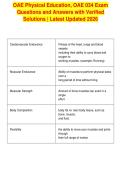
Cardiovascular Endurance Fitness of the heart, lungs and blood
vessels
including their ability to carry blood and
oxygen to
working muscles. (example: Running)
Muscular Endurance Ability of muscles to perform physical tasks
over a
long period of time without tiring
Muscular Strength Amount of force muscles can exert in a
single
effort
Body Composition body fat vs. lean body tissue, such as
bone, muscle,
and fluid
Flexibility the ability to move your muscles and joints
through
their full range of motion
,Principle of Specificity exercising a certain body part or
component of the
body primarily develops that part. The
Principle of
Specificity implies that, to become better at
a
particular exercise or skill, you must
perform that
exercise or skill. A runner should train by
running, a
swimmer by swimming and a cyclist by
cycling.
Principle Of Individual Differences because we all are unique individuals, we
will all
have a slightly different response to an
exercise
program (body size and shape, genetics,
past
experience, chronic conditions, injuries
and even
gender). Well-designed exercise programs
should
be based on our individual differences and
responses to exercise.
Principle of Overload a greater than normal stress or load on the
body is
required for training adaptation to take
place. What
this means is that in order to improve our
fitness,
strength or endurance, we need to
increase the
workload accordingly.
, Principle of Progression implies that there is an optimal level of
overload
that should be achieved, and an optimal
time frame
for this overload to occur. A gradual and
systematic
increase of the workload over a period of
time will
result in improvements in fitness without
risk of
injury.
Principle of Use/Disuse implies that when it comes to fitness, you
"use it or
lose it." This simply means that your
muscles
hypertrophy with use and atrophy with
disuse.
anatomy Studies the STRUCTURE of body parts
physiology Studies the FUNCTION of body parts
Questions and Answers with Verified
Solutions | Latest Updated 2026
Cardiovascular Endurance Fitness of the heart, lungs and blood
vessels
including their ability to carry blood and
oxygen to
working muscles. (example: Running)
Muscular Endurance Ability of muscles to perform physical tasks
over a
long period of time without tiring
Muscular Strength Amount of force muscles can exert in a
single
effort
Body Composition body fat vs. lean body tissue, such as
bone, muscle,
and fluid
Flexibility the ability to move your muscles and joints
through
their full range of motion
,Principle of Specificity exercising a certain body part or
component of the
body primarily develops that part. The
Principle of
Specificity implies that, to become better at
a
particular exercise or skill, you must
perform that
exercise or skill. A runner should train by
running, a
swimmer by swimming and a cyclist by
cycling.
Principle Of Individual Differences because we all are unique individuals, we
will all
have a slightly different response to an
exercise
program (body size and shape, genetics,
past
experience, chronic conditions, injuries
and even
gender). Well-designed exercise programs
should
be based on our individual differences and
responses to exercise.
Principle of Overload a greater than normal stress or load on the
body is
required for training adaptation to take
place. What
this means is that in order to improve our
fitness,
strength or endurance, we need to
increase the
workload accordingly.
, Principle of Progression implies that there is an optimal level of
overload
that should be achieved, and an optimal
time frame
for this overload to occur. A gradual and
systematic
increase of the workload over a period of
time will
result in improvements in fitness without
risk of
injury.
Principle of Use/Disuse implies that when it comes to fitness, you
"use it or
lose it." This simply means that your
muscles
hypertrophy with use and atrophy with
disuse.
anatomy Studies the STRUCTURE of body parts
physiology Studies the FUNCTION of body parts


