

Lifespan Development Test 1 (Chapters 1-3)
Study online at https://quizlet.com/_htz36n
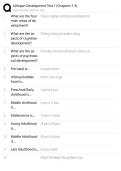
1. What are the four Physical, Cognitive, and Psychosocial development
main areas of de-
velopment?
2. What are the as- Thinking, learning, and problem solving
pects of cognitive
development?
3. What are the as- Personality, interactions with people, emotions, etc.
pects of psychoso-
cial development?
4. Pre natal is... conception to birth
5. Infancy/toddler- birth to 3 years of age
hood is...
6. Preschool/Early 3 years to 6 years
childhood is...
7. Middle childhood 6 years to 12 years
is...
8. Adolescence is... 12 years to 20 years
9. Young Adulthood 20 years to 40 years
is...
10. Middle Adulthood 40 years to 65 years
is...
11. Late Adulthood is... 65 years to death
12. Pretty In Pink Makes A Young Madam Leap
1/9
, Lifespan Development Test 1 (Chapters 1-3)
Study online at https://quizlet.com/_htz36n
Mnemonic for Age
Ranges:
13. What the Mnemon- Prenatal, Infancy/toddlerhood, preschool/ early childhood, middle childhood,
ic stands for: adolescence, young adulthood, middle adulthood, late adulthood
14. Definition of Cul- Customs that are passed down from one person to the next
ture:
15. Individualism (cul- what is good for someone personally
ture)
16. Collectivism (cul- What is good for the group overall
ture)
17. Cohort Group of people born around the same time.
18. Age-grade influ- All people go through these types of things (examples: puberty, menopause,
ences what age children all begin school at, etc.)
19. Sociocultural influ- Race, ethnicity, neighborhood, etc.
ences
20. Non-normative Something that happens when you don't expect it to (examples: teen preg-
events nancy, loosing a parent during childhood, child getting cancer, etc.)
21. Key Debates: Con- continues on (example: height)
tinuous
22. Key Debates: Dis- has stages for when something happens (example: going up the stairs)
continuous
23. Critical Period Specific timing for something to happen (example: problems with baby in
pregnancy)
2/9
Study online at https://quizlet.com/_htz36n
1. What are the four Physical, Cognitive, and Psychosocial development
main areas of de-
velopment?
2. What are the as- Thinking, learning, and problem solving
pects of cognitive
development?
3. What are the as- Personality, interactions with people, emotions, etc.
pects of psychoso-
cial development?
4. Pre natal is... conception to birth
5. Infancy/toddler- birth to 3 years of age
hood is...
6. Preschool/Early 3 years to 6 years
childhood is...
7. Middle childhood 6 years to 12 years
is...
8. Adolescence is... 12 years to 20 years
9. Young Adulthood 20 years to 40 years
is...
10. Middle Adulthood 40 years to 65 years
is...
11. Late Adulthood is... 65 years to death
12. Pretty In Pink Makes A Young Madam Leap
1/9
, Lifespan Development Test 1 (Chapters 1-3)
Study online at https://quizlet.com/_htz36n
Mnemonic for Age
Ranges:
13. What the Mnemon- Prenatal, Infancy/toddlerhood, preschool/ early childhood, middle childhood,
ic stands for: adolescence, young adulthood, middle adulthood, late adulthood
14. Definition of Cul- Customs that are passed down from one person to the next
ture:
15. Individualism (cul- what is good for someone personally
ture)
16. Collectivism (cul- What is good for the group overall
ture)
17. Cohort Group of people born around the same time.
18. Age-grade influ- All people go through these types of things (examples: puberty, menopause,
ences what age children all begin school at, etc.)
19. Sociocultural influ- Race, ethnicity, neighborhood, etc.
ences
20. Non-normative Something that happens when you don't expect it to (examples: teen preg-
events nancy, loosing a parent during childhood, child getting cancer, etc.)
21. Key Debates: Con- continues on (example: height)
tinuous
22. Key Debates: Dis- has stages for when something happens (example: going up the stairs)
continuous
23. Critical Period Specific timing for something to happen (example: problems with baby in
pregnancy)
2/9


