

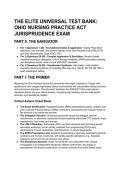
THE ELITE UNIVERSAL TEST BANK:
OHIO NURSING PRACTICE ACT
JURISPRUDENCE EXAM
PART 0: THE NAVIGATOR
● Tier 1 (Questions 1–28) - Foundational Syntax & Application: Testing "Hard Deck"
definitions, core formulas, and primary statutes of the Ohio Revised Code (ORC) 4723
and Ohio Administrative Code (OAC) 4723.
● Tier 2 (Questions 29–58) - Complex Application & Simulation: Situation-based
variables focusing on delegation, LPN IV therapy limitations, APRN prescriptive authority,
and disciplinary actions under current 2026/2027 standards.
● Tier 3 (Questions 59–88) - Grandmaster Synthesis: High-stakes, multi-variable
scenarios requiring synthesis of competing Ohio laws (e.g., HB 96, SB 109, SB 196) to
avert catastrophic liability.
PART I: THE PRIMER
Mastering the Ohio Nursing Practice Act transcends mere legal compliance; it forges elite
practitioners who navigate high-stakes clinical environments with untouchable liability protection
and autonomous precision. This document hardwires the 2026/2027 Ohio jurisprudence
standards directly into your clinical intuition, translating rigid statutory text into elite patient
advocacy and operational mastery.
Critical Axioms Cheat Sheet
● The Scope Stratification: Registered Nurses (RNs) independently assess, analyze, and
plan; Licensed Practical Nurses (LPNs) contribute to assessment and evaluate strictly at
the direction of an authorized provider.
● The Delegation Directive: Unlicensed personnel cannot sub-delegate, perform
assessments, or administer medications beyond explicitly authorized OTC topicals, drops,
suppositories, foot soaks, and enemas.
● The LPN IV Boundary: Authorized LPNs may flush peripheral lines and hang specific
secondary antibiotics, but are strictly prohibited from programming PCA pumps,
administering IV push medications, blood products, or cancer therapeutics.
● The APRN Prescriptive Limit: Schedule II prescribing is rigorously restricted to terminal
conditions and 72-hour maximums, with facility-specific exemptions (e.g., hospitals,
hospices), but never from convenience care clinics.
● The Disciplinary Absolute: Under House Bill 96, non-cooperation with a Board
investigation is an independent disciplinary offense; furthermore, the sealing or
expungement of criminal records does not shield a licensee from public Board action.
, Jurisdictional Framework Table
Practice Level Assessment Authority Medication Delegation Authority
Administration
Limitations
RN Independent, Executes regimens May delegate to UAPs
comprehensive ordered by authorized if patient is stable and
assessment and providers. task is predictable.
nursing diagnosis.
LPN Contributes to Prohibited from IV May delegate to UAPs
assessment; collects push, PCA only at the direct
objective/subjective programming, blood, instruction of an RN.
data. TPN.
APRN Advanced diagnostic Schedule II restricted to Cannot delegate
assessment within 72 hours/terminal, medication
specialty standard care unless in exempt administration of
arrangement. facility. controlled substances.
UAP Strictly prohibited from Limited to OTC topicals Strictly prohibited from
any clinical assessment on intact skin, specific sub-delegating any
or judgment. drops, and nursing task.
suppositories.
PART II: THE ELITE TEST BANK
Tier 1: Foundational Syntax & Application
Q1: An RN assigns the admission intake of a stable patient to an LPN. Based on the principles
of the Ohio Administrative Code (OAC 4723-4-07 and 4723-4-08), which action by the LPN is
the MOST ACCURATE application of the nursing process? A) The LPN independently identifies
the patient's primary nursing diagnosis based on objective data. B) The LPN modifies the
overarching nursing care plan to reflect new subjective findings. C) The LPN collects and
documents objective and subjective data to contribute to the RN's assessment. D) The LPN
delegates the initial health status analysis to a qualified unlicensed assistive person.
● The Answer: C (The LPN collects and documents objective and subjective data to
contribute to the RN's assessment.)
● Distractor Analysis:
○ A is incorrect: LPNs are legally prohibited from independently establishing a nursing
diagnosis; this is exclusively an RN function.
○ B is incorrect: Modifying the overarching care plan is an RN duty; LPNs only
contribute to modifications.
○ D is incorrect: Neither RNs nor LPNs can delegate health status analysis to
unlicensed personnel, as it requires nursing judgment.
The Mentor's Analysis: Scope dictates hierarchy in clinical data handling. When facing an
admission assessment, the immediate priority is ensuring the RN maintains analytical authority.
By utilizing the LPN to contribute data rather than analyze it, you bypass the common trap of
unauthorized practice. Professional/Academic Intuition: The RN analyzes and plans; the LPN
contributes and implements.
OHIO NURSING PRACTICE ACT
JURISPRUDENCE EXAM
PART 0: THE NAVIGATOR
● Tier 1 (Questions 1–28) - Foundational Syntax & Application: Testing "Hard Deck"
definitions, core formulas, and primary statutes of the Ohio Revised Code (ORC) 4723
and Ohio Administrative Code (OAC) 4723.
● Tier 2 (Questions 29–58) - Complex Application & Simulation: Situation-based
variables focusing on delegation, LPN IV therapy limitations, APRN prescriptive authority,
and disciplinary actions under current 2026/2027 standards.
● Tier 3 (Questions 59–88) - Grandmaster Synthesis: High-stakes, multi-variable
scenarios requiring synthesis of competing Ohio laws (e.g., HB 96, SB 109, SB 196) to
avert catastrophic liability.
PART I: THE PRIMER
Mastering the Ohio Nursing Practice Act transcends mere legal compliance; it forges elite
practitioners who navigate high-stakes clinical environments with untouchable liability protection
and autonomous precision. This document hardwires the 2026/2027 Ohio jurisprudence
standards directly into your clinical intuition, translating rigid statutory text into elite patient
advocacy and operational mastery.
Critical Axioms Cheat Sheet
● The Scope Stratification: Registered Nurses (RNs) independently assess, analyze, and
plan; Licensed Practical Nurses (LPNs) contribute to assessment and evaluate strictly at
the direction of an authorized provider.
● The Delegation Directive: Unlicensed personnel cannot sub-delegate, perform
assessments, or administer medications beyond explicitly authorized OTC topicals, drops,
suppositories, foot soaks, and enemas.
● The LPN IV Boundary: Authorized LPNs may flush peripheral lines and hang specific
secondary antibiotics, but are strictly prohibited from programming PCA pumps,
administering IV push medications, blood products, or cancer therapeutics.
● The APRN Prescriptive Limit: Schedule II prescribing is rigorously restricted to terminal
conditions and 72-hour maximums, with facility-specific exemptions (e.g., hospitals,
hospices), but never from convenience care clinics.
● The Disciplinary Absolute: Under House Bill 96, non-cooperation with a Board
investigation is an independent disciplinary offense; furthermore, the sealing or
expungement of criminal records does not shield a licensee from public Board action.
, Jurisdictional Framework Table
Practice Level Assessment Authority Medication Delegation Authority
Administration
Limitations
RN Independent, Executes regimens May delegate to UAPs
comprehensive ordered by authorized if patient is stable and
assessment and providers. task is predictable.
nursing diagnosis.
LPN Contributes to Prohibited from IV May delegate to UAPs
assessment; collects push, PCA only at the direct
objective/subjective programming, blood, instruction of an RN.
data. TPN.
APRN Advanced diagnostic Schedule II restricted to Cannot delegate
assessment within 72 hours/terminal, medication
specialty standard care unless in exempt administration of
arrangement. facility. controlled substances.
UAP Strictly prohibited from Limited to OTC topicals Strictly prohibited from
any clinical assessment on intact skin, specific sub-delegating any
or judgment. drops, and nursing task.
suppositories.
PART II: THE ELITE TEST BANK
Tier 1: Foundational Syntax & Application
Q1: An RN assigns the admission intake of a stable patient to an LPN. Based on the principles
of the Ohio Administrative Code (OAC 4723-4-07 and 4723-4-08), which action by the LPN is
the MOST ACCURATE application of the nursing process? A) The LPN independently identifies
the patient's primary nursing diagnosis based on objective data. B) The LPN modifies the
overarching nursing care plan to reflect new subjective findings. C) The LPN collects and
documents objective and subjective data to contribute to the RN's assessment. D) The LPN
delegates the initial health status analysis to a qualified unlicensed assistive person.
● The Answer: C (The LPN collects and documents objective and subjective data to
contribute to the RN's assessment.)
● Distractor Analysis:
○ A is incorrect: LPNs are legally prohibited from independently establishing a nursing
diagnosis; this is exclusively an RN function.
○ B is incorrect: Modifying the overarching care plan is an RN duty; LPNs only
contribute to modifications.
○ D is incorrect: Neither RNs nor LPNs can delegate health status analysis to
unlicensed personnel, as it requires nursing judgment.
The Mentor's Analysis: Scope dictates hierarchy in clinical data handling. When facing an
admission assessment, the immediate priority is ensuring the RN maintains analytical authority.
By utilizing the LPN to contribute data rather than analyze it, you bypass the common trap of
unauthorized practice. Professional/Academic Intuition: The RN analyzes and plans; the LPN
contributes and implements.


