

Elite Universal Test Bank: Hawaii Notary
Public Law & Practice Exam (2026/2027
Standards)
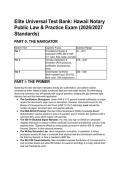
PART 0: THE NAVIGATOR
Section Tiers Cognitive Focus Question Range
Tier 1 Foundational Syntax & Q1 – Q15
Application (HRS 456 & HAR
5-11 rules, fees, seals, journals)
Tier 2 Complex Application & Q16 – Q35
Simulation (RON protocols,
certification discrepancies,
fines)
Tier 3 Grandmaster Synthesis Q36 – Q60
(Multi-variable fraud, SB 2782
deed voids, Title suspensions)
PART I: THE PRIMER
Mastering this elite test bank translates directly into authoritative, zero-defect notarial
competence within Hawaii’s highly scrutinized legal and real estate sectors. By internalizing
these sixty scenarios, you will operate with surgical precision, bridging the gap between rigid
statutory text and fluid real-world application.
● The Certification Divergence: Under HAR 5-11-8, general notarial certificates no longer
require the document's page count or description. However, documents bound for the
Bureau of Conveyances or Land Court (HAR 13-16-7) absolutely must include the
number of pages, document type, and grantee address.
● The KBA 80/120 Protocol: Remote Online Notarization (RON) Knowledge-Based
Authentication requires signers to pass a 5-question quiz (5 choices per question) with a
minimum 80% score within exactly 120 seconds.
● The 456-19 Disabled Signer Mandate: You may only sign on behalf of a physically
disabled individual if a doctor’s written certificate is provided and attached, and you must
explicitly write: "Signature affixed by notary public pursuant to section 456-19, Hawaii
Revised Statutes" in their physical presence.
● The 90-Day Surrender Law: Upon resignation, revocation, or expiration, a notary
possesses exactly 90 days to surrender their physical seal and commission certificate to
the Attorney General, or face a mandatory $200 fine.
● The SB 2782 Fraud Authority: New mandates empower the Bureau of Conveyances to
void recorded deeds and allow title holders to suspend recordings if a notary attests their
seal was fraudulently used.
,Essential Metrics Table
Metric / Requirement Statutory/Administrative Rule Parameter
Physical Seal HAR 5-11-5 / HRS 456-3 Circular, max 2" dia.,
milled/serrated edge, Comm.
No.
Journal Retention HAR 5-11-46 10 years post-last entry
Standard Oath Fee HRS 456-17 $5.00 per party
RON Execution Fee HRS 456-17 $25.00 per act
Status Change Notice HAR 5-11-10.5 30 Days (Address, Name,
Conviction)
PART II: THE ELITE TEST BANK
Q1: A newly commissioned Hawaii notary is ordering their official physical seal. Based on the
statutory requirements of HAR 5-11-5, which seal configuration is MOST ACCURATE? A) A
rectangular rubber stamp containing the notary's name, commission number, and commission
expiration date. B) A circular rubber stamp, not exceeding two inches in diameter, featuring a
milled edge border, the notary's name, commission number, and the words "notary public" and
"State of Hawaii." C) A circular embossing seal that leaves a raised impression of the state coat
of arms and the notary's commission number. D) A circular rubber stamp featuring a smooth
border, the notary's name, and the words "State of Hawaii."
● The Answer: B (A circular rubber stamp, not exceeding two inches in diameter, featuring
a milled edge border, the notary's name, commission number, and the words "notary
public" and "State of Hawaii.")
● Distractor Analysis:
○ A is incorrect: Rectangular stamps are strictly prohibited; seals must be circular,
and the expiration date must not be on the seal itself.
○ C is incorrect: Embossing seals are no longer the standalone standard; a rubber
stamp that can be photographically reproduced is legally required.
○ D is incorrect: The border must be serrated or milled, not smooth, and it is missing
the mandatory commission number.
The Mentor's Analysis: The physical seal is the ultimate instrument of notarial authority. Strict
adherence to dimensional and textual mandates ensures uniformity and prevents photographic
reproduction failures during document recordation. Professional/Academic Intuition: A seal is
invalid without the commission number and a serrated/milled border.
Q2: A notary performs an acknowledgment for a client. When recording the transaction in the
official Notarial Record Book, which entry protocol is MOST APPROPRIATE? A) Recording the
client's social security number to definitively prove identity. B) Noting the date, time, document
type, signer's printed name, address, signature, and the specific method of identification used.
C) Attaching a photocopy of the client's driver's license directly into the journal using staples. D)
Leaving the fee section blank if no fee was charged, rather than entering a zero.
● The Answer: B (Noting the date, time, document type, signer's printed name, address,
signature, and the specific method of identification used.)
● Distractor Analysis:
○ A is incorrect: Recording a social security number violates privacy standards and is
not a statutorily authorized journal entry.
, ○ C is incorrect: Physically stapling ID copies into the softbound journal damages the
book's integrity and violates standard recording practices.
○ D is incorrect: Best practice dictates explicitly writing "No Fee" or "$0.00" to prevent
post-entry tampering.
The Mentor's Analysis: The journal acts as the definitive chronological ledger of a notary's
career. Comprehensive, tamper-evident entries shield the notary against future litigation and
establish an unbreakable chain of evidence. Professional/Academic Intuition: If an entry
parameter does not apply, proactively nullify the space (e.g., "$0.00") rather than leaving
it blank.
Q3: A signer presents a document for notarization, but physically cannot sign or make a mark
due to advanced ALS. Based on HRS 456-19, what is the FIRST prerequisite before the notary
can affix the signer's name? A) The signer must provide a verbal oath witnessed by two family
members. B) The notary must obtain authorization from the Attorney General's office. C) A
written certificate from a doctor must be provided, certifying the physical inability to sign and the
capability to communicate intentions. D) The notary must use a signature stamp provided by the
signer's legal counsel.
● The Answer: C (A written certificate from a doctor must be provided, certifying the
physical inability to sign and the capability to communicate intentions.)
● Distractor Analysis:
○ A is incorrect: Family witnesses do not cure the statutory requirement for
independent medical verification of the disability.
○ B is incorrect: The Attorney General oversees commissions, but does not
micromanage individual disabled-signer authorizations.
○ D is incorrect: A proxy signature stamp is not authorized under HRS 456-19; the
notary must physically write the signature and the mandated statutory phrase.
The Mentor's Analysis: Bypassing a physical signature is a high-risk maneuver. The statute
strictly transfers the burden of verifying communicative competence from the notary to a
licensed medical professional via a written certificate. Professional/Academic Intuition:
Medical certification is the non-negotiable shield when substituting your pen for the
signer's hand.
Q4: A notary’s commission expires, and they decide to retire. According to HAR 5-11, how many
days does the notary have to surrender their physical rubber stamp seal to the Attorney General
to avoid a $200 fine? A) 30 days B) 60 days C) 90 days D) 120 days
● The Answer: C (90 days)
● Distractor Analysis:
○ A is incorrect: 30 days is the timeframe required to report a change of address or
employment, not seal surrender.
○ B is incorrect: 60 days is the standard window prior to expiration to begin the
renewal process.
○ D is incorrect: 120 days exceeds the strict statutory deadline and would trigger
administrative fines under HAR 5-11-46.
The Mentor's Analysis: Abandoned seals are prime vectors for real estate fraud. The 90-day
surrender window ensures official instruments of the state are decommissioned and destroyed
rapidly after authorization lapses. Professional/Academic Intuition: Commission end plus 90
days equals mandatory seal destruction.
Q5: A client requires an oath administered for a general affidavit. According to Hawaii's statutory
fee schedule (HRS 456-17), what is the maximum fee the notary may charge for administering
the oath itself? A) $5.00 B) $10.00 C) $15.00 D) $25.00
Public Law & Practice Exam (2026/2027
Standards)
PART 0: THE NAVIGATOR
Section Tiers Cognitive Focus Question Range
Tier 1 Foundational Syntax & Q1 – Q15
Application (HRS 456 & HAR
5-11 rules, fees, seals, journals)
Tier 2 Complex Application & Q16 – Q35
Simulation (RON protocols,
certification discrepancies,
fines)
Tier 3 Grandmaster Synthesis Q36 – Q60
(Multi-variable fraud, SB 2782
deed voids, Title suspensions)
PART I: THE PRIMER
Mastering this elite test bank translates directly into authoritative, zero-defect notarial
competence within Hawaii’s highly scrutinized legal and real estate sectors. By internalizing
these sixty scenarios, you will operate with surgical precision, bridging the gap between rigid
statutory text and fluid real-world application.
● The Certification Divergence: Under HAR 5-11-8, general notarial certificates no longer
require the document's page count or description. However, documents bound for the
Bureau of Conveyances or Land Court (HAR 13-16-7) absolutely must include the
number of pages, document type, and grantee address.
● The KBA 80/120 Protocol: Remote Online Notarization (RON) Knowledge-Based
Authentication requires signers to pass a 5-question quiz (5 choices per question) with a
minimum 80% score within exactly 120 seconds.
● The 456-19 Disabled Signer Mandate: You may only sign on behalf of a physically
disabled individual if a doctor’s written certificate is provided and attached, and you must
explicitly write: "Signature affixed by notary public pursuant to section 456-19, Hawaii
Revised Statutes" in their physical presence.
● The 90-Day Surrender Law: Upon resignation, revocation, or expiration, a notary
possesses exactly 90 days to surrender their physical seal and commission certificate to
the Attorney General, or face a mandatory $200 fine.
● The SB 2782 Fraud Authority: New mandates empower the Bureau of Conveyances to
void recorded deeds and allow title holders to suspend recordings if a notary attests their
seal was fraudulently used.
,Essential Metrics Table
Metric / Requirement Statutory/Administrative Rule Parameter
Physical Seal HAR 5-11-5 / HRS 456-3 Circular, max 2" dia.,
milled/serrated edge, Comm.
No.
Journal Retention HAR 5-11-46 10 years post-last entry
Standard Oath Fee HRS 456-17 $5.00 per party
RON Execution Fee HRS 456-17 $25.00 per act
Status Change Notice HAR 5-11-10.5 30 Days (Address, Name,
Conviction)
PART II: THE ELITE TEST BANK
Q1: A newly commissioned Hawaii notary is ordering their official physical seal. Based on the
statutory requirements of HAR 5-11-5, which seal configuration is MOST ACCURATE? A) A
rectangular rubber stamp containing the notary's name, commission number, and commission
expiration date. B) A circular rubber stamp, not exceeding two inches in diameter, featuring a
milled edge border, the notary's name, commission number, and the words "notary public" and
"State of Hawaii." C) A circular embossing seal that leaves a raised impression of the state coat
of arms and the notary's commission number. D) A circular rubber stamp featuring a smooth
border, the notary's name, and the words "State of Hawaii."
● The Answer: B (A circular rubber stamp, not exceeding two inches in diameter, featuring
a milled edge border, the notary's name, commission number, and the words "notary
public" and "State of Hawaii.")
● Distractor Analysis:
○ A is incorrect: Rectangular stamps are strictly prohibited; seals must be circular,
and the expiration date must not be on the seal itself.
○ C is incorrect: Embossing seals are no longer the standalone standard; a rubber
stamp that can be photographically reproduced is legally required.
○ D is incorrect: The border must be serrated or milled, not smooth, and it is missing
the mandatory commission number.
The Mentor's Analysis: The physical seal is the ultimate instrument of notarial authority. Strict
adherence to dimensional and textual mandates ensures uniformity and prevents photographic
reproduction failures during document recordation. Professional/Academic Intuition: A seal is
invalid without the commission number and a serrated/milled border.
Q2: A notary performs an acknowledgment for a client. When recording the transaction in the
official Notarial Record Book, which entry protocol is MOST APPROPRIATE? A) Recording the
client's social security number to definitively prove identity. B) Noting the date, time, document
type, signer's printed name, address, signature, and the specific method of identification used.
C) Attaching a photocopy of the client's driver's license directly into the journal using staples. D)
Leaving the fee section blank if no fee was charged, rather than entering a zero.
● The Answer: B (Noting the date, time, document type, signer's printed name, address,
signature, and the specific method of identification used.)
● Distractor Analysis:
○ A is incorrect: Recording a social security number violates privacy standards and is
not a statutorily authorized journal entry.
, ○ C is incorrect: Physically stapling ID copies into the softbound journal damages the
book's integrity and violates standard recording practices.
○ D is incorrect: Best practice dictates explicitly writing "No Fee" or "$0.00" to prevent
post-entry tampering.
The Mentor's Analysis: The journal acts as the definitive chronological ledger of a notary's
career. Comprehensive, tamper-evident entries shield the notary against future litigation and
establish an unbreakable chain of evidence. Professional/Academic Intuition: If an entry
parameter does not apply, proactively nullify the space (e.g., "$0.00") rather than leaving
it blank.
Q3: A signer presents a document for notarization, but physically cannot sign or make a mark
due to advanced ALS. Based on HRS 456-19, what is the FIRST prerequisite before the notary
can affix the signer's name? A) The signer must provide a verbal oath witnessed by two family
members. B) The notary must obtain authorization from the Attorney General's office. C) A
written certificate from a doctor must be provided, certifying the physical inability to sign and the
capability to communicate intentions. D) The notary must use a signature stamp provided by the
signer's legal counsel.
● The Answer: C (A written certificate from a doctor must be provided, certifying the
physical inability to sign and the capability to communicate intentions.)
● Distractor Analysis:
○ A is incorrect: Family witnesses do not cure the statutory requirement for
independent medical verification of the disability.
○ B is incorrect: The Attorney General oversees commissions, but does not
micromanage individual disabled-signer authorizations.
○ D is incorrect: A proxy signature stamp is not authorized under HRS 456-19; the
notary must physically write the signature and the mandated statutory phrase.
The Mentor's Analysis: Bypassing a physical signature is a high-risk maneuver. The statute
strictly transfers the burden of verifying communicative competence from the notary to a
licensed medical professional via a written certificate. Professional/Academic Intuition:
Medical certification is the non-negotiable shield when substituting your pen for the
signer's hand.
Q4: A notary’s commission expires, and they decide to retire. According to HAR 5-11, how many
days does the notary have to surrender their physical rubber stamp seal to the Attorney General
to avoid a $200 fine? A) 30 days B) 60 days C) 90 days D) 120 days
● The Answer: C (90 days)
● Distractor Analysis:
○ A is incorrect: 30 days is the timeframe required to report a change of address or
employment, not seal surrender.
○ B is incorrect: 60 days is the standard window prior to expiration to begin the
renewal process.
○ D is incorrect: 120 days exceeds the strict statutory deadline and would trigger
administrative fines under HAR 5-11-46.
The Mentor's Analysis: Abandoned seals are prime vectors for real estate fraud. The 90-day
surrender window ensures official instruments of the state are decommissioned and destroyed
rapidly after authorization lapses. Professional/Academic Intuition: Commission end plus 90
days equals mandatory seal destruction.
Q5: A client requires an oath administered for a general affidavit. According to Hawaii's statutory
fee schedule (HRS 456-17), what is the maximum fee the notary may charge for administering
the oath itself? A) $5.00 B) $10.00 C) $15.00 D) $25.00


