

Written by students who passed Immediately available after payment Read online or as PDF Wrong document? Swap it for free 4.6 TrustPilot
logo-home
Document preview thumbnail
Preview 2 out of 5 pages
Exam (elaborations)

MPDS (Medical Priority Dispatch System) | 60+ Exam Revision Questions & Verified Answers | Case Entry, Priority Symptoms, Determinant Levels, Dispatch Protocols & Emergency Call Handling | IAED Emergency Medical Dispatcher Certification

Document preview thumbnail
Preview 2 out of 5 pages

Prepare for the Medical Priority Dispatch System (MPDS) certification with this focused exam revision guide containing 60+ verified questions and answers covering the essential concepts required for Emergency Medical Dispatcher (EMD) certification. This resource reviews the core principles of emergency medical dispatch, including Case Entry Rules, Chief Complaint Protocols, Priority Symptoms, Determinant Levels, Dispatch Protocols, Pre-Question Qualifiers (PQQs), caller classifications, scene safety, trauma assessment, emergency medical interrogation, protocol clarification, protocol axioms, emergency response prioritization, CPR guidance, emergency communication techniques, and effective emergency call management. The structured question-and-answer format enables learners to strengthen protocol knowledge while reinforcing the standardized decision-making process used during emergency medical call handling. Designed specifically for candidates preparing for the IAED Emergency Medical Dispatcher (EMD) certification, this revision guide provides concise yet comprehensive coverage of the most frequently tested MPDS concepts. The material emphasizes standardized emergency call processing, accurate protocol compliance, patient assessment, emergency prioritization, and effective communication strategies that improve patient outcomes before emergency responders arrive. It also explores dispatcher responsibilities, emergency call scripting, protocol laws and axioms, caller management techniques, determinant coding, and emergency response sequencing, making it an excellent resource for self-study, dispatcher academy training, classroom revision, continuing professional development, technical interviews, and final certification preparation. The content reflects internationally recognized emergency dispatch practices established by the International Academies of Emergency Dispatch (IAED) and the Medical Priority Dispatch System (MPDS®), which provide the global standard for emergency medical call triage, dispatch prioritization, quality improvement, and pre-arrival medical instruction. The concepts are supported by evidence-based emergency communication practices and internationally accepted prehospital emergency care guidelines, ensuring learners develop the knowledge and confidence required to deliver safe, efficient, and protocol-compliant emergency medical dispatch services. Relevant Students: IAED Emergency Medical Dispatcher (EMD) certification candidates, Emergency Medical Dispatch trainees, 911 Dispatch students, Emergency Communications Officers, Public Safety Telecommunicators, Ambulance Dispatchers, EMS Communications Officers, Fire Dispatchers, Emergency Operations Centre personnel, Paramedic students, Emergency Medical Services students, Healthcare Communications students, Public Safety professionals, Emergency Call Handlers, Communications Supervisors, and professionals preparing for MPDS certification examinations. Keywords: MPDS, Medical Priority Dispatch System, IAED, Emergency Medical Dispatcher, EMD Certification, Emergency Dispatch, Emergency Communications, 911 Dispatcher, Ambulance Dispatch, EMS Dispatch, Public Safety Telecommunicator, Emergency Call Handling, Case Entry, Chief Complaint Protocol, Priority Symptoms, Determinant Levels, Determinant Codes, Dispatch Protocols, Emergency Call Triage, Scene Safety, Trauma Assessment, CPR Instructions, Protocol Compliance, Emergency Response, Caller Management, Pre Question Qualifiers, PQQ, Dispatch Life Support, DLS, Pre Arrival Instructions, PAI, Post Dispatch Instructions, PDI, Emergency Medical Services, Emergency Communications Centre, Protocol Axioms, Practice Questions, Exam Revision, Verified Answers, Certification Preparation.

Content preview

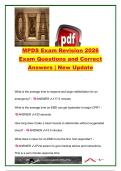
MPDS Exam Revision 2026
Exam Questions and Correct
Answers | New Update


What is the average time to respond and begin defibrillation for an

emergency? - ANSWER ✔✔17.5 minutes


What is the average time an EMD can get bystander to begin CPR? -

ANSWER ✔✔20 seconds


How long does it take a heart muscle to deteriorate without oxygenated

blood? - ANSWER ✔✔4.5 minutes


What does it mean for an EMD to be the first, first responder? -

ANSWER ✔✔First person to give medical advice and instructions.

This is a zero minute response time

, How must you ask every protocol question? - ANSWER ✔✔As

written, unless spontaneously given by caller


What is Deluca's law? - ANSWER ✔✔Follow all protocol avoiding

freelance questions unless it enhances script


What is Frenza's law? - ANSWER ✔✔Something not looked for is

seldom found


What is a freelance instruction? - ANSWER ✔✔Incorrect instructions

or beyond scope of practice


What is a leading question? - ANSWER ✔✔A question which,

because of the way it is phrased, suggests a certain answer.


What is acceptable clarification or enhancements? - ANSWER

✔✔Can rephrase question is caller does not understand phrasing or

gives ambiguous answer


What are PQQ's? - ANSWER ✔✔Pre question qualify: identify

conditional questions


What is a 1st party caller? - ANSWER ✔✔Patient


What is a 2nd party caller? - ANSWER ✔✔With patient


What is a 3rd party caller? - ANSWER ✔✔Not with patient

Document information

Uploaded on
July 12, 2026
Number of pages
5
Written in
2025/2026
Type
Exam (elaborations)
Contains
Questions & answers
$18.99

Wrong document? Swap it for free Within 14 days of purchase and before downloading, you can choose a different document. You can simply spend the amount again.
Written by students who passed
Immediately available after payment
Read online or as PDF

Seller avatar
Reputation scores are based on the amount of documents a seller has sold for a fee and the reviews they have received for those documents. There are three levels: Bronze, Silver and Gold. The better the reputation, the more your can rely on the quality of the sellers work.
PROFFKERRYMARTIN
3.4
(53)
Sold
267
Followers
9
Items
10856
Last sold
1 day ago


Why students choose Stuvia

Created by fellow students, verified by reviews

Quality you can trust: written by students who passed their tests and reviewed by others who've used these notes.

Didn't get what you expected? Choose another document

No worries! You can instantly pick a different document that better fits what you're looking for.

Pay as you like, start learning right away

No subscription, no commitments. Pay the way you're used to via credit card and download your PDF document instantly.

Student with book image

“Bought, downloaded, and aced it. It really can be that simple.”

Alisha Student

Working on your references?

Create accurate citations in APA, MLA and Harvard with our free citation generator.

Working on your references?

Frequently asked questions

