

Chapter 5 Problems 1 – 7 ED 3
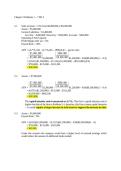
5-1 Sales increase = 15% from $8,000,000 to $9,200,000
Assets = $5,000,000
Current Liabilities = $1,400,000
Acct Pay = $450,000; Notes Pay = $500,000; Accruals = $450,000
Operating at Full Capacity
Profit Margin after tax = 6%
Payout Ratio = 40%
AFN = (A0*/S0) ∆S – (L0*/S0)∆S – (PM)(S1)(1 – payout rate)
(
$ 5 ,000 ,000
) (
$ 900 ,000
)
= $ 8 ,000 ,000 $1,200,000 – $ 8 ,000 ,000 $1,200,000 – 0.06($9,200,000) (1 – 0.4)
= (0.625) ($1,200,000) – (0.1125) ($1,200,000) – ($552,000) (0.6)
= $750,000 – $135,000 – $331,200
= $283,800.
5-2 Assets1 = $7,000,000
(
$ 7 ,000 ,000
) (
$ 900 ,000
)
AFN = $ 8 ,000 ,000 $1,200,000 – $ 8 ,000 ,000 $1,200,000 – 0.06($9,200,000) (1 – 0.4)
= (0.875) ($1,200,000) – $135,000 – $331,200
= $1,050,000 – $466,200
= $583,800.
The capital intensity ratio is measured as A0*/S0. This firm’s capital intensity ratio is
higher than that of the firm in Problem 5-1; therefore, this firm is more capital intensive
—it would require a larger increase in total assets to support the increase in sales.
5-3 Assets = $5,000,000
Payout Ratio = 0%
AFN = (0.625)($1,200,000) – (0.1125)($1,200,000) – 0.06($9,200,000)(1 – 0)
= $750,000 – $135,000 – $552,000
= $63,000.
Under this scenario the company would have a higher level of retained earnings which
would reduce the amount of additional funds needed.
, 5-4 S0 = $5,000,000; A0* = $2,500,000; NP = $300,000; AP = $500,000; Accruals = $200,000;
L0* = (AP + Accruals) = ($500,000 + $200,000) = $700,000; M = 7%; payout ratio = 80%;
A0*/S0 = 0.50; L0*/ S0 = $700,000/$5,000,000 = 0.14.
AFN = (A0*/S0)∆S – (L0*/S0)∆S – (M)(S1)(1 – payout rate)
= (0.50)∆S – (0.14) ∆S – (0.07)(S1)(1 – 0.8)
= (0.50)∆S – (0.14)∆S – (0.014)S1
= (0.36)∆S – (0.014)S1
= 0.36(S1 – S0) – (0.014)S1
= 0.36(S1 – $5,000,000) – (0.014)S1
= 0.36S1 – $1,800,000 – 0.014S1
$1,800,000 = 0.346S1
$5,202,312 = S1.
Sales can increase by $5,202,312 – $5,000,000 = $202,312 without additional funds being
needed.
5-5 Total Assets = $2,170,000
Accts Pay = $560,000
Sales2015 = $3,500,000
Sales2016 = 1.35 x Sales2015
Total Assets and Accts Pay will grow with sales growth
Common Stock2015 = $625,000
Retained Earnings2015 = $395,000
Common Stock2016 = $625,000 + 195,000 = $820,000
Profit Margin ( M) = 5%
Payout Ratio = 45%
Year 2015
Total liab . Accounts Long-term Common Retained
a. and equity = payable + debt + stock + earnings
$2,170,000 = $560,000 + Long-term debt + $625,000 + $395,000
Long-term debt = $590,000.
Total liab. = Accounts payable + Long-term debt
= $560,000 + $590,000 = $1,150,000.
5-1 Sales increase = 15% from $8,000,000 to $9,200,000
Assets = $5,000,000
Current Liabilities = $1,400,000
Acct Pay = $450,000; Notes Pay = $500,000; Accruals = $450,000
Operating at Full Capacity
Profit Margin after tax = 6%
Payout Ratio = 40%
AFN = (A0*/S0) ∆S – (L0*/S0)∆S – (PM)(S1)(1 – payout rate)
(
$ 5 ,000 ,000
) (
$ 900 ,000
)
= $ 8 ,000 ,000 $1,200,000 – $ 8 ,000 ,000 $1,200,000 – 0.06($9,200,000) (1 – 0.4)
= (0.625) ($1,200,000) – (0.1125) ($1,200,000) – ($552,000) (0.6)
= $750,000 – $135,000 – $331,200
= $283,800.
5-2 Assets1 = $7,000,000
(
$ 7 ,000 ,000
) (
$ 900 ,000
)
AFN = $ 8 ,000 ,000 $1,200,000 – $ 8 ,000 ,000 $1,200,000 – 0.06($9,200,000) (1 – 0.4)
= (0.875) ($1,200,000) – $135,000 – $331,200
= $1,050,000 – $466,200
= $583,800.
The capital intensity ratio is measured as A0*/S0. This firm’s capital intensity ratio is
higher than that of the firm in Problem 5-1; therefore, this firm is more capital intensive
—it would require a larger increase in total assets to support the increase in sales.
5-3 Assets = $5,000,000
Payout Ratio = 0%
AFN = (0.625)($1,200,000) – (0.1125)($1,200,000) – 0.06($9,200,000)(1 – 0)
= $750,000 – $135,000 – $552,000
= $63,000.
Under this scenario the company would have a higher level of retained earnings which
would reduce the amount of additional funds needed.
, 5-4 S0 = $5,000,000; A0* = $2,500,000; NP = $300,000; AP = $500,000; Accruals = $200,000;
L0* = (AP + Accruals) = ($500,000 + $200,000) = $700,000; M = 7%; payout ratio = 80%;
A0*/S0 = 0.50; L0*/ S0 = $700,000/$5,000,000 = 0.14.
AFN = (A0*/S0)∆S – (L0*/S0)∆S – (M)(S1)(1 – payout rate)
= (0.50)∆S – (0.14) ∆S – (0.07)(S1)(1 – 0.8)
= (0.50)∆S – (0.14)∆S – (0.014)S1
= (0.36)∆S – (0.014)S1
= 0.36(S1 – S0) – (0.014)S1
= 0.36(S1 – $5,000,000) – (0.014)S1
= 0.36S1 – $1,800,000 – 0.014S1
$1,800,000 = 0.346S1
$5,202,312 = S1.
Sales can increase by $5,202,312 – $5,000,000 = $202,312 without additional funds being
needed.
5-5 Total Assets = $2,170,000
Accts Pay = $560,000
Sales2015 = $3,500,000
Sales2016 = 1.35 x Sales2015
Total Assets and Accts Pay will grow with sales growth
Common Stock2015 = $625,000
Retained Earnings2015 = $395,000
Common Stock2016 = $625,000 + 195,000 = $820,000
Profit Margin ( M) = 5%
Payout Ratio = 45%
Year 2015
Total liab . Accounts Long-term Common Retained
a. and equity = payable + debt + stock + earnings
$2,170,000 = $560,000 + Long-term debt + $625,000 + $395,000
Long-term debt = $590,000.
Total liab. = Accounts payable + Long-term debt
= $560,000 + $590,000 = $1,150,000.


