

Name: BIO 230
Instructor: Dr. Suran
Week 10 Study Questions
1. Define transformation.
Transformation is a type of horizontal gene transfer where cells take up “naked”
DNA from the environment around them. “Naked” DNA is DNA that is free in the
environment, as opposed to DNA that is inside another bacterial cell (transferred
through conjugation) or in a viral particle (transferred through transduction).
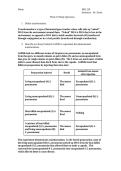
2. Describe (or draw) Frederick Griffith’s experiment that demonstrated
transformation.
Griffith had two different strains of Streptococcus pneumoniae, an encapsulated
form that grew in smooth colonies on petri dishes (S) and an unencapsulated form
that grew in rough colonies on petri dishes (R). The S form was much more virulent
(able to cause disease) than the R form, due to the capsule. Griffith tested four
different preparations by injecting them into mice:
Isolated from mouse
Preparation injected Result
after injection
Living encapsulated (S) S. The mouse Encapsulated (S) S.
pneumoniae died pneumoniae
Living unencapsulated (R) S. The mouse Unencapsulated (R) S.
pneumoniae lived pneumoniae
Heat-killed encapsulated (S) S. The mouse
Nothing
pneumoniae lived
A mixture of heat-killed
encapsulated (S) S. pneumoniae The mouse Encapsulated (S) S.
and living unencapsulated (R) died pneumoniae
S. pneumoniae
This experiment demonstrates transformation. In the fourth preparation, some of
the living unencapsulated (R) S. pneumoniae picked up DNA from the heat-killed
encapsulated (S) S. pneumoniae that allowed them to make a capsule. This
converted the unencapsulated R S. pneumoniae into encapsulated S S. pneumoniae,
which allowed them to cause disease.
, Name: BIO 230
Instructor: Dr. Suran
3. Describe conjugation. In your description, make sure to define F+ cells, F- cells, R
factors, and Hfr cells.
Conjugation occurs when DNA is transferred from one bacterium to another
through a sex pilus. The ability to transfer DNA via conjugation is carried by a
plasmid known as the F factor (Fertility factor).
There are two mating types
F+ cells: Contain the plasmid and are able to initiate mating
F- cells: Lack the plasmid and are unable to initiate mating
Sometimes, the F factor plasmid becomes integrated into the cell genome. These
cells become high frequency of recombination (Hfr) cells. Since the F factor is now
on the chromosome of Hfr cells, parts of the F+ cell chromosome are transferred to
the F- cell.
Plasmids that have significant medical importance are called resistance factors (or
R factors). These R factors carry genes that confer resistance to antibiotics, heavy
metals, or cellular toxins to their host (referred to as R-determinants) in addition to
the genes normally found on the F factor plasmid that are involved in transferring
the plasmid (termed resistance transfer factors or RTFs)
4. Briefly describe transduction.
Transduction is the transfer of DNA from a donor cell to a recipient cell via a phage
(a bacterial virus) intermediary. The simplest form of transduction involves DNA
from one host cell being aberrantly packaged into a viral particle and being
introduced to another host cell by the viral particle via the mechanisms used to
infect cells. The DNA from the first cell can recombine with the chromosome of the
second cell. Once the new DNA is integrated, it will be passed on to the decedents of
the second cell when it divides.
There are other forms of transduction that will be discussed when we discuss
viruses.
5. List one example of a substance that is produced by genetic
engineering.
We use Human Growth Hormone as an example of a protein
produced by genetic engineering, but there are a wide range of
other proteins, including commercially available restriction
enzymes and other enzymes (Taq), insulin, monoclonal
antibodies used for anti-COVID infusions, lactases used to
make lactose-free milk, etc.
Instructor: Dr. Suran
Week 10 Study Questions
1. Define transformation.
Transformation is a type of horizontal gene transfer where cells take up “naked”
DNA from the environment around them. “Naked” DNA is DNA that is free in the
environment, as opposed to DNA that is inside another bacterial cell (transferred
through conjugation) or in a viral particle (transferred through transduction).
2. Describe (or draw) Frederick Griffith’s experiment that demonstrated
transformation.
Griffith had two different strains of Streptococcus pneumoniae, an encapsulated
form that grew in smooth colonies on petri dishes (S) and an unencapsulated form
that grew in rough colonies on petri dishes (R). The S form was much more virulent
(able to cause disease) than the R form, due to the capsule. Griffith tested four
different preparations by injecting them into mice:
Isolated from mouse
Preparation injected Result
after injection
Living encapsulated (S) S. The mouse Encapsulated (S) S.
pneumoniae died pneumoniae
Living unencapsulated (R) S. The mouse Unencapsulated (R) S.
pneumoniae lived pneumoniae
Heat-killed encapsulated (S) S. The mouse
Nothing
pneumoniae lived
A mixture of heat-killed
encapsulated (S) S. pneumoniae The mouse Encapsulated (S) S.
and living unencapsulated (R) died pneumoniae
S. pneumoniae
This experiment demonstrates transformation. In the fourth preparation, some of
the living unencapsulated (R) S. pneumoniae picked up DNA from the heat-killed
encapsulated (S) S. pneumoniae that allowed them to make a capsule. This
converted the unencapsulated R S. pneumoniae into encapsulated S S. pneumoniae,
which allowed them to cause disease.
, Name: BIO 230
Instructor: Dr. Suran
3. Describe conjugation. In your description, make sure to define F+ cells, F- cells, R
factors, and Hfr cells.
Conjugation occurs when DNA is transferred from one bacterium to another
through a sex pilus. The ability to transfer DNA via conjugation is carried by a
plasmid known as the F factor (Fertility factor).
There are two mating types
F+ cells: Contain the plasmid and are able to initiate mating
F- cells: Lack the plasmid and are unable to initiate mating
Sometimes, the F factor plasmid becomes integrated into the cell genome. These
cells become high frequency of recombination (Hfr) cells. Since the F factor is now
on the chromosome of Hfr cells, parts of the F+ cell chromosome are transferred to
the F- cell.
Plasmids that have significant medical importance are called resistance factors (or
R factors). These R factors carry genes that confer resistance to antibiotics, heavy
metals, or cellular toxins to their host (referred to as R-determinants) in addition to
the genes normally found on the F factor plasmid that are involved in transferring
the plasmid (termed resistance transfer factors or RTFs)
4. Briefly describe transduction.
Transduction is the transfer of DNA from a donor cell to a recipient cell via a phage
(a bacterial virus) intermediary. The simplest form of transduction involves DNA
from one host cell being aberrantly packaged into a viral particle and being
introduced to another host cell by the viral particle via the mechanisms used to
infect cells. The DNA from the first cell can recombine with the chromosome of the
second cell. Once the new DNA is integrated, it will be passed on to the decedents of
the second cell when it divides.
There are other forms of transduction that will be discussed when we discuss
viruses.
5. List one example of a substance that is produced by genetic
engineering.
We use Human Growth Hormone as an example of a protein
produced by genetic engineering, but there are a wide range of
other proteins, including commercially available restriction
enzymes and other enzymes (Taq), insulin, monoclonal
antibodies used for anti-COVID infusions, lactases used to
make lactose-free milk, etc.


