CIPS L4M1 (Latest 2026/2027
Update) 100% Actual Exam
Questions & Answers | Grade A
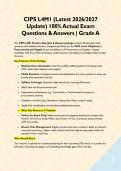
This CIPS L4M1 Practice Question & Answer package contains 50 past exam-style
questions with detailed solutions. Designed specifically for the CIPS Level 4 Diploma in
Procurement and Supply (Scope and Influence of Procurement and Supply), it equips
candidates with the written techniques, model answers, and syllabus knowledge needed to pass
the exam.
Key Features of the Package
• Realistic Exam Simulation: Over 50 carefully crafted questions mimicking actual
CIPS constructed-response exam papers.
• Model Solutions: Complete answers and explanations for every question to show you
exactly what examiners look for.
• Syllabus Coverage: Questions align with all core Learning Outcomes:
• Added value and the procurement cycle.
• Organizational infrastructure (e.g., Centralized vs. Decentralized structures, e-
procurement systems).
• Compliance and ethics (e.g., Mendelow’s Stakeholder Matrix, ethical codes).
• Supply chain classifications and primary/secondary/tertiary sectors.
• Why This Resource Is Valuable
• Perfect for Exam Prep: Helps learners practice applying theoretical concepts (like
Porter's Five Forces, Kraljic Matrix, and Carter's 10 Cs) to practical, scenario-based
CIPS case studies.
• Boosts Time Management: Regular practice improves a student's ability to interpret
command words (e.g., explain, outline, discuss) and write high-scoring essays within the
standard 3-hour exam limit.
Who Should Buy It
This material is essential for students preparing for their upcoming CIPS exams. It is perfect for
self-study, reviewing past papers, and identifying knowledge gaps before test day.
1
, Quiz_________________?
O1. Outline FIVE differences between purchasing goods and purchasing services. -
Answer
1. Goods are tangible, services are intangible:
2. Services cannot be separated from their supplier:
3. Heterogeneity: goods are usually uniform in nature while services are unique at each delivery
4. Services 'perish' immediately on delivery whereas goods can be stored until required
5. Products are easier to specify, being tangible
Quiz_________________?
O2. Explain THREE circumstances in which a competitive tendering exercise might not be the
best approach to making a purchase. -
Answer
1. Urgency
2. Commercial confidentiality or national security (e.g. military organisations):
3. Value of the purchase:
4. Production costs cannot be measured accurately:
5. Price is not the only criterion for supplier selection and contract award
6. Intellectual Property Rights and monopoly
Quiz_________________?
O2. Describe TWO e-sourcing tools and their use in procurement and supply. -
Answer
1. E-Catalogues
2. E-Tendering
3. E. Auction
2
, 4. Reverse Auctions
5. Online suppleir evaluation data
Quiz_________________?
O3. Explain the role of a shared services unit (SSU). -
Answer
SSUs reflect a desire to centralise and share services
The shared service provider becomes a dedicated provider of services such as; finance, HR, IT
and procurement which continue to be provided internally
An SSU manages costs and quality SLAs to demonstrate value for money.
An SSU's benefits may be summarised as:
• cost effective internal service;
• liaison with its customers;
• anticipating future demand;
• employing resources and providing higher levels of service more cost effectively than if they
were provided by a department or an external provider.
Quiz_________________?
O3. A manufacturer of electrically powered tools for the engineering industry consists of four
separate business units, each of which undertakes its own purchasing activities.
Discuss THREE benefits of centralising all purchasing activities with those of retaining the
present decentralised structure. (1 of 2) -
Answer
Centralisation' and 'decentralisation' refer to the degree to which responsibility and authority is
delegated. Arguments for centralisation can only be evaluated in the context of specific
organisational environment and might include:
3
Update) 100% Actual Exam
Questions & Answers | Grade A
This CIPS L4M1 Practice Question & Answer package contains 50 past exam-style
questions with detailed solutions. Designed specifically for the CIPS Level 4 Diploma in
Procurement and Supply (Scope and Influence of Procurement and Supply), it equips
candidates with the written techniques, model answers, and syllabus knowledge needed to pass
the exam.
Key Features of the Package
• Realistic Exam Simulation: Over 50 carefully crafted questions mimicking actual
CIPS constructed-response exam papers.
• Model Solutions: Complete answers and explanations for every question to show you
exactly what examiners look for.
• Syllabus Coverage: Questions align with all core Learning Outcomes:
• Added value and the procurement cycle.
• Organizational infrastructure (e.g., Centralized vs. Decentralized structures, e-
procurement systems).
• Compliance and ethics (e.g., Mendelow’s Stakeholder Matrix, ethical codes).
• Supply chain classifications and primary/secondary/tertiary sectors.
• Why This Resource Is Valuable
• Perfect for Exam Prep: Helps learners practice applying theoretical concepts (like
Porter's Five Forces, Kraljic Matrix, and Carter's 10 Cs) to practical, scenario-based
CIPS case studies.
• Boosts Time Management: Regular practice improves a student's ability to interpret
command words (e.g., explain, outline, discuss) and write high-scoring essays within the
standard 3-hour exam limit.
Who Should Buy It
This material is essential for students preparing for their upcoming CIPS exams. It is perfect for
self-study, reviewing past papers, and identifying knowledge gaps before test day.
1
, Quiz_________________?
O1. Outline FIVE differences between purchasing goods and purchasing services. -
Answer
1. Goods are tangible, services are intangible:
2. Services cannot be separated from their supplier:
3. Heterogeneity: goods are usually uniform in nature while services are unique at each delivery
4. Services 'perish' immediately on delivery whereas goods can be stored until required
5. Products are easier to specify, being tangible
Quiz_________________?
O2. Explain THREE circumstances in which a competitive tendering exercise might not be the
best approach to making a purchase. -
Answer
1. Urgency
2. Commercial confidentiality or national security (e.g. military organisations):
3. Value of the purchase:
4. Production costs cannot be measured accurately:
5. Price is not the only criterion for supplier selection and contract award
6. Intellectual Property Rights and monopoly
Quiz_________________?
O2. Describe TWO e-sourcing tools and their use in procurement and supply. -
Answer
1. E-Catalogues
2. E-Tendering
3. E. Auction
2
, 4. Reverse Auctions
5. Online suppleir evaluation data
Quiz_________________?
O3. Explain the role of a shared services unit (SSU). -
Answer
SSUs reflect a desire to centralise and share services
The shared service provider becomes a dedicated provider of services such as; finance, HR, IT
and procurement which continue to be provided internally
An SSU manages costs and quality SLAs to demonstrate value for money.
An SSU's benefits may be summarised as:
• cost effective internal service;
• liaison with its customers;
• anticipating future demand;
• employing resources and providing higher levels of service more cost effectively than if they
were provided by a department or an external provider.
Quiz_________________?
O3. A manufacturer of electrically powered tools for the engineering industry consists of four
separate business units, each of which undertakes its own purchasing activities.
Discuss THREE benefits of centralising all purchasing activities with those of retaining the
present decentralised structure. (1 of 2) -
Answer
Centralisation' and 'decentralisation' refer to the degree to which responsibility and authority is
delegated. Arguments for centralisation can only be evaluated in the context of specific
organisational environment and might include:
3