

Written by students who passed Immediately available after payment Read online or as PDF Wrong document? Swap it for free 4.6 TrustPilot
logo-home
Document preview thumbnail
Preview 3 out of 25 pages
Exam (elaborations)

FCCS Review and Pretest 2026 Exam Questions and Answers | 90+ Practice Questions | Shock, Sepsis, Mechanical Ventilation, Airway Management, ACLS & Critical Care | Society of Critical Care Medicine (SCCM) FCCS

Document preview thumbnail
Preview 3 out of 25 pages

This comprehensive study guide contains 90+ FCCS (Fundamental Critical Care Support) Review and Pretest exam questions with expertly verified answers, providing complete preparation for the Society of Critical Care Medicine (SCCM) Fundamental Critical Care Support (FCCS) Certification Course. The resource covers the core principles of critical care medicine, including airway assessment and management, rapid sequence intubation (RSI), difficult airway algorithms, oxygenation and ventilation, mechanical ventilation, ventilator settings, positive end-expiratory pressure (PEEP), auto-PEEP, plateau pressure, non-invasive positive pressure ventilation (NPPV), respiratory failure, arterial blood gas (ABG) interpretation, shock recognition and classification, septic shock, hypovolemic shock, cardiogenic shock, obstructive shock, trauma resuscitation, FAST examination, burn management, cardiac arrest, cardiopulmonary resuscitation (CPR), ACLS principles, STEMI and NSTEMI management, targeted temperature management (TTM), electrolyte disorders, diabetic ketoacidosis (DKA), hyperkalemia, hyponatremia, acute stroke, traumatic brain injury (TBI), increased intracranial pressure (ICP), aortic dissection, pulmonary edema, sepsis management, vasoactive medications, and evidence-based intensive care interventions. Organized in a realistic exam-style question-and-answer format, this guide strengthens clinical reasoning and reinforces the high-yield concepts most frequently assessed on FCCS certification examinations. Designed to simulate the format and difficulty of the official FCCS examination, this review resource enables learners to apply critical care knowledge through practical clinical scenarios involving emergency stabilization, airway emergencies, ventilator troubleshooting, cardiovascular collapse, trauma, neurologic emergencies, infectious diseases, and intensive care management. Candidates develop confidence in recognizing life-threatening conditions, selecting appropriate diagnostic and therapeutic interventions, interpreting hemodynamic and laboratory data, and applying current evidence-based critical care guidelines. This study guide serves as a valuable revision resource for physicians, residents, advanced practice providers, critical care nurses, emergency clinicians, respiratory therapists, paramedics, and healthcare professionals preparing for FCCS certification or advanced critical care examinations. The content aligns with the educational objectives of the Society of Critical Care Medicine (SCCM) FCCS Course and is supported by authoritative evidence-based references, including the FCCS Course Manual, the Surviving Sepsis Campaign: International Guidelines for Management of Sepsis and Septic Shock, the American Heart Association (AHA) Advanced Cardiovascular Life Support (ACLS) Guidelines, Marino's The ICU Book, Goldman-Cecil Medicine, Tintinalli's Emergency Medicine: A Comprehensive Study Guide, Rosen's Emergency Medicine: Concepts and Clinical Practice, and the Global Initiative for Chronic Obstructive Lung Disease (GOLD) Report. These internationally recognized resources establish the clinical standards and competencies evaluated during FCCS certification and modern critical care practice. Recommended for Students: FCCS certification candidates, Society of Critical Care Medicine (SCCM) course participants, Critical Care Medicine fellows, Emergency Medicine residents, Internal Medicine residents, Pulmonary and Critical Care fellows, Anesthesiology residents, Intensive Care Unit (ICU) nurses, Emergency Department nurses, Nurse Practitioner (NP) students, Physician Assistant (PA) students, Respiratory Therapy students, Trauma Surgery residents, Acute Care Surgery fellows, Paramedics, Critical Care Transport clinicians, Medical students completing critical care rotations, and healthcare professionals preparing for FCCS, ACLS, critical care, emergency medicine, ICU, and board certification examinations. References Society of Critical Care Medicine. (2024). Fundamental Critical Care Support (FCCS) Course Manual. Evans, L., Rhodes, A., Alhazzani, W., et al. (2021). Surviving Sepsis Campaign: International Guidelines for Management of Sepsis and Septic Shock 2021. Critical Care Medicine. American Heart Association. (2020). Advanced Cardiovascular Life Support (ACLS) Provider Manual. Marino, P. L. (2024). The ICU Book (5th ed.). Wolters Kluwer. Goldman, L., & Schafer, A. I. (2024). Goldman-Cecil Medicine (27th ed.). Elsevier. Tintinalli, J. E., et al. (2024). Tintinalli's Emergency Medicine: A Comprehensive Study Guide (10th ed.). McGraw-Hill. Walls, R. M., Hockberger, R. S., & Gausche-Hill, M. (2023). Rosen's Emergency Medicine: Concepts and Clinical Practice (10th ed.). Elsevier. Global Initiative for Chronic Obstructive Lung Disease. (2024). Global Strategy for the Diagnosis, Management, and Prevention of Chronic Obstructive Pulmonary Disease (GOLD Report). Keywords FCCS, Fundamental Critical Care Support, SCCM, FCCS Review, FCCS Pretest, FCCS Practice Questions, Critical Care Medicine, Intensive Care Unit, ICU, Emergency Medicine, Mechanical Ventilation, Ventilator Management, Airway Management, Rapid Sequence Intubation, RSI, Respiratory Failure, Non Invasive Ventilation, BiPAP, CPAP, Auto PEEP, Plateau Pressure, PEEP, Arterial Blood Gas, ABG Interpretation, Shock, Septic Shock, Cardiogenic Shock, Hypovolemic Shock, Obstructive Shock, Trauma Resuscitation, FAST Exam, Burn Management, CPR, ACLS, Cardiac Arrest, STEMI, NSTEMI, Targeted Temperature Management, TTM, Sepsis, Hyperkalemia, Hyponatremia, DKA, Stroke, Traumatic Brain Injury, Increased Intracranial Pressure, ICP, Aortic Dissection, Pulmonary Edema, Vasoactive Medications, Critical Care Certification, ICU Board Review, Emergency Medicine Board Review, FCCS Study Guide

Content preview

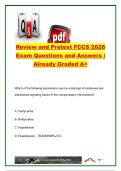
Review and Pretest FCCS 2026
Exam Questions and Answers |
Already Graded A+


Which of the following parameters may be a late sign of cardiovascular

disturbance signaling failure of the compensatory mechanisms?


A. Tachycardia

B. Bradycardia

C. Hypotension


D. Hypertension - ANSWER ✔✔C

,Investigative tests should be based on the patient's history and physical

examination as well as on previous tests. Which of the following is one

of the most important indicators of critical illness?


A. Respiratory acidosis

B. Metabolic acidosis

C. Elevated creatinine


D. Hyponatremia - ANSWER ✔✔B


A 22-year-old man is brought to the emergency room after falling from a

horse. He is awaiting transfer to another facility. He has a chest

contusion and a non-displaced femur fracture. He is in spinal motion

restriction with a cervical collar and long backboard. He has worsening

respiratory distress and hypoxemia requiring endotracheal intubation.

Which of the following modifications of the manual assisted ventilation

technique is appropriate?


A. Place an oral airway one size larger than usual.

B. Add additional downward pressure on the face mask once it is sealed.

C. Use a jaw thrust technique in place of neck extension.

, D. Increase the tidal volume with each manual assisted breath. -

ANSWER ✔✔C


Which of the following anatomic features is most likely to contribute to

difficulty in maintaining a patent airway in a supine patient?


A. Edentulous mandible

B. Posteriorly displaced tongue

C. Deviated nasal septum


D. Anteriorly displaced thyroid cartilage - ANSWER ✔✔B


An elderly patient is on the medical ward for respiratory distress. Which

of the following is correct regarding airway assessment?


A. Laryngeal displacement toward the chest during inspiration occurs

only with upper airway obstruction

B. Chest rise with inspiration indicates an adequate tidal volume

C. Unilateral absent breath sounds on auscultation is a tension

pneumothorax


COPYRIGHT©PROFFKERRYMARTIN 2025/2026. YEAR PUBLISHED 2026. COMPANY REGISTRATION NUMBER: 619652435. TERMS OF USE.
PRIVACY STATEMENT. ALL RIGHTS RESERVED


Document information

Uploaded on
July 11, 2026
Number of pages
25
Written in
2025/2026
Type
Exam (elaborations)
Contains
Questions & answers
$18.99

Wrong document? Swap it for free Within 14 days of purchase and before downloading, you can choose a different document. You can simply spend the amount again.
Written by students who passed
Immediately available after payment
Read online or as PDF

Seller avatar
Reputation scores are based on the amount of documents a seller has sold for a fee and the reviews they have received for those documents. There are three levels: Bronze, Silver and Gold. The better the reputation, the more your can rely on the quality of the sellers work.
PROFFKERRYMARTIN
3.3
(55)
Sold
281
Followers
9
Items
11103
Last sold
14 hours ago


Why students choose Stuvia

Created by fellow students, verified by reviews

Quality you can trust: written by students who passed their tests and reviewed by others who've used these notes.

Didn't get what you expected? Choose another document

No worries! You can instantly pick a different document that better fits what you're looking for.

Pay as you like, start learning right away

No subscription, no commitments. Pay the way you're used to via credit card and download your PDF document instantly.

Student with book image

“Bought, downloaded, and aced it. It really can be that simple.”

Alisha Student

Working on your references?

Create accurate citations in APA, MLA and Harvard with our free citation generator.

Working on your references?

Frequently asked questions
