

Written by students who passed Immediately available after payment Read online or as PDF Wrong document? Swap it for free 4.6 TrustPilot
logo-home
Document preview thumbnail
Preview 2 out of 11 pages
Exam (elaborations)

NS 1410 Exam 1 Part 2 2026 Exam Questions and Answers | 200+ Practice Questions | Digestion, Carbohydrates, GI Physiology, Diabetes, Fiber & Nutrient Absorption | NS 1410 Human Nutrition

Document preview thumbnail
Preview 2 out of 11 pages

This comprehensive study guide contains 200+ NS 1410 Exam 1 Part 2 practice questions and expertly verified answers, providing targeted preparation for NS 1410 Human Nutrition examinations. The resource focuses on the physiological and biochemical foundations of nutrition, covering appetite regulation, hunger and satiety, gastrointestinal (GI) anatomy and physiology, digestion and absorption, mechanical and chemical digestion, digestive enzymes, gastrointestinal hormones (gastrin, secretin, cholecystokinin, and gastric inhibitory peptide), peristalsis, segmentation, nutrient transport, carbohydrate digestion and metabolism, monosaccharides, disaccharides, polysaccharides, glycemic index, glycemic load, glycogen storage, blood glucose regulation, insulin and glucagon, diabetes mellitus (Type 1, Type 2, and gestational diabetes), dietary fiber, lactose intolerance, gastrointestinal disorders, nutrient absorption mechanisms, and digestive health. The exam-style question-and-answer format strengthens conceptual understanding while helping students prepare confidently for quizzes, midterm examinations, and comprehensive final assessments. Designed to mirror the structure and difficulty of undergraduate nutrition examinations, this study guide reinforces essential concepts through realistic review questions covering digestive physiology, carbohydrate metabolism, endocrine regulation, nutrient transport, gastrointestinal disorders, energy metabolism, and evidence-based dietary recommendations. Students develop a solid understanding of the processes involved in nutrient digestion, absorption, transport, and utilization while learning the physiological mechanisms that maintain glucose homeostasis and digestive health. This resource serves as a comprehensive revision tool for students enrolled in nutrition, nursing, health sciences, dietetics, exercise science, public health, and other allied health programs. The content aligns with learning objectives commonly used in introductory nutrition and human physiology courses and is supported by authoritative references, including the Dietary Reference Intakes (DRIs) published by the National Academies of Sciences, Engineering, and Medicine, the Dietary Guidelines for Americans, 2020–2025, the Academy of Nutrition and Dietetics Nutrition Care Manual, Krause's Food & the Nutrition Care Process, Wardlaw's Perspectives in Nutrition, Understanding Nutrition by Whitney and Rolfes, Modern Nutrition in Health and Disease, and the American Diabetes Association Standards of Care in Diabetes. These evidence-based resources provide the scientific foundation for nutrition education and the topics commonly assessed in NS 1410 and related undergraduate nutrition courses. Recommended for Students: NS 1410 Human Nutrition students Introduction to Nutrition students Human Nutrition students Nursing students Pre-Nursing students Dietetics and Nutrition students Public Health students Exercise Science students Kinesiology students Health Science students Allied Health students Pre-Medical students Physician Assistant students Occupational Therapy students Students preparing for NS 1410 Exam 1, midterm examinations, and final exams References National Academies of Sciences, Engineering, and Medicine. (2020). Dietary Reference Intakes (DRIs). U.S. Department of Agriculture & U.S. Department of Health and Human Services. (2020). Dietary Guidelines for Americans, 2020–2025 (9th ed.). Academy of Nutrition and Dietetics. (2024). Nutrition Care Manual. Lacey, K., & Pritchett, E. (2023). Krause's Food & the Nutrition Care Process (16th ed.). Elsevier. Byrd-Bredbenner, C., Moe, G., Beshgetoor, D., & Berning, J. (2024). Wardlaw's Perspectives in Nutrition (12th ed.). McGraw-Hill. Whitney, E., & Rolfes, S. R. (2023). Understanding Nutrition (16th ed.). Cengage Learning. Ross, A. C., Caballero, B., Cousins, R. J., Tucker, K. L., & Ziegler, T. R. (2020). Modern Nutrition in Health and Disease (12th ed.). Wolters Kluwer. American Diabetes Association Professional Practice Committee. (2024). Standards of Care in Diabetes—2024. Diabetes Care. Keywords NS 1410, NS 1410 Exam 1, Human Nutrition, Nutrition Exam Questions, Digestion, Gastrointestinal System, GI Physiology, Appetite, Hunger, Satiety, Peristalsis, Segmentation, Chyme, Digestive Enzymes, Gastrin, Secretin, Cholecystokinin, Gastric Inhibitory Peptide, Digestion and Absorption, Nutrient Absorption, Active Transport, Passive Diffusion, Facilitated Diffusion, Carbohydrates, Carbohydrate Metabolism, Monosaccharides, Disaccharides, Polysaccharides, Glycogen, Glycemic Index, Glycemic Load, Blood Glucose, Insulin, Glucagon, Diabetes Mellitus, Type 1 Diabetes, Type 2 Diabetes, Gestational Diabetes, Lactose Intolerance, Dietary Fiber, Soluble Fiber, Insoluble Fiber, Gastrointestinal Disorders, GERD, Constipation, Diarrhea, Nutrition Study Guide, College Nutrition Exam, Final Exam Review

Content preview

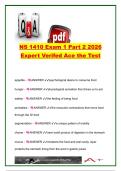
NS 1410 Exam 1 Part 2 2026
Expert Verifed Ace the Test


appetite - ANSWER ✔✔psychological desire to consume food


hunger - ANSWER ✔✔physiological sensation that drives us to eat


satiety - ANSWER ✔✔the feeling of being food


peristalsis - ANSWER ✔✔the muscular contractions that move food

through the GI tract


segmentation - ANSWER ✔✔a unique pattern of motility


chyme - ANSWER ✔✔semi solid product of digestion in the stomach


mucus - ANSWER ✔✔moistens the food and oral cavity, layer

protects the stomach lining from the acid in gastric juices

, sphincter muscles - ANSWER ✔✔muscles that control the passage

of food material from one organ to the next


primary site for absorption of nutrients - ANSWER ✔✔small intestine


what allows the small intestine greater surface area - ANSWER

✔✔villi/ microvilli


mechanical digestion - ANSWER ✔✔physical breakdown of food

(chewing, mixing, squeezing)


where does mechanical digestion occur - ANSWER ✔✔mouth,

stomach


chemical digestion - ANSWER ✔✔enzymes break down food into

smaller molecules


where does chemical digestion occur - ANSWER ✔✔mouth,

stomach, small intestine


role of vascular system - ANSWER ✔✔blood circulatory system or

bloodstream, heart serves as the pump, transports water soluble

nutrients

Document information

Uploaded on
July 11, 2026
Number of pages
11
Written in
2025/2026
Type
Exam (elaborations)
Contains
Questions & answers
$18.99

Wrong document? Swap it for free Within 14 days of purchase and before downloading, you can choose a different document. You can simply spend the amount again.
Written by students who passed
Immediately available after payment
Read online or as PDF

Seller avatar
Reputation scores are based on the amount of documents a seller has sold for a fee and the reviews they have received for those documents. There are three levels: Bronze, Silver and Gold. The better the reputation, the more your can rely on the quality of the sellers work.
PROFFKERRYMARTIN
3.3
(55)
Sold
278
Followers
9
Items
11092
Last sold
1 day ago


Why students choose Stuvia

Created by fellow students, verified by reviews

Quality you can trust: written by students who passed their tests and reviewed by others who've used these notes.

Didn't get what you expected? Choose another document

No worries! You can instantly pick a different document that better fits what you're looking for.

Pay as you like, start learning right away

No subscription, no commitments. Pay the way you're used to via credit card and download your PDF document instantly.

Student with book image

“Bought, downloaded, and aced it. It really can be that simple.”

Alisha Student

Working on your references?

Create accurate citations in APA, MLA and Harvard with our free citation generator.

Working on your references?

Frequently asked questions

