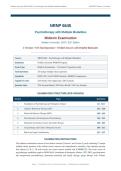
Walden University NRNP 6645 | Psychotherapy with Multiple Modalities Midterm 2026/2027 Edition | 2 Versions
NRNP 6645
Psychotherapy with Multiple Modalities
Midterm Examination
Walden University | Edition
2 Versions • 150 Total Questions • Verified Answers with Detailed Rationales
Course: NRNP 6645 - Psychotherapy with Multiple Modalities
Institution: Walden University PMHNP Program
Exam Type: Midterm Examination - 2 Versions (75 questions each)
Total Questions: 150 unique multiple choice questions
Standards: DSM-5-TR | AACN DNP Essentials | PMHNP Competencies
Cognitive Levels: 25% Recall | 55% Application | 20% Analysis
Question Style: 70% Scenario-Based | 20% Direct Recall | 10% Case Analysis
EXAMINATION STRUCTURE (PER VERSION)
Section Topic Questions
1 Foundations of Psychotherapy and Therapeutic Alliance Q1 - Q12
2 Cognitive Behavioral Therapy (CBT) Q13 - Q28
3 Dialectical Behavior Therapy (DBT) Q29 - Q42
4 Psychodynamic and Interpersonal Psychotherapy Q43 - Q55
5 Humanistic-Existential, Gestalt, and Family Therapy Q56 - Q65
6 Group Therapy and Yalom's Therapeutic Factors Q66 - Q72
7 Ethical and Legal Considerations Q73 - Q75
EXAMINATION INSTRUCTIONS
This midterm examination consists of two distinct versions (Version 1 and Version 2), each containing 75 unique
multiple-choice questions with verified correct answers and comprehensive rationales. Each question presents
four options (A, B, C, D) with exactly one correct answer marked with [CORRECT]. The exam covers all
psychotherapy modalities taught in NRNP 6645: foundations of therapeutic alliance, CBT, DBT, psychodynamic
and interpersonal psychotherapy, humanistic-existential and family therapy, group therapy with Yalom's
Page 1 | 150 Questions Across 2 Versions (75 each) | Verified Answers with Rationales
,Walden University NRNP 6645 | Psychotherapy with Multiple Modalities Midterm 2026/2027 Edition | 2 Versions
therapeutic factors, and ethical/legal considerations. Integration of DSM-5-TR criteria, AACN DNP Essentials,
and PMHNP certification competencies is reflected throughout.
Page 2 | 150 Questions Across 2 Versions (75 each) | Verified Answers with Rationales
,Walden University NRNP 6645 | Psychotherapy with Multiple Modalities Midterm 2026/2027 Edition | 2 Versions
VERSION 1
75 Questions | A Form
Section 1: Foundations of Psychotherapy and Therapeutic Alliance
Therapeutic Frame, Alliance, Phases of Therapy, Benner's Model (Q1-Q12)
Q1: A PMHNP establishes a new therapeutic relationship with a 34-year-old patient. The patient frequently
asks the NP personal questions about marital status, religion, and political views. Which component of the
therapeutic frame is most directly involved, and what is the appropriate response?
A. Non-intrusiveness; the NP should disclose personal information to build trust
B. Anonymity; the NP should maintain neutrality, gently redirecting the focus back to the patient's experience
and therapeutic goals [CORRECT]
C. Empathy; the NP should answer all questions to demonstrate warmth
D. Collaboration; the NP and patient should negotiate what personal information is shared
Correct Answer: B
Rationale: Anonymity is a core component of the therapeutic frame that requires the therapist to maintain neutrality and avoid
self-disclosure that could compromise the therapeutic relationship. The PMHNP should gently redirect personal questions back
to the patient's experience, as the therapy should focus on the patient, not the clinician. Excessive self-disclosure can blur
boundaries, introduce transference complications, and shift focus away from the patient's needs. Non-intrusiveness refers to
allowing the patient to lead content, while empathy and collaboration are alliance components but do not justify personal
disclosure.
Q2: During the working phase of therapy, a patient with major depressive disorder states, "I don't think
talking is helping. I want to just stop coming." What is the most therapeutic response that demonstrates active
listening and maintains the alliance?
A. "I understand your frustration. Let's explore what specifically feels unhelpful so we can adjust our
approach together." [CORRECT]
B. "If you stop therapy now, your depression will likely worsen, and you may need hospitalization."
C. "You have the right to stop therapy at any time. I'll send a termination summary to your PCP."
D. "Therapy takes time. Most patients see improvement after 12-16 sessions."
Correct Answer: A
Rationale: Active listening and collaboration in the working phase require acknowledging the patient's frustration, validating
their experience, and inviting joint exploration of barriers to progress. This response maintains the alliance by treating the
patient's concern as meaningful therapeutic data rather than resistance to be dismissed. Option B uses fear-based coercion that
violates neutrality. Option C abandons the alliance prematurely without exploring the statement's meaning. Option D is
dismissive and generic, failing to address the patient's specific experience. The working phase requires navigating ruptures in the
alliance as opportunities for therapeutic growth.
Page 3 | 150 Questions Across 2 Versions (75 each) | Verified Answers with Rationales
, Walden University NRNP 6645 | Psychotherapy with Multiple Modalities Midterm 2026/2027 Edition | 2 Versions
Q3: According to Benner's role acquisition model, a PMHNP student in their first clinical practicum who
relies heavily on supervision, follows treatment protocols step-by-step, and has not yet developed intuitive
grasp of clinical situations is at which stage?
A. Advanced beginner
B. Competent
C. Novice [CORRECT]
D. Proficient
Correct Answer: C
Rationale: Benner's novice stage is characterized by reliance on rules, protocols, and supervision because the clinician lacks
experiential learning to guide intuitive decision-making. Novices follow instructions literally and cannot yet recognize
contextual nuances. The advanced beginner (A) has some experience and can recognize recurring meaningful situational
components. The competent stage (B) involves conscious deliberate planning with emotional investment. The proficient stage
(D) demonstrates holistic understanding and intuitive grasp. Benner's model, originally for nursing, applies to PMHNP role
development in psychotherapy competency acquisition.
Q4: A patient with borderline personality disorder frequently calls the PMHNP between sessions with
escalating crises, demanding immediate callbacks. Which therapeutic frame principle is most relevant to
address this behavior?
A. Anonymity
B. Non-intrusiveness and neutrality [CORRECT]
C. Empathy
D. Genuineness
Correct Answer: B
Rationale: Non-intrusiveness and neutrality require the PMHNP to establish and maintain clear boundaries around availability,
response times, and the structure of therapy. Frequent between-session contact with escalating demands reflects boundary
testing common in BPD, and failing to address it reinforces maladaptive patterns. The PMHNP should collaboratively establish
a clear contact policy, discuss it in session, and consistently maintain it. Anonymity (A) concerns self-disclosure. While
empathy (C) and genuineness (D) are important therapist qualities, they do not substitute for structural boundaries that contain
the therapeutic frame.
Q5: A PMHNP is treating a patient from a different cultural background who views mental illness as spiritual
in origin. The patient's family suggests consulting a traditional healer. Applying a psychosocial framework
rather than a biomedical model, what is the most appropriate approach?
A. Explain that biomedical treatment is superior and discourage traditional healing
B. Collaborate with the patient and family, integrating their spiritual framework into the treatment plan while
providing psychoeducation about evidence-based options [CORRECT]
C. Refer the patient exclusively to the traditional healer since their beliefs take priority
D. Insist on DSM-5-TR diagnostic categories as the only valid framework for treatment
Correct Answer: B
Page 4 | 150 Questions Across 2 Versions (75 each) | Verified Answers with Rationales
NRNP 6645
Psychotherapy with Multiple Modalities
Midterm Examination
Walden University | Edition
2 Versions • 150 Total Questions • Verified Answers with Detailed Rationales
Course: NRNP 6645 - Psychotherapy with Multiple Modalities
Institution: Walden University PMHNP Program
Exam Type: Midterm Examination - 2 Versions (75 questions each)
Total Questions: 150 unique multiple choice questions
Standards: DSM-5-TR | AACN DNP Essentials | PMHNP Competencies
Cognitive Levels: 25% Recall | 55% Application | 20% Analysis
Question Style: 70% Scenario-Based | 20% Direct Recall | 10% Case Analysis
EXAMINATION STRUCTURE (PER VERSION)
Section Topic Questions
1 Foundations of Psychotherapy and Therapeutic Alliance Q1 - Q12
2 Cognitive Behavioral Therapy (CBT) Q13 - Q28
3 Dialectical Behavior Therapy (DBT) Q29 - Q42
4 Psychodynamic and Interpersonal Psychotherapy Q43 - Q55
5 Humanistic-Existential, Gestalt, and Family Therapy Q56 - Q65
6 Group Therapy and Yalom's Therapeutic Factors Q66 - Q72
7 Ethical and Legal Considerations Q73 - Q75
EXAMINATION INSTRUCTIONS
This midterm examination consists of two distinct versions (Version 1 and Version 2), each containing 75 unique
multiple-choice questions with verified correct answers and comprehensive rationales. Each question presents
four options (A, B, C, D) with exactly one correct answer marked with [CORRECT]. The exam covers all
psychotherapy modalities taught in NRNP 6645: foundations of therapeutic alliance, CBT, DBT, psychodynamic
and interpersonal psychotherapy, humanistic-existential and family therapy, group therapy with Yalom's
Page 1 | 150 Questions Across 2 Versions (75 each) | Verified Answers with Rationales
,Walden University NRNP 6645 | Psychotherapy with Multiple Modalities Midterm 2026/2027 Edition | 2 Versions
therapeutic factors, and ethical/legal considerations. Integration of DSM-5-TR criteria, AACN DNP Essentials,
and PMHNP certification competencies is reflected throughout.
Page 2 | 150 Questions Across 2 Versions (75 each) | Verified Answers with Rationales
,Walden University NRNP 6645 | Psychotherapy with Multiple Modalities Midterm 2026/2027 Edition | 2 Versions
VERSION 1
75 Questions | A Form
Section 1: Foundations of Psychotherapy and Therapeutic Alliance
Therapeutic Frame, Alliance, Phases of Therapy, Benner's Model (Q1-Q12)
Q1: A PMHNP establishes a new therapeutic relationship with a 34-year-old patient. The patient frequently
asks the NP personal questions about marital status, religion, and political views. Which component of the
therapeutic frame is most directly involved, and what is the appropriate response?
A. Non-intrusiveness; the NP should disclose personal information to build trust
B. Anonymity; the NP should maintain neutrality, gently redirecting the focus back to the patient's experience
and therapeutic goals [CORRECT]
C. Empathy; the NP should answer all questions to demonstrate warmth
D. Collaboration; the NP and patient should negotiate what personal information is shared
Correct Answer: B
Rationale: Anonymity is a core component of the therapeutic frame that requires the therapist to maintain neutrality and avoid
self-disclosure that could compromise the therapeutic relationship. The PMHNP should gently redirect personal questions back
to the patient's experience, as the therapy should focus on the patient, not the clinician. Excessive self-disclosure can blur
boundaries, introduce transference complications, and shift focus away from the patient's needs. Non-intrusiveness refers to
allowing the patient to lead content, while empathy and collaboration are alliance components but do not justify personal
disclosure.
Q2: During the working phase of therapy, a patient with major depressive disorder states, "I don't think
talking is helping. I want to just stop coming." What is the most therapeutic response that demonstrates active
listening and maintains the alliance?
A. "I understand your frustration. Let's explore what specifically feels unhelpful so we can adjust our
approach together." [CORRECT]
B. "If you stop therapy now, your depression will likely worsen, and you may need hospitalization."
C. "You have the right to stop therapy at any time. I'll send a termination summary to your PCP."
D. "Therapy takes time. Most patients see improvement after 12-16 sessions."
Correct Answer: A
Rationale: Active listening and collaboration in the working phase require acknowledging the patient's frustration, validating
their experience, and inviting joint exploration of barriers to progress. This response maintains the alliance by treating the
patient's concern as meaningful therapeutic data rather than resistance to be dismissed. Option B uses fear-based coercion that
violates neutrality. Option C abandons the alliance prematurely without exploring the statement's meaning. Option D is
dismissive and generic, failing to address the patient's specific experience. The working phase requires navigating ruptures in the
alliance as opportunities for therapeutic growth.
Page 3 | 150 Questions Across 2 Versions (75 each) | Verified Answers with Rationales
, Walden University NRNP 6645 | Psychotherapy with Multiple Modalities Midterm 2026/2027 Edition | 2 Versions
Q3: According to Benner's role acquisition model, a PMHNP student in their first clinical practicum who
relies heavily on supervision, follows treatment protocols step-by-step, and has not yet developed intuitive
grasp of clinical situations is at which stage?
A. Advanced beginner
B. Competent
C. Novice [CORRECT]
D. Proficient
Correct Answer: C
Rationale: Benner's novice stage is characterized by reliance on rules, protocols, and supervision because the clinician lacks
experiential learning to guide intuitive decision-making. Novices follow instructions literally and cannot yet recognize
contextual nuances. The advanced beginner (A) has some experience and can recognize recurring meaningful situational
components. The competent stage (B) involves conscious deliberate planning with emotional investment. The proficient stage
(D) demonstrates holistic understanding and intuitive grasp. Benner's model, originally for nursing, applies to PMHNP role
development in psychotherapy competency acquisition.
Q4: A patient with borderline personality disorder frequently calls the PMHNP between sessions with
escalating crises, demanding immediate callbacks. Which therapeutic frame principle is most relevant to
address this behavior?
A. Anonymity
B. Non-intrusiveness and neutrality [CORRECT]
C. Empathy
D. Genuineness
Correct Answer: B
Rationale: Non-intrusiveness and neutrality require the PMHNP to establish and maintain clear boundaries around availability,
response times, and the structure of therapy. Frequent between-session contact with escalating demands reflects boundary
testing common in BPD, and failing to address it reinforces maladaptive patterns. The PMHNP should collaboratively establish
a clear contact policy, discuss it in session, and consistently maintain it. Anonymity (A) concerns self-disclosure. While
empathy (C) and genuineness (D) are important therapist qualities, they do not substitute for structural boundaries that contain
the therapeutic frame.
Q5: A PMHNP is treating a patient from a different cultural background who views mental illness as spiritual
in origin. The patient's family suggests consulting a traditional healer. Applying a psychosocial framework
rather than a biomedical model, what is the most appropriate approach?
A. Explain that biomedical treatment is superior and discourage traditional healing
B. Collaborate with the patient and family, integrating their spiritual framework into the treatment plan while
providing psychoeducation about evidence-based options [CORRECT]
C. Refer the patient exclusively to the traditional healer since their beliefs take priority
D. Insist on DSM-5-TR diagnostic categories as the only valid framework for treatment
Correct Answer: B
Page 4 | 150 Questions Across 2 Versions (75 each) | Verified Answers with Rationales