

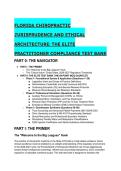
FLORIDA CHIROPRACTIC
JURISPRUDENCE AND ETHICAL
ARCHITECTURE: THE ELITE
PRACTITIONER COMPLIANCE TEST BANK
PART 0: THE NAVIGATOR
● PART I: THE PRIMER
○ The "Welcome to the Big Leagues" Hook
○ The "Critical Action" Cheat Sheet: 2026-2027 Regulatory Thresholds
● PART II: THE ELITE TEST BANK (THE 88-POINT MCQ GAUNTLET)
○ Phase 1: Foundational Syntax & Application (Questions 1–28)
■ Legislative Intent and Scope of Practice Definitions
■ Administrative Credentials and Initial Licensure (HB 975)
■ Continuing Education (CE) and Biennial Renewal Protocols
■ Minimum Recordkeeping and Retention Standards
○ Phase 2: Professional Simulation (Questions 29–58)
■ Auxiliary Personnel Management (CCPAs vs. RCAs)
■ Advertising Ethics, Solicitation, and Fee Disclosures
■ Personal Injury Protection (PIP) and the 14-Day Treatment Rule
■ Emergency Medical Condition (EMC) Determination Frameworks
○ Phase 3: Grandmaster Synthesis (Questions 59–88)
■ Trust Accounting and Advanced Patient Payments (SB 192/HB 259)
■ Clinic Ownership and the § 460.4167 Proprietorship Standard
■ Sexual Misconduct and Professional Boundary Violations
■ Disciplinary Penalty Matrix and Malpractice Classifications
■ 2026 Injection Certification and Sterile Substance Administration
PART I: THE PRIMER
The "Welcome to the Big Leagues" Hook
The practice of chiropractic medicine in the State of Florida is a high-stakes endeavor where
clinical excellence must be shielded by an airtight understanding of the regulatory environment.
In the 2026-2027 cycle, the Florida Board of Chiropractic Medicine has moved aggressively
toward stricter background screenings, refined trust accounting transparency, and a controlled
expansion of injectable nutritional scope. This elite test bank is designed to transition the
,practitioner from mere compliance to a state of professional intuition, ensuring that the legal
boundaries of Chapter 460 are not just memorized, but internalized as a component of clinical
decision-making.
The "Critical Action" Cheat Sheet
Regulatory Domain Mandatory Threshold / Statutory/Rule Authority
Requirement
PIP 14-Day Rule Initial treatment MUST occur § 627.736, F.S.
within 14 days of the accident
for any benefits to apply.
EMC Determination DCs CANNOT certify an § 627.736, F.S.
Emergency Medical Condition;
benefits are capped at $2,500
without it.
Trust Accounting SB 192 (2026): Removes the SB 192 / Rule 64B2-14.001
$1,500 cap on advances but
requires strict ledger
reconciliation.
Record Retention 4 YEARS from the date of the Rule 64B2-17.006
patient's last appointment for
active practitioners.
Overpayment Refund Must be returned within 30 § 456.0625, F.S.
DAYS of determining an
overpayment has occurred.
Supervision (RCA) Requires DIRECT § 460.403(7)
SUPERVISION (physical
presence of the DC on the
premises).
Supervision (CCPA) Allows INDIRECT § 460.403(8)
SUPERVISION (easy
availability via telephone/radio).
PART II: THE ELITE TEST BANK
Phase 1: Foundational Syntax & Application (Questions 1–28)
Q1: According to Florida Statute § 460.401, what is the SOLE legislative purpose for enacting
the Chiropractic Medicine Practice Act? A) To expand the diagnostic capabilities of chiropractic
physicians to include minor surgery and obstetrics. B) To ensure that every chiropractic
physician practicing in Florida meets minimum requirements for safe practice. C) To protect the
economic interests of licensed practitioners against competition from unlicensed technicians. D)
To mandate that insurance carriers provide equal reimbursement for chiropractic and
osteopathic services.
● The Answer: B (To ensure that every chiropractic physician practicing in Florida meets
minimum requirements for safe practice.)
● Distractor Analysis:
, ○ A is incorrect: Chiropractic scope specifically excludes surgery and obstetrics under
2026 standards.
○ C is incorrect: The legislative intent is public safety, not the protection of practitioner
market share.
○ D is incorrect: While reimbursement is handled in the Insurance Code, the "sole
purpose" of Chapter 460 is defined as safety-focused.
The Mentor's Analysis: Every regulation in the Florida Administrative Code (FAC) originates
from the mandate of safety. The Board’s primary function is to exclude those who fall below
minimum competency or present a danger to public health. When interpreting a vague rule, the
practitioner must always choose the path that maximizes public protection. Professional
Intuition: Safety is the only currency the Board truly trades in; your clinical freedom is a
secondary outcome of proven competency.
Q2: A chiropractic student is completing a clinical internship under the DIRECT SUPERVISION
of a faculty member. Which statement MOST ACCURATELY reflects the legal requirement for
this supervision? A) The supervisor must be reachable via mobile phone within 30 minutes of
any emergency. B) The supervisor must be physically present on the premises for consultation
and direction. C) The supervisor is exempt from liability for any errors made by the student. D)
The supervisor must review and co-sign the student's notes within 72 hours of treatment.
● The Answer: B (The supervisor must be physically present on the premises for
consultation and direction.)
● Distractor Analysis:
○ A is incorrect: This describes "easy availability," which is the standard for INDIRECT
supervision of CCPAs. * C is incorrect: Under § 460.403(7), the licensed physician
assumes full legal liability for the services rendered by a student.
○ D is incorrect: While record-keeping is required, physical presence is the defining
statutory element of direct supervision.
The Mentor's Analysis: Direct supervision is a "physical presence" standard. In the
high-performance training environment, "I was just next door" or "I was reachable by phone"
does not satisfy the law for students or Registered Assistants. The physician is the legal
vanguard. Professional Intuition: If you are the supervisor, you are the legal extension of every
hand that touches a patient under your license. Physical presence ensures that your
professional judgment is immediately available to prevent errors.
Q3: The "Practice of Chiropractic Medicine" in Florida is defined as a noncombative principle
and practice. Which of the following is EXPRESSLY permitted within this scope under §
460.403? A) The prescription of medicinal drugs for the management of chronic inflammatory
diseases. B) The use of X-ray for diagnostic purposes to analyze the human body and its
diseases. C) The performance of intravenous (IV) therapy for the administration of antioxidants.
D) The administration of local anesthetics via subcutaneous injection for minor lacerations.
● The Answer: B (The use of X-ray for diagnostic purposes to analyze the human body
and its diseases.)
● Distractor Analysis:
○ A is incorrect: Chiropractic physicians are prohibited from prescribing legend drugs,
with very narrow exceptions for emergency oxygen and topical anesthetics.
○ C is incorrect: Even under the new 2026 injection laws (HB 439), IV therapy
remains strictly prohibited.
○ D is incorrect: While topical aerosol anesthetics are allowed for emergencies,
subcutaneous injection of anesthetics is generally outside the standard chiropractic
scope.
JURISPRUDENCE AND ETHICAL
ARCHITECTURE: THE ELITE
PRACTITIONER COMPLIANCE TEST BANK
PART 0: THE NAVIGATOR
● PART I: THE PRIMER
○ The "Welcome to the Big Leagues" Hook
○ The "Critical Action" Cheat Sheet: 2026-2027 Regulatory Thresholds
● PART II: THE ELITE TEST BANK (THE 88-POINT MCQ GAUNTLET)
○ Phase 1: Foundational Syntax & Application (Questions 1–28)
■ Legislative Intent and Scope of Practice Definitions
■ Administrative Credentials and Initial Licensure (HB 975)
■ Continuing Education (CE) and Biennial Renewal Protocols
■ Minimum Recordkeeping and Retention Standards
○ Phase 2: Professional Simulation (Questions 29–58)
■ Auxiliary Personnel Management (CCPAs vs. RCAs)
■ Advertising Ethics, Solicitation, and Fee Disclosures
■ Personal Injury Protection (PIP) and the 14-Day Treatment Rule
■ Emergency Medical Condition (EMC) Determination Frameworks
○ Phase 3: Grandmaster Synthesis (Questions 59–88)
■ Trust Accounting and Advanced Patient Payments (SB 192/HB 259)
■ Clinic Ownership and the § 460.4167 Proprietorship Standard
■ Sexual Misconduct and Professional Boundary Violations
■ Disciplinary Penalty Matrix and Malpractice Classifications
■ 2026 Injection Certification and Sterile Substance Administration
PART I: THE PRIMER
The "Welcome to the Big Leagues" Hook
The practice of chiropractic medicine in the State of Florida is a high-stakes endeavor where
clinical excellence must be shielded by an airtight understanding of the regulatory environment.
In the 2026-2027 cycle, the Florida Board of Chiropractic Medicine has moved aggressively
toward stricter background screenings, refined trust accounting transparency, and a controlled
expansion of injectable nutritional scope. This elite test bank is designed to transition the
,practitioner from mere compliance to a state of professional intuition, ensuring that the legal
boundaries of Chapter 460 are not just memorized, but internalized as a component of clinical
decision-making.
The "Critical Action" Cheat Sheet
Regulatory Domain Mandatory Threshold / Statutory/Rule Authority
Requirement
PIP 14-Day Rule Initial treatment MUST occur § 627.736, F.S.
within 14 days of the accident
for any benefits to apply.
EMC Determination DCs CANNOT certify an § 627.736, F.S.
Emergency Medical Condition;
benefits are capped at $2,500
without it.
Trust Accounting SB 192 (2026): Removes the SB 192 / Rule 64B2-14.001
$1,500 cap on advances but
requires strict ledger
reconciliation.
Record Retention 4 YEARS from the date of the Rule 64B2-17.006
patient's last appointment for
active practitioners.
Overpayment Refund Must be returned within 30 § 456.0625, F.S.
DAYS of determining an
overpayment has occurred.
Supervision (RCA) Requires DIRECT § 460.403(7)
SUPERVISION (physical
presence of the DC on the
premises).
Supervision (CCPA) Allows INDIRECT § 460.403(8)
SUPERVISION (easy
availability via telephone/radio).
PART II: THE ELITE TEST BANK
Phase 1: Foundational Syntax & Application (Questions 1–28)
Q1: According to Florida Statute § 460.401, what is the SOLE legislative purpose for enacting
the Chiropractic Medicine Practice Act? A) To expand the diagnostic capabilities of chiropractic
physicians to include minor surgery and obstetrics. B) To ensure that every chiropractic
physician practicing in Florida meets minimum requirements for safe practice. C) To protect the
economic interests of licensed practitioners against competition from unlicensed technicians. D)
To mandate that insurance carriers provide equal reimbursement for chiropractic and
osteopathic services.
● The Answer: B (To ensure that every chiropractic physician practicing in Florida meets
minimum requirements for safe practice.)
● Distractor Analysis:
, ○ A is incorrect: Chiropractic scope specifically excludes surgery and obstetrics under
2026 standards.
○ C is incorrect: The legislative intent is public safety, not the protection of practitioner
market share.
○ D is incorrect: While reimbursement is handled in the Insurance Code, the "sole
purpose" of Chapter 460 is defined as safety-focused.
The Mentor's Analysis: Every regulation in the Florida Administrative Code (FAC) originates
from the mandate of safety. The Board’s primary function is to exclude those who fall below
minimum competency or present a danger to public health. When interpreting a vague rule, the
practitioner must always choose the path that maximizes public protection. Professional
Intuition: Safety is the only currency the Board truly trades in; your clinical freedom is a
secondary outcome of proven competency.
Q2: A chiropractic student is completing a clinical internship under the DIRECT SUPERVISION
of a faculty member. Which statement MOST ACCURATELY reflects the legal requirement for
this supervision? A) The supervisor must be reachable via mobile phone within 30 minutes of
any emergency. B) The supervisor must be physically present on the premises for consultation
and direction. C) The supervisor is exempt from liability for any errors made by the student. D)
The supervisor must review and co-sign the student's notes within 72 hours of treatment.
● The Answer: B (The supervisor must be physically present on the premises for
consultation and direction.)
● Distractor Analysis:
○ A is incorrect: This describes "easy availability," which is the standard for INDIRECT
supervision of CCPAs. * C is incorrect: Under § 460.403(7), the licensed physician
assumes full legal liability for the services rendered by a student.
○ D is incorrect: While record-keeping is required, physical presence is the defining
statutory element of direct supervision.
The Mentor's Analysis: Direct supervision is a "physical presence" standard. In the
high-performance training environment, "I was just next door" or "I was reachable by phone"
does not satisfy the law for students or Registered Assistants. The physician is the legal
vanguard. Professional Intuition: If you are the supervisor, you are the legal extension of every
hand that touches a patient under your license. Physical presence ensures that your
professional judgment is immediately available to prevent errors.
Q3: The "Practice of Chiropractic Medicine" in Florida is defined as a noncombative principle
and practice. Which of the following is EXPRESSLY permitted within this scope under §
460.403? A) The prescription of medicinal drugs for the management of chronic inflammatory
diseases. B) The use of X-ray for diagnostic purposes to analyze the human body and its
diseases. C) The performance of intravenous (IV) therapy for the administration of antioxidants.
D) The administration of local anesthetics via subcutaneous injection for minor lacerations.
● The Answer: B (The use of X-ray for diagnostic purposes to analyze the human body
and its diseases.)
● Distractor Analysis:
○ A is incorrect: Chiropractic physicians are prohibited from prescribing legend drugs,
with very narrow exceptions for emergency oxygen and topical anesthetics.
○ C is incorrect: Even under the new 2026 injection laws (HB 439), IV therapy
remains strictly prohibited.
○ D is incorrect: While topical aerosol anesthetics are allowed for emergencies,
subcutaneous injection of anesthetics is generally outside the standard chiropractic
scope.


