

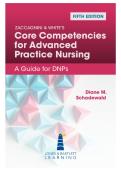
, TESTBANK FOR Zaccagnini & White's Core Competencies for Advanced
Practice Nursing A Guide for DNPs Fifth Edition Schadewald
Important Notes
The file includes the complete test bank, organized chapter by chapter.
A sample of selected pages has been provided for preview.
All available appendices and Excel files (if included in the original resources) are
provided.
Quizzes, Midterm and final exams are included (if available in the original resources).
We continuously update our files to ensure you receive the latest and most accurate
editions.
New editions are added regularly – stay connected for updates!
⚠️Note on Answer Keys: If the answer key is not included within the chapter
questions, you will find the complete answers and solutions at the end of each
chapter.
✅ Why Buy From Us?
📚 Complete & organized chapter-by-chapter – no missing content, no guessing.
⚡ Instant digital delivery – get your file the moment you pay, no waiting.
📅 Always up to date – we track new editions so you always get the latest version.
💬 Friendly support – real humans ready to help, anytime you need us.
🔒 Safe & secure – thousands of satisfied students trust us every semester.
🛡️Our Guarantees
💰 Money-Back Guarantee: Not satisfied? We offer a full refund – no questions asked.
🔄 Wrong File? No Problem: Contact us and we will replace it immediately with the
correct version, free of charge.
⏰ 24/7 Support: We are always here – reach out anytime and expect a fast response.
, Knowledge for Nursing Practice (DNP) – Test Bank
Chapter 01-Knowledge for Nursing Practice
1. Which action by an APN best incorporates the philosophies of nursing and different ways
of knowing?
a. Relying on laboratory test results for diagnosis without considering the patient's feelings
b. Developing a diagnosis and care plan based on intuitive feelings about a patient's needs
✓ c. Developing a plan of care that considers test results, the patient's emotional state, and personal
knowledge
d. Creating a care plan based on theoretical frameworks
2. How does nursing knowledge enhance effective communication for APNs/DNPs?
a. It allows the nurse to use technical medical language and build trust when communicating with patients.
b. It helps the nurse appropriately prioritize objective health concerns over patient concerns.
c. It encourages APNs/DNPs to rely on evidence-based communication practices.
✓ d. It forms a foundation for communication with patients, families, and other healthcare disciplines.
3. Which APN course of action best utilizes the concepts of clinical judgment, ethics, and
evidence-based practice?
a. Prescribing a medication based on the patient's expressed interest in the medication
b. Continuing to follow a 20-year-old treatment plan for diabetes because the patient has not voiced
concerns about the plan
c. Deciding to use an experimental procedure based on a single recent study that was highlighted in the
media as having great results
✓ d. Analyzing the patient's symptoms, reviewing the latest guidelines for stroke, and considering the
patient's autonomy in decision making
4. How does having a solid foundation of nursing knowledge inform the ethical decision
making of APNs/DNPs?
✓ a. It allows for integration of clinical experience and ethical principles to provide patient-centered care.
b. It limits ethical considerations to direct patient care scenarios.
c. It serves as the single source of decision making in ethical cases.
d. It serves as a second source of decision making, after using the American Nurses Association Code of
Ethics.
5. What can APNs/DNPs do to reduce the time for evidence-based practices to be integrated
into clinical care?
a. Rely upon the use of the medical model when making decisions.
b. Adopt a theoretical-only approach during their practice.
✓ c. Critically appraise new evidence and serve as a change agent.
d. Disregard new research in practice until it is validated by other studies.
,6. Which statement best describes the difference in the focus of nursing versus the focus of
medicine?
a. Nursing focuses on the diagnosis and treatment of disease.
✓ b. Nursing focuses on the human response to illness and its treatment.
c. Nursing is primarily concerned with pharmacology and drug interactions.
d. Nursing and medicine have the same focus, but nursing has a broader scope of practice.
7. What phase of nursing knowledge evolution involved nurse theorists concentrating on
disciplinary nursing knowledge?
a. Receptive phase
b. Progressive phase
c. Transformative phase
✓ d. Self-generative phase
8. How does Orem's Self-Care Deficit Theory manifest in disciplines other than nursing?
a. Medical doctors considering the family's wishes
✓ b. Physical therapists empowering patients to regain mobility
c. Laboratory scientists examining patient behavior
d. Occupational therapists treating patients as dependent upon needs
9. What critical role do DNP-prepared APNs play in the translation of evidence into practice?
a. Conduct original research to generate new knowledge.
b. Perform statistical analysis of research to establish the credibility of the evidence.
c. Review medical and nursing literature to inform policies.
✓ d. Synthesize the new knowledge into clinical practice guidelines.
10. Which consideration is key when focusing projects on outcomes and designing research
studies or quality improvement projects?
a. Involving only DNP-prepared nurses in the project team
b. Conducting retrospective chart reviews for qualitative analysis
c. Seeking approval from the hospital-shared governance committee
✓ d. Ensuring alignment with facility goals and demonstrating sustainability
11. Which group of individuals should be engaged to create a supportive colearning
environment that enables DNP and PhD collaboration?
a. DNP and PhD students
✓ b. Facility DNPs and PhDs
c. Unit practice management
d. Hospital-shared governance committee
12. Which of the following is a critical consideration when DNP and PhD nurses collaborate on
a project team?
a. Deferring final authority on decisions to the PhD nurse
b. Working independently to maintain individual perspectives
✓ c. Recognizing and acknowledging each other's unique contributions
, d. Relying solely on clinical inquiry and methods for decision making
13. What is the purpose of an institutional review board (IRB) in the context of human subjects
in research?
a. To approve nursing research proposals exempt from review
b. To enforce federal regulations for nursing research projects
✓ c. To ensure the protection of human rights and safety in research
d. To provide conflict resolution between researchers and institutions
14. How can APNs/DNPs demonstrate socially responsible leadership in their practice?
a. By applying biomedical theories to patient care
b. By solely focusing only on the needs of individual patients
✓ c. By advocating for social change and addressing social issues
d. By collaborating with other healthcare professionals to reduce costs
15. When the APN/DNP faces a situation where the principles of beneficence and justice are in
conflict, how should the nurse resolve this dilemma?
a. Prioritize the principle of beneficence over justice and take the action that benefits the patient the most.
b. Research the most common or traditional practice in similar cases and employ that approach.
c. Prioritize the principle of justice over beneficence and take the action that ensures equitable resource
allocation among patients.
✓ d. Consult with the ethics committee and engage in collaborative decision making to find a resolution that
upholds both principles.
16. What ethical responsibility does the APN/DNP have when a research study requires
informed consent and there are concerns with cultural barriers that may hinder
communication?
a. Exclude participants from diverse language and cultural backgrounds to avoid potential communication
challenges.
✓ b. Collaborate with interpreters or cultural liaisons to facilitate effective communication and ensure
comprehension of informed consent.
c. Proceed with obtaining informed consent despite the barriers, ensuring participants are aware of their
rights to decline participation.
d. Conduct the research study without obtaining informed consent to avoid potential complications related
to language and cultural barriers.
17. What is the primary purpose of clinical judgment in nursing practice?
✓ a. To evaluate and synthesize patient information for decision making
b. To prioritize patient preferences and values above all else in care planning
c. To rely solely on clinical experience and expertise for decision making
d. To standardize care for all patients based on evidence-based practice
18. Which example best describes APNs/DNPs synthesizing current and emerging evidence to
influence practice?
a. Replacing a common cold treatment with clinical practice guidelines
b. Facilitating collaboration with anesthesia during preoperative rounds
, ✓ c. Establishing a quality improvement project to address infection rates
d. Using patient preferences and values during patient care decisions
19. Which decision making model can help APNs/DNPs make informed and effective
decisions?
a. Six-Step Model of Clinical Decision Making
✓ b. Ottawa Decision Support Framework
c. Lasater's Clinical Judgment Rubric
d. McEwen and Wills's Psychology of Behavior Framework
20. In what way does the integration of foundational knowledge into clinical judgment benefit
patient care?
✓ a. It helps APNs/DNPs understand complex social factors influencing patient health.
b. It allows APNs/DNPs to specialize in specific areas of clinical practice.
c. It facilitates the development of innovative healthcare technologies.
d. It enables APNs/DNPs to prescribe medications effectively.
Chapter 02-Person-Centered Care
1. When interacting with a patient who has a terminal diagnosis and using the empathy
continuum, which approach reflects the perceiving stage?
✓ a. Suspending personal beliefs and any prejudices
b. Offering to be present and summarize what was heard
c. Reflecting on past experiences with similar patients
d. Engaging in active listening
2. Healthcare providers can improve their empathetic skills and improve relationships with
patients by doing which of the following?
a. Engaging in helping patients self-reflect
✓ b. Participating in loving-kindness meditation sessions
c. Utilizing a coping mechanism to respond to patient suffering
d. Processing how the nurses' experiences shape the patient's story
3. Which communication approach would the nurse use during a patient encounter to ensure
cultural safety and demonstrate they value the patient's historical and personal narratives?
a. Politely stop the patient if they begin to share nonrelevant information.
b. Use person-first language when discussing the patient's condition.
✓ c. Ask about social barriers when reviewing nonadherence to medications.
d. Share similar experiences to empathize with the patient's feelings.
4. A patient comes to a primary care clinic and expresses dissatisfaction with previous
healthcare encounters at the clinic. Which response by the clinician best reflects adopting a
trauma-informed approach?
a. "I understand. Let's focus on your current health issues."
, ✓ b. "I'm sorry to hear that. Let's work together to ensure you feel comfortable and heard."
c. "I'm surprised to hear that. Most patients have positive experiences in our clinic."
d. "Can you provide more context, so we can investigate this further."
5. What potential implicit biases can occur when conducting a mental health assessment of an
LGBTQ+ patient with a history of depression and anxiety?
a. Assuming that the patient's mental health concerns are unrelated to their LGBTQ+ identity
✓ b. Thinking the patient's mental health challenges are from society's discrimination 'of their sexual
orientation
c. Assuming the patient's mental health challenges are due to their sexual orientation
d. Dismissing the patient's mental health concerns based on their LGBTQ+ identity
6. Which statement accurately describes the Person-Centered Practice Framework (PCPF)
when delivering health care?
a. It is specifically designed for nurses and has limited application to other healthcare workers.
b. It emphasizes clinician-centered outcomes, such as patient satisfaction scores.
✓ c. It emphasizes the significance of staff relationships and organizational systems in providing
person-centered care.
d. It is a standardized nursing taxonomy used for capturing health concepts, interventions, and outcomes.
7. A healthcare organization is considering an initiative to redesign patient flow processes.
Which approach best aligns with the principles of innovation and design thinking?
a. Consulting with senior leadership for potential solutions
b. Bringing in an external consultant to review and suggest changes
✓ c. Asking nurses to participate in a workshop to create ideas to solve the issue
d. Implementing tested patient flow models from other hospitals
8. How does the Omaha System contribute to healthcare quality and safety, particularly in
nurse-led services?
a. It provides standardized nursing diagnoses, interventions, and outcomes to ensure consistency in care.
b. It helps healthcare professionals track changes in care delivery and interventions during different health
crises.
c. It supports the development of person-centered healthcare policies and processes, promoting patient
engagement.
✓ d. It aggregates data to evaluate care quality and outcomes among adults receiving nurse-led health
care services.
9. In which situation would a healthcare organization use Patient-Centered Outcomes
Research Institute (PCORI) resources?
a. To support healthcare providers in conducting clinical trials to compare the effectiveness of different
COVID-19 treatment methods
✓ b. To evaluate the outcomes of various healthcare interventions and treatments to improve cancer care
and inform cancer treatment policies
c. To develop evidence-based guidelines for managing diabetes in primary care settings
d. To measure patient satisfaction with telemedicine services during the pandemic
,10. A clinic wishes to evaluate the effectiveness of its patient-centered care (PCC)
implementation at various levels. How should the clinic measure PCC outcomes at the
individual level?
a. By examining the feedback of clinicians and staff about the clinic's PCC approach
b. By assessing the clinic's ability to provide care across multiple settings and organizations
✓ c. By evaluating the patient's perspective of the care they received
d. By calculating the patient's costs saved since the PCC approach was adopted
11. Which behavior by a healthcare professional is an example of contributing to addressing
health disparities when reporting population-level outcomes?
✓ a. Acknowledging how social determinants of health impact access to care in cancer treatment outcomes
b. Conducting more randomized control trials to compare treatment methods for acute respiratory
infections in different populations
c. Identifying clinicians who can improve diabetes population outcomes
d. Developing evidence-based guidelines for mental health care without considering cultural barriers
12. Patient engagement essential in the person-centered care coordination model because it:
a. ensures all individuals receive the same standardized care plan based on evidence-based guidelines.
b. allows the nurse care coordinator to coordinate with various healthcare professionals to address
individual needs.
c. increases the satisfaction in communication between the care team and the care recipient.
✓ d. increases the likelihood that individuals will actively follow their care plan and participate in
evidence-based preventive services.
13. In which situation would the nurse benefit the most from using a decision aid?
a. Teaching a patient newly diagnosed with diabetes about different types of medications
✓ b. Helping a caregiver decide between a tracheostomy or feeding tube for an intubated patient
c. Informing a patient about the various physical therapy clinics in the community
d. Telling a patient that the physician is going to prescribe a new type of antibiotic
14. How can fostering partnerships with community organizations through social capital be
beneficial in promoting self-care management?
a. It can increase patient satisfaction with healthcare services.
b. It can lead to identification of new financial resources for patients.
✓ c. It can significantly improve an individual's self-management behaviors and health practices.
d. It ensures that healthcare facilities are well-connected and easily accessible to patients.
15. How can a nurse practitioner use shared decision making (SDM) to assist a patient who
has been newly diagnosed with diabetes with their diabetes management?
✓ a. Discuss the potential benefits and drawbacks of different diabetes medications
b. Provide a pamphlet with information about various diabetes treatments
c. Present the patient with a fixed treatment plan, emphasizing the effectiveness of insulin therapy
d. Prescribe metformin as the primary treatment and tell the patient to follow up in 6 months
,16. Which approach demonstrates a response to a patient seeking healthier dietary habits in
the precontemplation stage of change?
a. Give the patient a detailed meal plan and emphasize the importance of dietary changes.
✓ b. Encourage the patient to ask questions about dietary habits and explore their ambivalence toward
change.
c. Refer the patient to a nutritionist and inform them to make an appointment soon.
d. First prescribe medications to manage the patient's existing health conditions and then address dietary
concerns.
17. The nurse is developing a plan of care for a patient with hypertension who is interested in
lifestyle modifications. What is the appropriate sequence of steps if the nurse is incorporating
the 5-A's Framework for behavior change?
✓ a. Assess the patient's health behaviors, advise the patient on lifestyle modifications, and assist the
patient in identifying barriers to change.
b. Prescribe antihypertensive medications, arrange follow-up visits, and assess the patient's health
behaviors.
c. Advise the patient on lifestyle modifications, assist the patient in identifying barriers to change, and agree
on a set of care goals.
d. Assist the patient in identifying barriers to change, agree on a set of care goals, and advise the patient
on lifestyle modifications.
18. A patient expresses their understanding of the benefits of a new diet plan and rates their
readiness for change as a 4. Which stage of behavior change is the patient in?
a. Precontemplation
✓ b. Contemplation
c. Preparation
d. Making changes
19. A nurse care coordinator is working with a high-risk population to improve care
coordination across settings. Which outcome measure is most relevant to evaluate the impact
of care coordination for this population?
a. Increased number of new and recurring primary care visits across services
✓ b. Improved management of chronic conditions with recommended testing and treatments
c. Increased satisfaction in communication between the care team and the care recipient
d. Higher percentage of individuals complete annual medical and dental preventative care visits
20. What action demonstrates a care coordinator helping a patient with complex care navigate
healthcare resources to support accessing the right level of care?
a. Implement a standardized care plan for a patient based on evidence-based guidelines.
b. Provide a patient with a list of specialty providers and community resources.
✓ c. Collaborate with a patient to identify weight-loss goals and develop a plan.
d. Create an online education course for an older adult patient in a community health center.
Chapter 03-Population Health
, 1. A DNP-prepared nurse working on population health to develop proper interventions must
have an understanding of:
✓ a. the difference between relative risk and attributable risk.
b. patient-centered communication best practices.
c. the hospital management system.
d. the impact of pharmaceutical marketing on populations.
2. When analyzing primary and secondary population health data against relevant
benchmarks, why is the ability to perform rate adjustments important for a DNP-prepared
nurse?
a. To increase hospital revenue
b. To market the healthcare program
✓ c. To use the data when developing interventions
d. To satisfy regulatory requirements
3. A DNP-prepared nurse is evaluating the potential of a new healthcare system to serve a
community subpopulation. Which approach would be the most comprehensive?
a. Checking the financial capacity of the system for supplies and messaging
b. Reviewing personnel roles within the system to determine if training is needed
c. Meeting with the mayor and school leaders to gather their perspectives on the system
✓ d. Combining a review of the system's assets and identifying potential partners
4. A community healthcare program for low-income families is being developed. A goal is to
achieve health equity for the community. Which approach best achieves this?
a. Distributing the same healthcare package to every family in the community
✓ b. Collaborating with the community to design a tailored program for each family's specific needs
c. Creating a program to provide family aid to families of those with the most common chronic condition in
this population
d. Designing a healthcare program for the community based exclusively on government guidelines
5. A DNP-prepared nurse is conducting a readiness assessment related to a potential
hurricane making landfall in a coastal region. Which critical aspect of the readiness of local
partners would the nurse focus on?
a. Financial contribution of each partner to the preparedness fund
b. Creation of a uniform flood response plan for all communities in the region
c. Confirmation that the central hospital is restocking medical supplies
✓ d. Establishment of a joint disaster response protocol with community organizations in the region
6. A nursing organization is considering implementing a new health initiative using the
co-creation model. Which approach would best exemplify the principles of this model?
a. Designing a program based on the results of a community survey
b. Inviting community members for feedback after implementing a health program designed by experts
✓ c. Involving the community in the entire process of building a health program and implementing the
agreed-upon solutions
d. Implementing a health program based on what has worked in another community and then adapting it
Practice Nursing A Guide for DNPs Fifth Edition Schadewald
Important Notes
The file includes the complete test bank, organized chapter by chapter.
A sample of selected pages has been provided for preview.
All available appendices and Excel files (if included in the original resources) are
provided.
Quizzes, Midterm and final exams are included (if available in the original resources).
We continuously update our files to ensure you receive the latest and most accurate
editions.
New editions are added regularly – stay connected for updates!
⚠️Note on Answer Keys: If the answer key is not included within the chapter
questions, you will find the complete answers and solutions at the end of each
chapter.
✅ Why Buy From Us?
📚 Complete & organized chapter-by-chapter – no missing content, no guessing.
⚡ Instant digital delivery – get your file the moment you pay, no waiting.
📅 Always up to date – we track new editions so you always get the latest version.
💬 Friendly support – real humans ready to help, anytime you need us.
🔒 Safe & secure – thousands of satisfied students trust us every semester.
🛡️Our Guarantees
💰 Money-Back Guarantee: Not satisfied? We offer a full refund – no questions asked.
🔄 Wrong File? No Problem: Contact us and we will replace it immediately with the
correct version, free of charge.
⏰ 24/7 Support: We are always here – reach out anytime and expect a fast response.
, Knowledge for Nursing Practice (DNP) – Test Bank
Chapter 01-Knowledge for Nursing Practice
1. Which action by an APN best incorporates the philosophies of nursing and different ways
of knowing?
a. Relying on laboratory test results for diagnosis without considering the patient's feelings
b. Developing a diagnosis and care plan based on intuitive feelings about a patient's needs
✓ c. Developing a plan of care that considers test results, the patient's emotional state, and personal
knowledge
d. Creating a care plan based on theoretical frameworks
2. How does nursing knowledge enhance effective communication for APNs/DNPs?
a. It allows the nurse to use technical medical language and build trust when communicating with patients.
b. It helps the nurse appropriately prioritize objective health concerns over patient concerns.
c. It encourages APNs/DNPs to rely on evidence-based communication practices.
✓ d. It forms a foundation for communication with patients, families, and other healthcare disciplines.
3. Which APN course of action best utilizes the concepts of clinical judgment, ethics, and
evidence-based practice?
a. Prescribing a medication based on the patient's expressed interest in the medication
b. Continuing to follow a 20-year-old treatment plan for diabetes because the patient has not voiced
concerns about the plan
c. Deciding to use an experimental procedure based on a single recent study that was highlighted in the
media as having great results
✓ d. Analyzing the patient's symptoms, reviewing the latest guidelines for stroke, and considering the
patient's autonomy in decision making
4. How does having a solid foundation of nursing knowledge inform the ethical decision
making of APNs/DNPs?
✓ a. It allows for integration of clinical experience and ethical principles to provide patient-centered care.
b. It limits ethical considerations to direct patient care scenarios.
c. It serves as the single source of decision making in ethical cases.
d. It serves as a second source of decision making, after using the American Nurses Association Code of
Ethics.
5. What can APNs/DNPs do to reduce the time for evidence-based practices to be integrated
into clinical care?
a. Rely upon the use of the medical model when making decisions.
b. Adopt a theoretical-only approach during their practice.
✓ c. Critically appraise new evidence and serve as a change agent.
d. Disregard new research in practice until it is validated by other studies.
,6. Which statement best describes the difference in the focus of nursing versus the focus of
medicine?
a. Nursing focuses on the diagnosis and treatment of disease.
✓ b. Nursing focuses on the human response to illness and its treatment.
c. Nursing is primarily concerned with pharmacology and drug interactions.
d. Nursing and medicine have the same focus, but nursing has a broader scope of practice.
7. What phase of nursing knowledge evolution involved nurse theorists concentrating on
disciplinary nursing knowledge?
a. Receptive phase
b. Progressive phase
c. Transformative phase
✓ d. Self-generative phase
8. How does Orem's Self-Care Deficit Theory manifest in disciplines other than nursing?
a. Medical doctors considering the family's wishes
✓ b. Physical therapists empowering patients to regain mobility
c. Laboratory scientists examining patient behavior
d. Occupational therapists treating patients as dependent upon needs
9. What critical role do DNP-prepared APNs play in the translation of evidence into practice?
a. Conduct original research to generate new knowledge.
b. Perform statistical analysis of research to establish the credibility of the evidence.
c. Review medical and nursing literature to inform policies.
✓ d. Synthesize the new knowledge into clinical practice guidelines.
10. Which consideration is key when focusing projects on outcomes and designing research
studies or quality improvement projects?
a. Involving only DNP-prepared nurses in the project team
b. Conducting retrospective chart reviews for qualitative analysis
c. Seeking approval from the hospital-shared governance committee
✓ d. Ensuring alignment with facility goals and demonstrating sustainability
11. Which group of individuals should be engaged to create a supportive colearning
environment that enables DNP and PhD collaboration?
a. DNP and PhD students
✓ b. Facility DNPs and PhDs
c. Unit practice management
d. Hospital-shared governance committee
12. Which of the following is a critical consideration when DNP and PhD nurses collaborate on
a project team?
a. Deferring final authority on decisions to the PhD nurse
b. Working independently to maintain individual perspectives
✓ c. Recognizing and acknowledging each other's unique contributions
, d. Relying solely on clinical inquiry and methods for decision making
13. What is the purpose of an institutional review board (IRB) in the context of human subjects
in research?
a. To approve nursing research proposals exempt from review
b. To enforce federal regulations for nursing research projects
✓ c. To ensure the protection of human rights and safety in research
d. To provide conflict resolution between researchers and institutions
14. How can APNs/DNPs demonstrate socially responsible leadership in their practice?
a. By applying biomedical theories to patient care
b. By solely focusing only on the needs of individual patients
✓ c. By advocating for social change and addressing social issues
d. By collaborating with other healthcare professionals to reduce costs
15. When the APN/DNP faces a situation where the principles of beneficence and justice are in
conflict, how should the nurse resolve this dilemma?
a. Prioritize the principle of beneficence over justice and take the action that benefits the patient the most.
b. Research the most common or traditional practice in similar cases and employ that approach.
c. Prioritize the principle of justice over beneficence and take the action that ensures equitable resource
allocation among patients.
✓ d. Consult with the ethics committee and engage in collaborative decision making to find a resolution that
upholds both principles.
16. What ethical responsibility does the APN/DNP have when a research study requires
informed consent and there are concerns with cultural barriers that may hinder
communication?
a. Exclude participants from diverse language and cultural backgrounds to avoid potential communication
challenges.
✓ b. Collaborate with interpreters or cultural liaisons to facilitate effective communication and ensure
comprehension of informed consent.
c. Proceed with obtaining informed consent despite the barriers, ensuring participants are aware of their
rights to decline participation.
d. Conduct the research study without obtaining informed consent to avoid potential complications related
to language and cultural barriers.
17. What is the primary purpose of clinical judgment in nursing practice?
✓ a. To evaluate and synthesize patient information for decision making
b. To prioritize patient preferences and values above all else in care planning
c. To rely solely on clinical experience and expertise for decision making
d. To standardize care for all patients based on evidence-based practice
18. Which example best describes APNs/DNPs synthesizing current and emerging evidence to
influence practice?
a. Replacing a common cold treatment with clinical practice guidelines
b. Facilitating collaboration with anesthesia during preoperative rounds
, ✓ c. Establishing a quality improvement project to address infection rates
d. Using patient preferences and values during patient care decisions
19. Which decision making model can help APNs/DNPs make informed and effective
decisions?
a. Six-Step Model of Clinical Decision Making
✓ b. Ottawa Decision Support Framework
c. Lasater's Clinical Judgment Rubric
d. McEwen and Wills's Psychology of Behavior Framework
20. In what way does the integration of foundational knowledge into clinical judgment benefit
patient care?
✓ a. It helps APNs/DNPs understand complex social factors influencing patient health.
b. It allows APNs/DNPs to specialize in specific areas of clinical practice.
c. It facilitates the development of innovative healthcare technologies.
d. It enables APNs/DNPs to prescribe medications effectively.
Chapter 02-Person-Centered Care
1. When interacting with a patient who has a terminal diagnosis and using the empathy
continuum, which approach reflects the perceiving stage?
✓ a. Suspending personal beliefs and any prejudices
b. Offering to be present and summarize what was heard
c. Reflecting on past experiences with similar patients
d. Engaging in active listening
2. Healthcare providers can improve their empathetic skills and improve relationships with
patients by doing which of the following?
a. Engaging in helping patients self-reflect
✓ b. Participating in loving-kindness meditation sessions
c. Utilizing a coping mechanism to respond to patient suffering
d. Processing how the nurses' experiences shape the patient's story
3. Which communication approach would the nurse use during a patient encounter to ensure
cultural safety and demonstrate they value the patient's historical and personal narratives?
a. Politely stop the patient if they begin to share nonrelevant information.
b. Use person-first language when discussing the patient's condition.
✓ c. Ask about social barriers when reviewing nonadherence to medications.
d. Share similar experiences to empathize with the patient's feelings.
4. A patient comes to a primary care clinic and expresses dissatisfaction with previous
healthcare encounters at the clinic. Which response by the clinician best reflects adopting a
trauma-informed approach?
a. "I understand. Let's focus on your current health issues."
, ✓ b. "I'm sorry to hear that. Let's work together to ensure you feel comfortable and heard."
c. "I'm surprised to hear that. Most patients have positive experiences in our clinic."
d. "Can you provide more context, so we can investigate this further."
5. What potential implicit biases can occur when conducting a mental health assessment of an
LGBTQ+ patient with a history of depression and anxiety?
a. Assuming that the patient's mental health concerns are unrelated to their LGBTQ+ identity
✓ b. Thinking the patient's mental health challenges are from society's discrimination 'of their sexual
orientation
c. Assuming the patient's mental health challenges are due to their sexual orientation
d. Dismissing the patient's mental health concerns based on their LGBTQ+ identity
6. Which statement accurately describes the Person-Centered Practice Framework (PCPF)
when delivering health care?
a. It is specifically designed for nurses and has limited application to other healthcare workers.
b. It emphasizes clinician-centered outcomes, such as patient satisfaction scores.
✓ c. It emphasizes the significance of staff relationships and organizational systems in providing
person-centered care.
d. It is a standardized nursing taxonomy used for capturing health concepts, interventions, and outcomes.
7. A healthcare organization is considering an initiative to redesign patient flow processes.
Which approach best aligns with the principles of innovation and design thinking?
a. Consulting with senior leadership for potential solutions
b. Bringing in an external consultant to review and suggest changes
✓ c. Asking nurses to participate in a workshop to create ideas to solve the issue
d. Implementing tested patient flow models from other hospitals
8. How does the Omaha System contribute to healthcare quality and safety, particularly in
nurse-led services?
a. It provides standardized nursing diagnoses, interventions, and outcomes to ensure consistency in care.
b. It helps healthcare professionals track changes in care delivery and interventions during different health
crises.
c. It supports the development of person-centered healthcare policies and processes, promoting patient
engagement.
✓ d. It aggregates data to evaluate care quality and outcomes among adults receiving nurse-led health
care services.
9. In which situation would a healthcare organization use Patient-Centered Outcomes
Research Institute (PCORI) resources?
a. To support healthcare providers in conducting clinical trials to compare the effectiveness of different
COVID-19 treatment methods
✓ b. To evaluate the outcomes of various healthcare interventions and treatments to improve cancer care
and inform cancer treatment policies
c. To develop evidence-based guidelines for managing diabetes in primary care settings
d. To measure patient satisfaction with telemedicine services during the pandemic
,10. A clinic wishes to evaluate the effectiveness of its patient-centered care (PCC)
implementation at various levels. How should the clinic measure PCC outcomes at the
individual level?
a. By examining the feedback of clinicians and staff about the clinic's PCC approach
b. By assessing the clinic's ability to provide care across multiple settings and organizations
✓ c. By evaluating the patient's perspective of the care they received
d. By calculating the patient's costs saved since the PCC approach was adopted
11. Which behavior by a healthcare professional is an example of contributing to addressing
health disparities when reporting population-level outcomes?
✓ a. Acknowledging how social determinants of health impact access to care in cancer treatment outcomes
b. Conducting more randomized control trials to compare treatment methods for acute respiratory
infections in different populations
c. Identifying clinicians who can improve diabetes population outcomes
d. Developing evidence-based guidelines for mental health care without considering cultural barriers
12. Patient engagement essential in the person-centered care coordination model because it:
a. ensures all individuals receive the same standardized care plan based on evidence-based guidelines.
b. allows the nurse care coordinator to coordinate with various healthcare professionals to address
individual needs.
c. increases the satisfaction in communication between the care team and the care recipient.
✓ d. increases the likelihood that individuals will actively follow their care plan and participate in
evidence-based preventive services.
13. In which situation would the nurse benefit the most from using a decision aid?
a. Teaching a patient newly diagnosed with diabetes about different types of medications
✓ b. Helping a caregiver decide between a tracheostomy or feeding tube for an intubated patient
c. Informing a patient about the various physical therapy clinics in the community
d. Telling a patient that the physician is going to prescribe a new type of antibiotic
14. How can fostering partnerships with community organizations through social capital be
beneficial in promoting self-care management?
a. It can increase patient satisfaction with healthcare services.
b. It can lead to identification of new financial resources for patients.
✓ c. It can significantly improve an individual's self-management behaviors and health practices.
d. It ensures that healthcare facilities are well-connected and easily accessible to patients.
15. How can a nurse practitioner use shared decision making (SDM) to assist a patient who
has been newly diagnosed with diabetes with their diabetes management?
✓ a. Discuss the potential benefits and drawbacks of different diabetes medications
b. Provide a pamphlet with information about various diabetes treatments
c. Present the patient with a fixed treatment plan, emphasizing the effectiveness of insulin therapy
d. Prescribe metformin as the primary treatment and tell the patient to follow up in 6 months
,16. Which approach demonstrates a response to a patient seeking healthier dietary habits in
the precontemplation stage of change?
a. Give the patient a detailed meal plan and emphasize the importance of dietary changes.
✓ b. Encourage the patient to ask questions about dietary habits and explore their ambivalence toward
change.
c. Refer the patient to a nutritionist and inform them to make an appointment soon.
d. First prescribe medications to manage the patient's existing health conditions and then address dietary
concerns.
17. The nurse is developing a plan of care for a patient with hypertension who is interested in
lifestyle modifications. What is the appropriate sequence of steps if the nurse is incorporating
the 5-A's Framework for behavior change?
✓ a. Assess the patient's health behaviors, advise the patient on lifestyle modifications, and assist the
patient in identifying barriers to change.
b. Prescribe antihypertensive medications, arrange follow-up visits, and assess the patient's health
behaviors.
c. Advise the patient on lifestyle modifications, assist the patient in identifying barriers to change, and agree
on a set of care goals.
d. Assist the patient in identifying barriers to change, agree on a set of care goals, and advise the patient
on lifestyle modifications.
18. A patient expresses their understanding of the benefits of a new diet plan and rates their
readiness for change as a 4. Which stage of behavior change is the patient in?
a. Precontemplation
✓ b. Contemplation
c. Preparation
d. Making changes
19. A nurse care coordinator is working with a high-risk population to improve care
coordination across settings. Which outcome measure is most relevant to evaluate the impact
of care coordination for this population?
a. Increased number of new and recurring primary care visits across services
✓ b. Improved management of chronic conditions with recommended testing and treatments
c. Increased satisfaction in communication between the care team and the care recipient
d. Higher percentage of individuals complete annual medical and dental preventative care visits
20. What action demonstrates a care coordinator helping a patient with complex care navigate
healthcare resources to support accessing the right level of care?
a. Implement a standardized care plan for a patient based on evidence-based guidelines.
b. Provide a patient with a list of specialty providers and community resources.
✓ c. Collaborate with a patient to identify weight-loss goals and develop a plan.
d. Create an online education course for an older adult patient in a community health center.
Chapter 03-Population Health
, 1. A DNP-prepared nurse working on population health to develop proper interventions must
have an understanding of:
✓ a. the difference between relative risk and attributable risk.
b. patient-centered communication best practices.
c. the hospital management system.
d. the impact of pharmaceutical marketing on populations.
2. When analyzing primary and secondary population health data against relevant
benchmarks, why is the ability to perform rate adjustments important for a DNP-prepared
nurse?
a. To increase hospital revenue
b. To market the healthcare program
✓ c. To use the data when developing interventions
d. To satisfy regulatory requirements
3. A DNP-prepared nurse is evaluating the potential of a new healthcare system to serve a
community subpopulation. Which approach would be the most comprehensive?
a. Checking the financial capacity of the system for supplies and messaging
b. Reviewing personnel roles within the system to determine if training is needed
c. Meeting with the mayor and school leaders to gather their perspectives on the system
✓ d. Combining a review of the system's assets and identifying potential partners
4. A community healthcare program for low-income families is being developed. A goal is to
achieve health equity for the community. Which approach best achieves this?
a. Distributing the same healthcare package to every family in the community
✓ b. Collaborating with the community to design a tailored program for each family's specific needs
c. Creating a program to provide family aid to families of those with the most common chronic condition in
this population
d. Designing a healthcare program for the community based exclusively on government guidelines
5. A DNP-prepared nurse is conducting a readiness assessment related to a potential
hurricane making landfall in a coastal region. Which critical aspect of the readiness of local
partners would the nurse focus on?
a. Financial contribution of each partner to the preparedness fund
b. Creation of a uniform flood response plan for all communities in the region
c. Confirmation that the central hospital is restocking medical supplies
✓ d. Establishment of a joint disaster response protocol with community organizations in the region
6. A nursing organization is considering implementing a new health initiative using the
co-creation model. Which approach would best exemplify the principles of this model?
a. Designing a program based on the results of a community survey
b. Inviting community members for feedback after implementing a health program designed by experts
✓ c. Involving the community in the entire process of building a health program and implementing the
agreed-upon solutions
d. Implementing a health program based on what has worked in another community and then adapting it


