

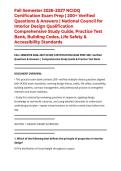
Fall Semester 2026–2027 NCIDQ
Certification Exam Prep | 200+ Verified
Questions & Answers | National Council for
Interior Design Qualification
Comprehensive Study Guide, Practice Test
Bank, Building Codes, Life Safety &
Accessibility Standards
═══════════════════════════════════════════════════════
════════════════════════
FALL SEMESTER 2026–2027 NCIDQ CERTIFICATION EXAM PREP 200+ Verified
Questions & Answers | Comprehensive Study Guide & Practice Test Bank
═══════════════════════════════════════════════════════
════════════════════════
DOCUMENT OVERVIEW:
• This practice exam bank contains 200+ verified multiple-choice questions aligned
with NCIDQ exam standards, covering design theory, codes, life safety, accessibility,
building systems, contract management, and professional practice to strengthen
retention and exam readiness.
• Study this material by reviewing questions in sequence, applying design
knowledge to real-world scenarios, and using detailed rationales to understand
underlying principles—repeat missed sections to reinforce weak areas before test
day.
═══════════════════════════════════════════════════════
════════════════════════
SECTION 1: DESIGN THEORY & PROCESS
═══════════════════════════════════════════════════════
════════════════════════
1. Which of the following best defines the principle of proportion in interior
design?
A) The distribution of visual weight throughout a space
,B) The relationship between the size of objects and the size of the space
C) The repeated use of design elements to create unity
D) The balance of warm and cool colors in a room
E) The contrast between two opposing design elements
✓ CORRECT ANSWER: B) The relationship between the size of objects and the
size of the space
RATIONALE: Proportion refers to the relationship between the dimensions of
objects and the overall space. It is about how the size of furniture, artwork, and
architectural elements relates to the room and to each other. Answer A describes
balance, C describes rhythm, D relates to color theory, and E defines contrast.
Proper proportion ensures that furnishings and design elements are appropriately
scaled to their environment, creating visual harmony and functional comfort.
───────────────────────────────────────────────────────
────────────────────────
2. In the design process, the schematic design phase typically includes which
of the following?
A) Preparation of detailed construction documents and specifications
B) Development of preliminary design concepts and spatial arrangements
C) Construction administration and site observations
D) Final selection of all finishes and furnishings
E) Client approval of the budget and project timeline
✓ CORRECT ANSWER: B) Development of preliminary design concepts and
spatial arrangements
RATIONALE: Schematic design is an early phase of the design process where
designers develop preliminary concepts, create spatial arrangements, and establish
the overall design direction. This phase involves sketches, bubble diagrams, and
preliminary floor plans to communicate design ideas to the client. Answer A
pertains to design development/construction documents, C refers to construction
,administration, D occurs after schematic design, and E is part of project initiation.
Schematic design sets the foundation for all subsequent design work.
───────────────────────────────────────────────────────
────────────────────────
3. What is the primary purpose of a design program in interior design?
A) To establish the budget constraints for the project
B) To document all client preferences and design requirements
C) To define the project scope, goals, and spatial requirements
D) To select the final color palette and material specifications
E) To schedule construction timelines and contractor responsibilities
✓ CORRECT ANSWER: C) To define the project scope, goals, and spatial
requirements
RATIONALE: A design program is a comprehensive document that establishes the
project scope, identifies goals, defines spatial requirements, and articulates client
needs and objectives. It serves as the foundation for all design decisions and
ensures alignment between the client's vision and the designer's work. Answer B is
too narrow, A is addressed separately in budgeting, D occurs in later design phases,
and E is handled in the construction phase. The program acts as a roadmap for the
entire project.
───────────────────────────────────────────────────────
────────────────────────
4. Which design principle is most important for creating visual unity in an
interior space?
A) Emphasis
B) Rhythm
C) Proportion
D) Variety
E) Repetition
, ✓ CORRECT ANSWER: E) Repetition
RATIONALE: Repetition is the recurrence of design elements (colors, textures,
shapes, patterns) throughout a space, which creates visual unity and cohesion. By
repeating certain elements, designers tie the space together and establish a
cohesive design narrative. Answer A creates focal points, B creates movement, C
relates to scale, and D adds interest but can work against unity if overused.
Repetition with variation is the foundation of unified interior design.
───────────────────────────────────────────────────────
────────────────────────
5. When working with a residential client, which communication tool is most
effective for presenting design concepts?
A) Written specifications only
B) Verbal descriptions without visual aids
C) 3D renderings, mood boards, and floor plans
D) Budget spreadsheets and cost analysis documents
E) Technical construction drawings and building sections
✓ CORRECT ANSWER: C) 3D renderings, mood boards, and floor plans
RATIONALE: Visual communication tools such as 3D renderings, mood boards, and
floor plans help clients understand and visualize design concepts before
implementation. These tools communicate design intent clearly and allow clients to
provide informed feedback. Answer A lacks visual communication, B is insufficient
without visuals, D is for financial planning only, and E is too technical for client
presentations in early phases. Effective designer-client communication relies on
visual representations.
───────────────────────────────────────────────────────
────────────────────────
6. Which of the following is a primary responsibility during the design
development phase?
A) Obtaining client approval of the initial design concept
Certification Exam Prep | 200+ Verified
Questions & Answers | National Council for
Interior Design Qualification
Comprehensive Study Guide, Practice Test
Bank, Building Codes, Life Safety &
Accessibility Standards
═══════════════════════════════════════════════════════
════════════════════════
FALL SEMESTER 2026–2027 NCIDQ CERTIFICATION EXAM PREP 200+ Verified
Questions & Answers | Comprehensive Study Guide & Practice Test Bank
═══════════════════════════════════════════════════════
════════════════════════
DOCUMENT OVERVIEW:
• This practice exam bank contains 200+ verified multiple-choice questions aligned
with NCIDQ exam standards, covering design theory, codes, life safety, accessibility,
building systems, contract management, and professional practice to strengthen
retention and exam readiness.
• Study this material by reviewing questions in sequence, applying design
knowledge to real-world scenarios, and using detailed rationales to understand
underlying principles—repeat missed sections to reinforce weak areas before test
day.
═══════════════════════════════════════════════════════
════════════════════════
SECTION 1: DESIGN THEORY & PROCESS
═══════════════════════════════════════════════════════
════════════════════════
1. Which of the following best defines the principle of proportion in interior
design?
A) The distribution of visual weight throughout a space
,B) The relationship between the size of objects and the size of the space
C) The repeated use of design elements to create unity
D) The balance of warm and cool colors in a room
E) The contrast between two opposing design elements
✓ CORRECT ANSWER: B) The relationship between the size of objects and the
size of the space
RATIONALE: Proportion refers to the relationship between the dimensions of
objects and the overall space. It is about how the size of furniture, artwork, and
architectural elements relates to the room and to each other. Answer A describes
balance, C describes rhythm, D relates to color theory, and E defines contrast.
Proper proportion ensures that furnishings and design elements are appropriately
scaled to their environment, creating visual harmony and functional comfort.
───────────────────────────────────────────────────────
────────────────────────
2. In the design process, the schematic design phase typically includes which
of the following?
A) Preparation of detailed construction documents and specifications
B) Development of preliminary design concepts and spatial arrangements
C) Construction administration and site observations
D) Final selection of all finishes and furnishings
E) Client approval of the budget and project timeline
✓ CORRECT ANSWER: B) Development of preliminary design concepts and
spatial arrangements
RATIONALE: Schematic design is an early phase of the design process where
designers develop preliminary concepts, create spatial arrangements, and establish
the overall design direction. This phase involves sketches, bubble diagrams, and
preliminary floor plans to communicate design ideas to the client. Answer A
pertains to design development/construction documents, C refers to construction
,administration, D occurs after schematic design, and E is part of project initiation.
Schematic design sets the foundation for all subsequent design work.
───────────────────────────────────────────────────────
────────────────────────
3. What is the primary purpose of a design program in interior design?
A) To establish the budget constraints for the project
B) To document all client preferences and design requirements
C) To define the project scope, goals, and spatial requirements
D) To select the final color palette and material specifications
E) To schedule construction timelines and contractor responsibilities
✓ CORRECT ANSWER: C) To define the project scope, goals, and spatial
requirements
RATIONALE: A design program is a comprehensive document that establishes the
project scope, identifies goals, defines spatial requirements, and articulates client
needs and objectives. It serves as the foundation for all design decisions and
ensures alignment between the client's vision and the designer's work. Answer B is
too narrow, A is addressed separately in budgeting, D occurs in later design phases,
and E is handled in the construction phase. The program acts as a roadmap for the
entire project.
───────────────────────────────────────────────────────
────────────────────────
4. Which design principle is most important for creating visual unity in an
interior space?
A) Emphasis
B) Rhythm
C) Proportion
D) Variety
E) Repetition
, ✓ CORRECT ANSWER: E) Repetition
RATIONALE: Repetition is the recurrence of design elements (colors, textures,
shapes, patterns) throughout a space, which creates visual unity and cohesion. By
repeating certain elements, designers tie the space together and establish a
cohesive design narrative. Answer A creates focal points, B creates movement, C
relates to scale, and D adds interest but can work against unity if overused.
Repetition with variation is the foundation of unified interior design.
───────────────────────────────────────────────────────
────────────────────────
5. When working with a residential client, which communication tool is most
effective for presenting design concepts?
A) Written specifications only
B) Verbal descriptions without visual aids
C) 3D renderings, mood boards, and floor plans
D) Budget spreadsheets and cost analysis documents
E) Technical construction drawings and building sections
✓ CORRECT ANSWER: C) 3D renderings, mood boards, and floor plans
RATIONALE: Visual communication tools such as 3D renderings, mood boards, and
floor plans help clients understand and visualize design concepts before
implementation. These tools communicate design intent clearly and allow clients to
provide informed feedback. Answer A lacks visual communication, B is insufficient
without visuals, D is for financial planning only, and E is too technical for client
presentations in early phases. Effective designer-client communication relies on
visual representations.
───────────────────────────────────────────────────────
────────────────────────
6. Which of the following is a primary responsibility during the design
development phase?
A) Obtaining client approval of the initial design concept


