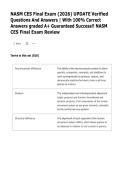
NASM CES Final Exam (2026) UPDATE Verified
Questions And Answers | With 100% Correct
Answers graded A+ Guaranteed Success!! NASM
CES Final Exam Review
Save
similarities and differences in these exams and how they prepare students for their respective careers.________________________________________1. Business Exams1.1.
Overview of Business EducationBusiness education prepares students for leadership and management roles in various industries. It focuses on critical thinking, decision-
Terms in this set (818)
Neuromuscular efficiency The ability of the neuromuscular system to allow
agonists, antagonists, synergists, and stablilzers to
work synergistically to produce, reduce, and
dynamically stabilize the kinetic chain in all three
planes of motion.
Posture The independent and interdependent alignment
(static posture) and function (transitional and
dynamic posture) of all components of the human
movement system at any given moment; controlled
by the central nervous system.
Structural efficiency The alignment of each segment of the human
movement system (HMS), which allows posture to
be balanced in relation to one's center of gravity.
,similarities and differences in these exams and how they prepare students for their respective careers.________________________________________1. Business Exams1.1.
Overview of Business EducationBusiness education prepares students for leadership and management roles in various industries. It focuses on critical thinking, decision-
Functional efficiency The ability of the neuromuscular system to recruit
correct muscle synergies, at the right time, with the
appropriate amount of force to perform functional
tasks with the least amount of energy and stress on
the human movement system.
Cumulative injury cycle A cycle in which an injury will induce inflammation,
muscle spasm, adhesion, altered neuromusclular
control, and muscle imbalances.
Movement impairment syndrome Refers to the state in which the structural integrity
of the human movement system (HMS) is
compromised because the components are out of
alignment.
Altered reciprocal inhibition The process whereby a tight muscle (short,
overactive, myofascial adhesions) causes
decreased neural drive and therefore optimal
recruitment of its functional antagonist.
Synergistic dominance The process by which a synergist compenstates for
a prime mover to maintain force production.
Lower extremity movement Usually characterized by excessive foot pronation
impairment syndrome (flat feet), increased knee valgus (tibia externally
rotated and femur internally rotated and adducted
or knock-kneed), and increased movement at the
lumbo-pelvic-hip-complex (extension or flexion)
during functional movements.
Upper extremity movement Usually characterized as having rounded shoulders
impairment syndrome and a forward head posture or improper
scapulothoracic or glenohumeral kinematics during
functional movements.
, similarities and differences in these exams and how they prepare students for their respective careers.________________________________________1. Business Exams1.1.
Overview of Business EducationBusiness education prepares students for leadership and management roles in various industries. It focuses on critical thinking, decision-
Lengthening Techniques 2nd phase in the Corrective Exercise Continuum is
to lengthen those overactive or tight
neuromyofascial tissues.
Lengthening refers to the elongation of mechanically shortened
muscle and connective tissuenecessary to increase
range of motion (ROM) at the tissue and joint.
2 most common methods of Static stretching
stretching: Neuromuscular stretching
Static stretching Combines low force with long duration using
autogenic inhibition. This form of stretching allows
for relaxation and concomitant elongation of
muscle. To perform static stretching, the stretch is
held at the first point of tension or resistance
barrier for 30 seconds. Performed solo
Neuromuscular stretching commonly called proprioceptive neuromuscular
facilitation,or PNF involves taking the muscle to its
end ROM (point of joint compensation), actively
contracting the muscle to be stretched for 7 -15
seconds, then passively moving the joint to a new
end ROM and holding this position for 20-30
seconds.
Recurrent inhibition A feedback circuit that can decrease the excitability
of motor neurons via the interneuron called the
Renshaw cell.
Stretch reflex A muscle contraction in response to stretching
within the muscle.
Questions And Answers | With 100% Correct
Answers graded A+ Guaranteed Success!! NASM
CES Final Exam Review
Save
similarities and differences in these exams and how they prepare students for their respective careers.________________________________________1. Business Exams1.1.
Overview of Business EducationBusiness education prepares students for leadership and management roles in various industries. It focuses on critical thinking, decision-
Terms in this set (818)
Neuromuscular efficiency The ability of the neuromuscular system to allow
agonists, antagonists, synergists, and stablilzers to
work synergistically to produce, reduce, and
dynamically stabilize the kinetic chain in all three
planes of motion.
Posture The independent and interdependent alignment
(static posture) and function (transitional and
dynamic posture) of all components of the human
movement system at any given moment; controlled
by the central nervous system.
Structural efficiency The alignment of each segment of the human
movement system (HMS), which allows posture to
be balanced in relation to one's center of gravity.
,similarities and differences in these exams and how they prepare students for their respective careers.________________________________________1. Business Exams1.1.
Overview of Business EducationBusiness education prepares students for leadership and management roles in various industries. It focuses on critical thinking, decision-
Functional efficiency The ability of the neuromuscular system to recruit
correct muscle synergies, at the right time, with the
appropriate amount of force to perform functional
tasks with the least amount of energy and stress on
the human movement system.
Cumulative injury cycle A cycle in which an injury will induce inflammation,
muscle spasm, adhesion, altered neuromusclular
control, and muscle imbalances.
Movement impairment syndrome Refers to the state in which the structural integrity
of the human movement system (HMS) is
compromised because the components are out of
alignment.
Altered reciprocal inhibition The process whereby a tight muscle (short,
overactive, myofascial adhesions) causes
decreased neural drive and therefore optimal
recruitment of its functional antagonist.
Synergistic dominance The process by which a synergist compenstates for
a prime mover to maintain force production.
Lower extremity movement Usually characterized by excessive foot pronation
impairment syndrome (flat feet), increased knee valgus (tibia externally
rotated and femur internally rotated and adducted
or knock-kneed), and increased movement at the
lumbo-pelvic-hip-complex (extension or flexion)
during functional movements.
Upper extremity movement Usually characterized as having rounded shoulders
impairment syndrome and a forward head posture or improper
scapulothoracic or glenohumeral kinematics during
functional movements.
, similarities and differences in these exams and how they prepare students for their respective careers.________________________________________1. Business Exams1.1.
Overview of Business EducationBusiness education prepares students for leadership and management roles in various industries. It focuses on critical thinking, decision-
Lengthening Techniques 2nd phase in the Corrective Exercise Continuum is
to lengthen those overactive or tight
neuromyofascial tissues.
Lengthening refers to the elongation of mechanically shortened
muscle and connective tissuenecessary to increase
range of motion (ROM) at the tissue and joint.
2 most common methods of Static stretching
stretching: Neuromuscular stretching
Static stretching Combines low force with long duration using
autogenic inhibition. This form of stretching allows
for relaxation and concomitant elongation of
muscle. To perform static stretching, the stretch is
held at the first point of tension or resistance
barrier for 30 seconds. Performed solo
Neuromuscular stretching commonly called proprioceptive neuromuscular
facilitation,or PNF involves taking the muscle to its
end ROM (point of joint compensation), actively
contracting the muscle to be stretched for 7 -15
seconds, then passively moving the joint to a new
end ROM and holding this position for 20-30
seconds.
Recurrent inhibition A feedback circuit that can decrease the excitability
of motor neurons via the interneuron called the
Renshaw cell.
Stretch reflex A muscle contraction in response to stretching
within the muscle.