

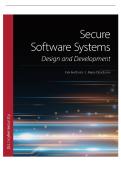
, TESTBANK FOR Secure Software Systems First Edition Fretheim
Important Notes
The file includes the complete test bank, organized chapter by chapter.
A sample of selected pages has been provided for preview.
All available appendices and Excel files (if included in the original resources) are
provided.
Quizzes, Midterm and final exams are included (if available in the original resources).
We continuously update our files to ensure you receive the latest and most accurate
editions.
New editions are added regularly – stay connected for updates!
⚠️Note on Answer Keys: If the answer key is not included within the chapter
questions, you will find the complete answers and solutions at the end of each
chapter.
✅ Why Buy From Us?
📚 Complete & organized chapter-by-chapter – no missing content, no guessing.
⚡ Instant digital delivery – get your file the moment you pay, no waiting.
📅 Always up to date – we track new editions so you always get the latest version.
💬 Friendly support – real humans ready to help, anytime you need us.
🔒 Safe & secure – thousands of satisfied students trust us every semester.
🛡️Our Guarantees
💰 Money-Back Guarantee: Not satisfied? We offer a full refund – no questions asked.
🔄 Wrong File? No Problem: Contact us and we will replace it immediately with the
correct version, free of charge.
⏰ 24/7 Support: We are always here – reach out anytime and expect a fast response.
,Secure Software Systems: Design and Development
Erik Fretheim and Marie Deschene
Test Bank
True/False
1. True or False? Nontechnical design is not included in SDLC.
Ans: False
Subject: Chapter 1
Multiple Choice
1. Attack methods change over time; therefore, software needs to:
A) be deletable.
B) be maintainable.
C) be constantly changed out for new systems.
D) be able to be changed by the users to protect against intrusion.
Ans: B
Subject: Chapter 1
2. Secure Software Lifecycle models include standardized __________ to ensure a quality and
secure product.
A) vulnerability checking
B) phases
C) fixtures
D) sets of stakeholders
Ans: C
Subject: Chapter 1
3. The most important part of any project (software or other) is:
A) the initiation phase.
B) looking for vulnerabilities.
C) communicating with stakeholders.
D) capturing effective requirements.
Ans: D
Subject: Chapter 1
Copyright © 2024 by Jones & Bartlett Learning, LLC, an Ascend Learning Company 1
,Secure Software Systems: Design and Development
Erik Fretheim and Marie Deschene
Test Bank
4. Which of the following would be considered a vulnerability, not a defect?
A) Network vulnerabilities
B) Software vulnerabilities
C) Hardware vulnerabilities
D) User/client requirement failures
Ans: B
Subject: Chapter 1
Copyright © 2024 by Jones & Bartlett Learning, LLC, an Ascend Learning Company 2
,Secure Software Systems: Design and Development
Erik Fretheim and Marie Deschene
Test Bank
Multiple Choice
1. How does program management differ from portfolio management?
A) Program management goals focus on performance, while portfolio management focuses on
quality.
B) Portfolio management seeks to have a set of software tools that that help organizations meet
their goals, while program management seeks to provide specific customers with software that
helps them maximize profits.
C) Portfolio management is usually performed by the development team, while program
management is usually performed by the Program Management Office.
D) Program management seeks to have a set of software tools that that help organizations meet
their goals, while portfolio management seeks to provide specific customers with software that
helps them maximize profits.
Ans: A
Subject: Chapter 2
2. Product planning is the responsibility of:
A) the management team.
B) the development team.
C) primarily the Product Management Office.
D) the customer oversight teams.
Ans: C
Subject: Chapter 2
3. Porter’s five forces model includes:
A) product quality, competitive rivalry, substitution threat, supplier power, and buyer financing.
B) competitive rivalry, threat of new entry, substitution threat, supplier power, and buyer power.
C) new technology threats, threat of new entry, supplier power, buyer power, and producer
financing capabilities.
D) offshoring rivalry, threat of new entry, substitution threat, scarce resources, and buyer power.
Ans: B
Subject: Chapter 2
4. Security issues in a software product:
A) will always be fixed.
Copyright © 2024 by Jones & Bartlett Learning, LLC, an Ascend Learning Company 1
,Secure Software Systems: Design and Development
Erik Fretheim and Marie Deschene
Test Bank
B) will be fixed only if there is time when making functional updates.
C) often require extensive changes to the software product.
D) cause a product to be abandoned or no longer updated.
Ans: D
Subject: Chapter 2
Copyright © 2024 by Jones & Bartlett Learning, LLC, an Ascend Learning Company 2
,Secure Software Systems: Design and Development
Erik Fretheim and Marie Deschene
Test Bank
Multiple Choice
1. Which of the following is true about projects?
A) They are the same as programs.
B) They have a beginning and an end.
C) They are unique to software development.
D) They can be extended if the need arises (such as the software needs modifications).
Ans: B
Subject: Chapter 3
2. How many phases of project management are there?
A) Six
B) Four
C) Five
D) Eight
Ans: C
Subject: Chapter 3
3. A communication plan needs to include:
A) stakeholders.
B) regular meetings.
C) management communications.
D) All of these are correct.
Ans: D
Subject: Chapter 3
4. Success of a project is judged by:
A) delivering a product on time, on budget, that fulfills the defined requirements.
B) few security issues, fulfills the defined requirements, and is delivered on time.
C) the ability to include functional requirements not originally included but that the stakeholder
added due to organizational needs and is delivered on budget.
D) how much it increases organizational productivity.
Ans: A
Subject: Chapter 3
Copyright © 2024 by Jones & Bartlett Learning, LLC, an Ascend Learning Company 1
,Secure Software Systems: Design and Development
Erik Fretheim and Marie Deschene
Test Bank
5. Anyone wanting to become a certified project manager (PMP) will need to follow the
requirements set by:
A) the IEEE.
B) the PMI.
C) the CISA.
D) the NIST organization.
Ans: B
Subject: Chapter 3
True/False
1. True or False? Program and project management contribute to software that helps businesses
meet their needs.
Ans: True
Subject: Chapter 3
Copyright © 2024 by Jones & Bartlett Learning, LLC, an Ascend Learning Company 2
,Secure Software Systems: Design and Development
Erik Fretheim and Marie Deschene
Test Bank
Multiple Choice
1. Quality assurance (QA) refers to:
A) the effort of testing the product.
B) confirming the product meets a specific quality level.
C) utilization of processes to meet product quality.
D) stakeholders performing assessment of the product.
Ans: B
Subject: Chapter 4
2. John is developing a new financial application and notes that entering a purchase order must
come before payment of a matching invoice. In software development, this:
A) is a queue requirement.
B) is a security requirement.
C) will require a specific coding language to manage.
D) is an example of SOP.
Ans: A
Subject: Chapter 4
3. Which of the following sets out the steps needed to complete a process?
A) Phases
B) Procedure
C) Process
D) Paradigm
Ans: B
Subject: Chapter 4
True/False
1. True or False? Queues are written so that they cannot be overloaded.
Ans: False
Subject: Chapter 4
Copyright © 2024 by Jones & Bartlett Learning, LLC, an Ascend Learning Company 1
, Secure Software Systems: Design and Development
Erik Fretheim and Marie Deschene
Test Bank
Multiple Selection
1. Which of the following contributes to secure development? Select all that apply.
A) Security testing
B) Threat mapping
C) Reusing previously written code
D) Vulnerability assessments
Ans: A, B, D
Subject: Chapter 4
Copyright © 2024 by Jones & Bartlett Learning, LLC, an Ascend Learning Company 2
Important Notes
The file includes the complete test bank, organized chapter by chapter.
A sample of selected pages has been provided for preview.
All available appendices and Excel files (if included in the original resources) are
provided.
Quizzes, Midterm and final exams are included (if available in the original resources).
We continuously update our files to ensure you receive the latest and most accurate
editions.
New editions are added regularly – stay connected for updates!
⚠️Note on Answer Keys: If the answer key is not included within the chapter
questions, you will find the complete answers and solutions at the end of each
chapter.
✅ Why Buy From Us?
📚 Complete & organized chapter-by-chapter – no missing content, no guessing.
⚡ Instant digital delivery – get your file the moment you pay, no waiting.
📅 Always up to date – we track new editions so you always get the latest version.
💬 Friendly support – real humans ready to help, anytime you need us.
🔒 Safe & secure – thousands of satisfied students trust us every semester.
🛡️Our Guarantees
💰 Money-Back Guarantee: Not satisfied? We offer a full refund – no questions asked.
🔄 Wrong File? No Problem: Contact us and we will replace it immediately with the
correct version, free of charge.
⏰ 24/7 Support: We are always here – reach out anytime and expect a fast response.
,Secure Software Systems: Design and Development
Erik Fretheim and Marie Deschene
Test Bank
True/False
1. True or False? Nontechnical design is not included in SDLC.
Ans: False
Subject: Chapter 1
Multiple Choice
1. Attack methods change over time; therefore, software needs to:
A) be deletable.
B) be maintainable.
C) be constantly changed out for new systems.
D) be able to be changed by the users to protect against intrusion.
Ans: B
Subject: Chapter 1
2. Secure Software Lifecycle models include standardized __________ to ensure a quality and
secure product.
A) vulnerability checking
B) phases
C) fixtures
D) sets of stakeholders
Ans: C
Subject: Chapter 1
3. The most important part of any project (software or other) is:
A) the initiation phase.
B) looking for vulnerabilities.
C) communicating with stakeholders.
D) capturing effective requirements.
Ans: D
Subject: Chapter 1
Copyright © 2024 by Jones & Bartlett Learning, LLC, an Ascend Learning Company 1
,Secure Software Systems: Design and Development
Erik Fretheim and Marie Deschene
Test Bank
4. Which of the following would be considered a vulnerability, not a defect?
A) Network vulnerabilities
B) Software vulnerabilities
C) Hardware vulnerabilities
D) User/client requirement failures
Ans: B
Subject: Chapter 1
Copyright © 2024 by Jones & Bartlett Learning, LLC, an Ascend Learning Company 2
,Secure Software Systems: Design and Development
Erik Fretheim and Marie Deschene
Test Bank
Multiple Choice
1. How does program management differ from portfolio management?
A) Program management goals focus on performance, while portfolio management focuses on
quality.
B) Portfolio management seeks to have a set of software tools that that help organizations meet
their goals, while program management seeks to provide specific customers with software that
helps them maximize profits.
C) Portfolio management is usually performed by the development team, while program
management is usually performed by the Program Management Office.
D) Program management seeks to have a set of software tools that that help organizations meet
their goals, while portfolio management seeks to provide specific customers with software that
helps them maximize profits.
Ans: A
Subject: Chapter 2
2. Product planning is the responsibility of:
A) the management team.
B) the development team.
C) primarily the Product Management Office.
D) the customer oversight teams.
Ans: C
Subject: Chapter 2
3. Porter’s five forces model includes:
A) product quality, competitive rivalry, substitution threat, supplier power, and buyer financing.
B) competitive rivalry, threat of new entry, substitution threat, supplier power, and buyer power.
C) new technology threats, threat of new entry, supplier power, buyer power, and producer
financing capabilities.
D) offshoring rivalry, threat of new entry, substitution threat, scarce resources, and buyer power.
Ans: B
Subject: Chapter 2
4. Security issues in a software product:
A) will always be fixed.
Copyright © 2024 by Jones & Bartlett Learning, LLC, an Ascend Learning Company 1
,Secure Software Systems: Design and Development
Erik Fretheim and Marie Deschene
Test Bank
B) will be fixed only if there is time when making functional updates.
C) often require extensive changes to the software product.
D) cause a product to be abandoned or no longer updated.
Ans: D
Subject: Chapter 2
Copyright © 2024 by Jones & Bartlett Learning, LLC, an Ascend Learning Company 2
,Secure Software Systems: Design and Development
Erik Fretheim and Marie Deschene
Test Bank
Multiple Choice
1. Which of the following is true about projects?
A) They are the same as programs.
B) They have a beginning and an end.
C) They are unique to software development.
D) They can be extended if the need arises (such as the software needs modifications).
Ans: B
Subject: Chapter 3
2. How many phases of project management are there?
A) Six
B) Four
C) Five
D) Eight
Ans: C
Subject: Chapter 3
3. A communication plan needs to include:
A) stakeholders.
B) regular meetings.
C) management communications.
D) All of these are correct.
Ans: D
Subject: Chapter 3
4. Success of a project is judged by:
A) delivering a product on time, on budget, that fulfills the defined requirements.
B) few security issues, fulfills the defined requirements, and is delivered on time.
C) the ability to include functional requirements not originally included but that the stakeholder
added due to organizational needs and is delivered on budget.
D) how much it increases organizational productivity.
Ans: A
Subject: Chapter 3
Copyright © 2024 by Jones & Bartlett Learning, LLC, an Ascend Learning Company 1
,Secure Software Systems: Design and Development
Erik Fretheim and Marie Deschene
Test Bank
5. Anyone wanting to become a certified project manager (PMP) will need to follow the
requirements set by:
A) the IEEE.
B) the PMI.
C) the CISA.
D) the NIST organization.
Ans: B
Subject: Chapter 3
True/False
1. True or False? Program and project management contribute to software that helps businesses
meet their needs.
Ans: True
Subject: Chapter 3
Copyright © 2024 by Jones & Bartlett Learning, LLC, an Ascend Learning Company 2
,Secure Software Systems: Design and Development
Erik Fretheim and Marie Deschene
Test Bank
Multiple Choice
1. Quality assurance (QA) refers to:
A) the effort of testing the product.
B) confirming the product meets a specific quality level.
C) utilization of processes to meet product quality.
D) stakeholders performing assessment of the product.
Ans: B
Subject: Chapter 4
2. John is developing a new financial application and notes that entering a purchase order must
come before payment of a matching invoice. In software development, this:
A) is a queue requirement.
B) is a security requirement.
C) will require a specific coding language to manage.
D) is an example of SOP.
Ans: A
Subject: Chapter 4
3. Which of the following sets out the steps needed to complete a process?
A) Phases
B) Procedure
C) Process
D) Paradigm
Ans: B
Subject: Chapter 4
True/False
1. True or False? Queues are written so that they cannot be overloaded.
Ans: False
Subject: Chapter 4
Copyright © 2024 by Jones & Bartlett Learning, LLC, an Ascend Learning Company 1
, Secure Software Systems: Design and Development
Erik Fretheim and Marie Deschene
Test Bank
Multiple Selection
1. Which of the following contributes to secure development? Select all that apply.
A) Security testing
B) Threat mapping
C) Reusing previously written code
D) Vulnerability assessments
Ans: A, B, D
Subject: Chapter 4
Copyright © 2024 by Jones & Bartlett Learning, LLC, an Ascend Learning Company 2


