

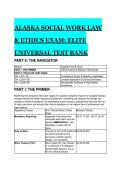
ALASKA SOCIAL WORK LAW
& ETHICS EXAM: ELITE
UNIVERSAL TEST BANK
PART 0: THE NAVIGATOR
Section Cognitive Tier & Focus
PART I: THE PRIMER Critical Axioms & Statutory Hard Decks
PART II: THE ELITE TEST BANK
Tier 1 (Q1–15) Foundational Syntax & Statutory Application
Tier 2 (Q16–35) Complex Application & Clinical Simulation
Tier 3 (Q36–60) Grandmaster Synthesis & High-Stakes
Compliance
PART I: THE PRIMER
Mastering this exhaustive test bank forges the cognitive discipline required to navigate Alaska’s
stringent behavioral health regulatory architecture, translating raw statutory knowledge into
bulletproof clinical compliance. By internalizing these scenarios, practitioners eliminate the risk
of board sanctions and elevate their clinical operations to the highest tiers of professional and
legal mastery.
Regulatory Domain The "Critical Axioms" Cheat Statutory Citation
Sheet
Mandatory Reporting Suspected child abuse and AS 47.17.020 , AS 47.24.010
vulnerable adult harm must be
reported IMMEDIATELY, and
absolutely no later than 24
hours.
Duty to Warn The duty to warn third parties of AS 08.95.900
imminent physical harm is
permissive (shields against
liability), not mandatory.
Minor Consent (16+) Minors aged 16+ may consent AS 25.20.028
to a maximum of 5 outpatient
mental health sessions (up to
90 min) without parents.
,Regulatory Domain The "Critical Axioms" Cheat Statutory Citation
Sheet
Prescribing medication strictly
requires parental consent.
Record Retention Adult records: 7 years 7 AAC 13.120
post-discharge. Minor records:
7 years post-discharge OR 2
years after reaching age
19—whichever is longer.
CE Synthesis 45 hours biennially. Mandates: 12 AAC 18.210
3 hrs Ethics, 3 hrs Suicide, 3
hrs Teletherapy, 6 hrs
Substance Abuse, 6 hrs
Cross-Cultural. Exactly one-half
must be synchronous.
Clinical Supervision Beginning mid-2026, 12 AAC 18.113
supervisors need 3 years
LCSW experience, 6 hours of
supervision CE, and a strict cap
of 5 supervisees.
PART II: THE ELITE TEST BANK
Tier 1 - Foundational Syntax & Application
Q1: A licensed clinical social worker (LCSW) suspects that a 10-year-old client is experiencing
physical abuse at home. According to AS 47.17.020, what is the MAXIMUM allowable
timeframe for the LCSW to file a Report of Harm with the Office of Children's Services (OCS)?
A) Immediately, not to exceed 48 hours. B) Within 72 hours, pending an internal agency review.
C) Immediately, and no later than 24 hours. D) Prior to the client's next scheduled therapy
session.
● The Answer: C (Immediately, and no later than 24 hours.)
● Distractor Analysis:
○ A is incorrect: 48 hours exceeds the statutory limit and represents a common
novice confusion with secondary documentation timelines.
○ B is incorrect: Agency policy cannot supersede state law; delaying for internal
review violates the mandate.
○ D is incorrect: Reporting must be based on time of suspicion, not clinical
scheduling.
The Mentor's Analysis: Alaska law treats suspected child abuse as an immediate crisis. The
statute explicitly uses the word "immediately" and defines the absolute ceiling as 24 hours.
Professional/Academic Intuition: When harm is suspected, the clock starts instantly;
never wait for administrative consensus to report.
Q2: Under AS 25.20.028 regarding behavioral and mental health treatment of minors, a
16-year-old seeks therapy without parental consent. Which limitation STRICTLY applies to this
scenario? A) The minor may receive unlimited sessions, provided they demonstrate clinical
maturity. B) The minor may receive up to five outpatient appointments of up to 90 minutes each.
C) The minor may receive therapy, but parents must be billed directly within 30 days. D) The
, minor can only receive services if emancipated by a court of law.
● The Answer: B (The minor may receive up to five outpatient appointments of up to 90
minutes each.)
● Distractor Analysis:
○ A is incorrect: The statute places a hard numerical cap on initial sessions.
○ C is incorrect: Billing parents without consent violates the minor's right to
confidential care under this specific statute.
○ D is incorrect: The statute explicitly empowers unemancipated 16- and
17-year-olds.
The Mentor's Analysis: This recent statutory update empowers mature minors to access crisis
or brief intervention safely, while setting a boundary (5 sessions) that forces a clinical
re-evaluation of parental involvement. Professional/Academic Intuition: The 16/5 rule
bridges the gap between minor autonomy and family integration.
Q3: An LMSW is completing their first biennial license renewal in Alaska. According to 12 AAC
18.210, how many of their 6 required hours in cross-cultural education must relate specifically to
Alaska Natives? A) Zero, provided they complete general diversity training. B) At least three (3)
hours. C) Exactly four (4) hours. D) All six (6) hours.
● The Answer: D (All six (6) hours.)
● Distractor Analysis:
○ A is incorrect: Alaska statutes strictly mandate indigenous-specific education.
○ B is incorrect: Three hours is the requirement for the second and subsequent
renewals, not the first.
○ C is incorrect: This is a fabricated number lacking statutory basis.
The Mentor's Analysis: The Board requires new licensees to deeply immerse themselves in
the specific historical and cultural contexts of Alaska Natives. Only veteran licensees
(subsequent renewals) are permitted to split these hours. Professional/Academic Intuition:
First renewal equals total immersion: 6 hours means 6 Alaska Native hours.
Q4: Based on Alaska's interpretation of the Tarasoff ruling and AS 08.95.900, if a client makes a
credible threat of imminent serious physical harm against an identified victim, the social worker's
duty to warn is legally classified as: A) A strict, mandatory obligation carrying criminal penalties
for failure to report. B) Permissive, allowing the social worker to break confidentiality without
legal liability. C) Prohibited unless the client explicitly signs a release of information. D)
Mandatory only if the victim is a minor or vulnerable adult.
● The Answer: B (Permissive, allowing the social worker to break confidentiality without
legal liability.)
● Distractor Analysis:
○ A is incorrect: Unlike many states, Alaska does not mandate the duty to warn under
AS 08.95.900.
○ C is incorrect: Imminent threat to life legally overrides the standard requirement for
a signed ROI.
○ D is incorrect: Minor and vulnerable adult statutes govern abuse, not future violence
against third parties.
The Mentor's Analysis: Alaska is a "permissive" state regarding the duty to warn. While
standard clinical ethics strongly compel the social worker to act, the state statute shields the
worker from liability for breaking confidentiality, rather than prosecuting them for failing to do so.
Professional/Academic Intuition: Permissive law removes the legal barrier to warning,
but clinical ethics dictate the action.
Q5: A client terminates therapy at age 18. Under 7 AAC 13.120, the social worker must retain
& ETHICS EXAM: ELITE
UNIVERSAL TEST BANK
PART 0: THE NAVIGATOR
Section Cognitive Tier & Focus
PART I: THE PRIMER Critical Axioms & Statutory Hard Decks
PART II: THE ELITE TEST BANK
Tier 1 (Q1–15) Foundational Syntax & Statutory Application
Tier 2 (Q16–35) Complex Application & Clinical Simulation
Tier 3 (Q36–60) Grandmaster Synthesis & High-Stakes
Compliance
PART I: THE PRIMER
Mastering this exhaustive test bank forges the cognitive discipline required to navigate Alaska’s
stringent behavioral health regulatory architecture, translating raw statutory knowledge into
bulletproof clinical compliance. By internalizing these scenarios, practitioners eliminate the risk
of board sanctions and elevate their clinical operations to the highest tiers of professional and
legal mastery.
Regulatory Domain The "Critical Axioms" Cheat Statutory Citation
Sheet
Mandatory Reporting Suspected child abuse and AS 47.17.020 , AS 47.24.010
vulnerable adult harm must be
reported IMMEDIATELY, and
absolutely no later than 24
hours.
Duty to Warn The duty to warn third parties of AS 08.95.900
imminent physical harm is
permissive (shields against
liability), not mandatory.
Minor Consent (16+) Minors aged 16+ may consent AS 25.20.028
to a maximum of 5 outpatient
mental health sessions (up to
90 min) without parents.
,Regulatory Domain The "Critical Axioms" Cheat Statutory Citation
Sheet
Prescribing medication strictly
requires parental consent.
Record Retention Adult records: 7 years 7 AAC 13.120
post-discharge. Minor records:
7 years post-discharge OR 2
years after reaching age
19—whichever is longer.
CE Synthesis 45 hours biennially. Mandates: 12 AAC 18.210
3 hrs Ethics, 3 hrs Suicide, 3
hrs Teletherapy, 6 hrs
Substance Abuse, 6 hrs
Cross-Cultural. Exactly one-half
must be synchronous.
Clinical Supervision Beginning mid-2026, 12 AAC 18.113
supervisors need 3 years
LCSW experience, 6 hours of
supervision CE, and a strict cap
of 5 supervisees.
PART II: THE ELITE TEST BANK
Tier 1 - Foundational Syntax & Application
Q1: A licensed clinical social worker (LCSW) suspects that a 10-year-old client is experiencing
physical abuse at home. According to AS 47.17.020, what is the MAXIMUM allowable
timeframe for the LCSW to file a Report of Harm with the Office of Children's Services (OCS)?
A) Immediately, not to exceed 48 hours. B) Within 72 hours, pending an internal agency review.
C) Immediately, and no later than 24 hours. D) Prior to the client's next scheduled therapy
session.
● The Answer: C (Immediately, and no later than 24 hours.)
● Distractor Analysis:
○ A is incorrect: 48 hours exceeds the statutory limit and represents a common
novice confusion with secondary documentation timelines.
○ B is incorrect: Agency policy cannot supersede state law; delaying for internal
review violates the mandate.
○ D is incorrect: Reporting must be based on time of suspicion, not clinical
scheduling.
The Mentor's Analysis: Alaska law treats suspected child abuse as an immediate crisis. The
statute explicitly uses the word "immediately" and defines the absolute ceiling as 24 hours.
Professional/Academic Intuition: When harm is suspected, the clock starts instantly;
never wait for administrative consensus to report.
Q2: Under AS 25.20.028 regarding behavioral and mental health treatment of minors, a
16-year-old seeks therapy without parental consent. Which limitation STRICTLY applies to this
scenario? A) The minor may receive unlimited sessions, provided they demonstrate clinical
maturity. B) The minor may receive up to five outpatient appointments of up to 90 minutes each.
C) The minor may receive therapy, but parents must be billed directly within 30 days. D) The
, minor can only receive services if emancipated by a court of law.
● The Answer: B (The minor may receive up to five outpatient appointments of up to 90
minutes each.)
● Distractor Analysis:
○ A is incorrect: The statute places a hard numerical cap on initial sessions.
○ C is incorrect: Billing parents without consent violates the minor's right to
confidential care under this specific statute.
○ D is incorrect: The statute explicitly empowers unemancipated 16- and
17-year-olds.
The Mentor's Analysis: This recent statutory update empowers mature minors to access crisis
or brief intervention safely, while setting a boundary (5 sessions) that forces a clinical
re-evaluation of parental involvement. Professional/Academic Intuition: The 16/5 rule
bridges the gap between minor autonomy and family integration.
Q3: An LMSW is completing their first biennial license renewal in Alaska. According to 12 AAC
18.210, how many of their 6 required hours in cross-cultural education must relate specifically to
Alaska Natives? A) Zero, provided they complete general diversity training. B) At least three (3)
hours. C) Exactly four (4) hours. D) All six (6) hours.
● The Answer: D (All six (6) hours.)
● Distractor Analysis:
○ A is incorrect: Alaska statutes strictly mandate indigenous-specific education.
○ B is incorrect: Three hours is the requirement for the second and subsequent
renewals, not the first.
○ C is incorrect: This is a fabricated number lacking statutory basis.
The Mentor's Analysis: The Board requires new licensees to deeply immerse themselves in
the specific historical and cultural contexts of Alaska Natives. Only veteran licensees
(subsequent renewals) are permitted to split these hours. Professional/Academic Intuition:
First renewal equals total immersion: 6 hours means 6 Alaska Native hours.
Q4: Based on Alaska's interpretation of the Tarasoff ruling and AS 08.95.900, if a client makes a
credible threat of imminent serious physical harm against an identified victim, the social worker's
duty to warn is legally classified as: A) A strict, mandatory obligation carrying criminal penalties
for failure to report. B) Permissive, allowing the social worker to break confidentiality without
legal liability. C) Prohibited unless the client explicitly signs a release of information. D)
Mandatory only if the victim is a minor or vulnerable adult.
● The Answer: B (Permissive, allowing the social worker to break confidentiality without
legal liability.)
● Distractor Analysis:
○ A is incorrect: Unlike many states, Alaska does not mandate the duty to warn under
AS 08.95.900.
○ C is incorrect: Imminent threat to life legally overrides the standard requirement for
a signed ROI.
○ D is incorrect: Minor and vulnerable adult statutes govern abuse, not future violence
against third parties.
The Mentor's Analysis: Alaska is a "permissive" state regarding the duty to warn. While
standard clinical ethics strongly compel the social worker to act, the state statute shields the
worker from liability for breaking confidentiality, rather than prosecuting them for failing to do so.
Professional/Academic Intuition: Permissive law removes the legal barrier to warning,
but clinical ethics dictate the action.
Q5: A client terminates therapy at age 18. Under 7 AAC 13.120, the social worker must retain


