

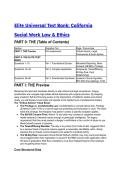
Elite Universal Test Bank: California
Social Work Law & Ethics
PART 0: THE (Table of Contents)
Section Cognitive Tier Page / Focus Area
PART I: THE Preview Pre-Assessment Critical Axioms, Legal
Frameworks & Exam Syntax
PART II: THE ELITE TEST
BANK
Questions 1–15 Tier 1: Foundational Syntax Mandated Reporting, Minor
Consent (AB 665), Privilege
Questions 16–35 Tier 2: Complex Application Subpoenas, Tarasoff/Ewing,
90-Day Rule, Dual
Relationships
Questions 36–60 Tier 3: Grandmaster Synthesis Systemic Clinical Vignettes,
BPC 650 (Fee Splitting), 5150
PART I: THE Preview
Mastering this test bank translates directly to elite clinical and legal competence, forging
practitioners who navigate high-stakes ethical dilemmas with surgical precision. By stripping
away academic fluff and focusing purely on the intersection of California statute and clinical
reality, you will bypass novice traps and operate at the highest level of professional mastery.
The "Critical Axioms" Cheat Sheet:
● The Privilege vs. Confidentiality Law: Confidentiality is a broad ethical duty; Privilege
(Evidence Code 1014) is a narrow legal rule protecting communication in court. The client
holds the privilege; the therapist must assert it unless a specific exception applies.
● The AB 665 Consent Pivot: Minors 12 and older may consent to outpatient mental
health treatment if deemed mature enough to participate intelligently. The legacy
requirement that they must present a danger to self/others or be a victim of abuse to use
Medi-Cal/self-consent is obsolete.
● The Tarasoff/Ewing Mandate: The duty is to protect (Civil Code 43.92), triggered ONLY
by a serious threat of physical violence against a reasonably identifiable victim. Ewing
expands this to threats communicated by the patient's immediate family.
● The 90-Day Rule: Associate Clinical Social Workers (ASWs) may only count post-degree
hours logged before their registration is issued IF the BBS receives their application within
90 days of graduation AND they completed a Live Scan fingerprinting for their employer
prior to gaining those hours.
Core Structural Data
,Legal Framework Key Threshold / Timeline Source / Statute
Elder Abuse (Physical in Serious bodily injury: 911
LTC) immediately, written report
within 2 hours.
Child Abuse (General) Phone immediately, written
report within 36 hours.
Subpoena vs. Court Order Subpoena = Assert Privilege.
Court Order = Comply.
Record Retention Minimum 7 years
post-termination for adults.
Supervision Limits Max 6 individual/triadic
supervisees in nonexempt
settings.
PART II: THE ELITE TEST BANK
Tier 1 (Questions 1–15) - Foundational Syntax & Application
Q1: A 13-year-old client utilizing Medi-Cal seeks outpatient trauma counseling. The client is not
currently a danger to themselves or others and is not a victim of abuse. Based on the principles
of the California Family Code 6924 (AB 665), which action is the MOST APPROPRIATE? A)
Require parental consent because the client does not meet the criteria of being a danger to self
or others. B) Deny services until the client obtains full-scope Medi-Cal minor consent approval.
C) Allow the client to consent to treatment if the clinician determines they are mature enough to
participate intelligently. D) Allow the client to consent but mandate immediate notification to the
parents regardless of the client's wishes.
● The Answer: C (Allow the client to consent to treatment if the clinician determines they
are mature enough to participate intelligently.)
● Distractor Analysis:
○ A is incorrect: AB 665 removed the requirement that a minor must be in danger or a
victim of abuse to consent.
○ B is incorrect: Minors already eligible for Medi-Cal do not need to apply for separate
limited-scope minor consent services.
○ D is incorrect: The law requires parental involvement unless the clinician
determines, after consulting the minor, that such involvement is inappropriate.
The Mentor's Analysis: The passage of AB 665 streamlined minor consent, aligning standard
Family Code rules with Medi-Cal access. When facing minor consent issues, the immediate
priority is assessing the client's maturity to participate intelligently. By utilizing the maturity
standard, you bypass the common trap of relying on outdated "danger to self/others" caveats.
Professional/Academic Intuition: Age 12 + Clinical Maturity = Consent Authority.
Q2: A licensed clinical social worker (LCSW) working in a Long-Term Care (LTC) facility
witnesses a staff member physically assault a resident, resulting in a broken arm. Based on the
principles of California Elder Abuse Mandated Reporting, which action is REQUIRED? A)
Submit a written SOC 341 report to the local Ombudsman within 2 working days. B) Call law
enforcement or 911 immediately, and submit a written report within 2 hours. C) Notify the facility
administrator and await their internal investigation before reporting. D) Call Adult Protective
Services (APS) within 24 hours.
● The Answer: B (Call law enforcement or 911 immediately, and submit a written report
, within 2 hours.)
● Distractor Analysis:
○ A is incorrect: Two working days is the timeline for non-physical abuse or physical
abuse without serious bodily injury outside of LTCs.
○ C is incorrect: Mandated reporting duties are individual and cannot be delegated to
supervisors or delayed by internal investigations.
○ D is incorrect: APS does not have jurisdiction over LTC facilities; the Ombudsman
and Law Enforcement handle LTC abuse. Furthermore, serious bodily injury triggers
a 2-hour written window.
The Mentor's Analysis: Serious bodily injury in an LTC setting escalates reporting to the
highest urgency under the Elder Justice Act and state law. When facing physical abuse with
severe injury, the immediate priority is law enforcement intervention. By utilizing the 2-hour rule,
you bypass the common trap of treating all elder abuse under the standard 2-day reporting
window. Professional/Academic Intuition: Serious bodily injury in an LTC equals 911
immediately and written report within 2 hours.
Q3: A therapist receives a subpoena duces tecum from a client's ex-spouse's attorney
demanding the client's complete psychotherapy records for an upcoming custody hearing.
Based on the principles of California Evidence Code 1014, what should the therapist do FIRST?
A) Turn over the records immediately to comply with the legal subpoena. B) Send a treatment
summary instead of the full records to protect confidentiality. C) Assert the
psychotherapist-patient privilege and contact the client. D) Ignore the subpoena until a judge
issues a formal court order.
● The Answer: C (Assert the psychotherapist-patient privilege and contact the client.)
● Distractor Analysis:
○ A is incorrect: A subpoena from an attorney is not a court order. Disclosing records
without client consent violates privilege.
○ B is incorrect: Sending a summary still constitutes a breach of privilege if the client
has not consented.
○ D is incorrect: Ignoring a validly served subpoena can lead to contempt charges;
the therapist must formally respond by asserting the privilege.
The Mentor's Analysis: The therapist acts as the guardian of the client's privilege. When facing
a lawyer-issued subpoena, the immediate priority is asserting privilege to freeze the process
until the client's wishes are known. By utilizing the assertion of privilege, you bypass the
common trap of confusing an attorney's subpoena with a compelling court order.
Professional/Academic Intuition: Subpoenas demand a response; court orders demand
compliance.
Q4: A client with Obsessive-Compulsive Disorder (OCD) tells their LCSW, "I keep having
intrusive, unwanted thoughts about stabbing my neighbor, and it terrifies me." The client has no
history of violence and employs compulsive rituals to avoid the neighbor. Based on the
principles of Civil Code 43.92 (Tarasoff), which conclusion is the MOST ACCURATE? A) The
therapist must warn the neighbor because the threat involves specific physical violence. B) The
therapist must hospitalize the client under a 5150 hold. C) The therapist has no duty to protect
because the client's statement is ego-dystonic and does not constitute a serious threat of
violence. D) The therapist must notify law enforcement to perform a welfare check on the
neighbor.
● The Answer: C (The therapist has no duty to protect because the client's statement is
ego-dystonic and does not constitute a serious threat of violence.)
● Distractor Analysis:
, ○ A is incorrect: Intrusive OCD thoughts are unwanted and resisted; they do not
represent a genuine "serious threat of physical violence" required to breach
confidentiality.
○ B is incorrect: The client is distressed by the thoughts, not planning to act on them;
a 5150 is not clinically or legally justified.
○ D is incorrect: Notifying police violates confidentiality without the legal justification of
an actual threat.
The Mentor's Analysis: Tarasoff requires a serious, volitional threat of violence, not merely the
presence of taboo cognitive intrusions. When facing OCD presentations, the immediate priority
is distinguishing ego-dystonic obsessions from genuine intent. By utilizing differential diagnosis,
you bypass the common trap of prematurely breaching confidentiality due to clinical anxiety.
Professional/Academic Intuition: An obsession is a fear, not a threat; duty to protect
requires intent.
Q5: An Associate Clinical Social Worker (ASW) graduated on May 1st. On May 10th, they
completed a Live Scan fingerprinting requested by their employer. On May 15th, they began
seeing clients. The BBS received their ASW application on June 1st, and the registration was
issued on August 1st. Based on the 90-Day Rule, which hours can the ASW count toward
licensure? A) None of the hours gained before August 1st. B) All hours gained from May 1st
onward. C) Hours gained from May 15th onward. D) Hours gained from June 1st onward.
● The Answer: C (Hours gained from May 15th onward.)
● Distractor Analysis:
○ A is incorrect: The 90-day rule allows pre-registration hours to count if strict criteria
are met.
○ B is incorrect: Hours cannot be counted prior to the completion of the
employer-required Live Scan (May 10th).
○ D is incorrect: The application receipt date (June 1st) simply validates the 90-day
window; the hours count from the date the Live Scan was completed and work
began.
The Mentor's Analysis: The 90-day rule is a strict mechanical timeline designed to allow
seamless transition from student to associate. When calculating eligible hours, the immediate
priority is verifying the date of the employer's Live Scan. By utilizing the Live Scan date
benchmark, you bypass the common trap of assuming graduation date alone activates hour
logging. Professional/Academic Intuition: No Live Scan, no logged hours—regardless of
graduation date.
Q6: A 15-year-old client reveals they are having consensual sexual intercourse with their
14-year-old partner. Neither party is in a position of authority over the other. Based on the Child
Abuse and Neglect Reporting Act, what is the therapist REQUIRED to do? A) Immediately
report the activity to Child Protective Services (CPS). B) File a report with local law enforcement
within 36 hours. C) Maintain confidentiality and explore safe sex practices with the client. D)
Mandate a joint session with the parents of both minors.
● The Answer: C (Maintain confidentiality and explore safe sex practices with the client.)
● Distractor Analysis:
○ A is incorrect: Under the "Age 13 Rule" in California, consensual sex between
minors where both are over 13 and under 21 is not automatically reportable unless
coercion or exploitation is suspected.
○ B is incorrect: Law enforcement reporting is not triggered by age-appropriate
consensual teenage sexual activity.
○ D is incorrect: Forcing a joint parent session violates the minor's right to
Social Work Law & Ethics
PART 0: THE (Table of Contents)
Section Cognitive Tier Page / Focus Area
PART I: THE Preview Pre-Assessment Critical Axioms, Legal
Frameworks & Exam Syntax
PART II: THE ELITE TEST
BANK
Questions 1–15 Tier 1: Foundational Syntax Mandated Reporting, Minor
Consent (AB 665), Privilege
Questions 16–35 Tier 2: Complex Application Subpoenas, Tarasoff/Ewing,
90-Day Rule, Dual
Relationships
Questions 36–60 Tier 3: Grandmaster Synthesis Systemic Clinical Vignettes,
BPC 650 (Fee Splitting), 5150
PART I: THE Preview
Mastering this test bank translates directly to elite clinical and legal competence, forging
practitioners who navigate high-stakes ethical dilemmas with surgical precision. By stripping
away academic fluff and focusing purely on the intersection of California statute and clinical
reality, you will bypass novice traps and operate at the highest level of professional mastery.
The "Critical Axioms" Cheat Sheet:
● The Privilege vs. Confidentiality Law: Confidentiality is a broad ethical duty; Privilege
(Evidence Code 1014) is a narrow legal rule protecting communication in court. The client
holds the privilege; the therapist must assert it unless a specific exception applies.
● The AB 665 Consent Pivot: Minors 12 and older may consent to outpatient mental
health treatment if deemed mature enough to participate intelligently. The legacy
requirement that they must present a danger to self/others or be a victim of abuse to use
Medi-Cal/self-consent is obsolete.
● The Tarasoff/Ewing Mandate: The duty is to protect (Civil Code 43.92), triggered ONLY
by a serious threat of physical violence against a reasonably identifiable victim. Ewing
expands this to threats communicated by the patient's immediate family.
● The 90-Day Rule: Associate Clinical Social Workers (ASWs) may only count post-degree
hours logged before their registration is issued IF the BBS receives their application within
90 days of graduation AND they completed a Live Scan fingerprinting for their employer
prior to gaining those hours.
Core Structural Data
,Legal Framework Key Threshold / Timeline Source / Statute
Elder Abuse (Physical in Serious bodily injury: 911
LTC) immediately, written report
within 2 hours.
Child Abuse (General) Phone immediately, written
report within 36 hours.
Subpoena vs. Court Order Subpoena = Assert Privilege.
Court Order = Comply.
Record Retention Minimum 7 years
post-termination for adults.
Supervision Limits Max 6 individual/triadic
supervisees in nonexempt
settings.
PART II: THE ELITE TEST BANK
Tier 1 (Questions 1–15) - Foundational Syntax & Application
Q1: A 13-year-old client utilizing Medi-Cal seeks outpatient trauma counseling. The client is not
currently a danger to themselves or others and is not a victim of abuse. Based on the principles
of the California Family Code 6924 (AB 665), which action is the MOST APPROPRIATE? A)
Require parental consent because the client does not meet the criteria of being a danger to self
or others. B) Deny services until the client obtains full-scope Medi-Cal minor consent approval.
C) Allow the client to consent to treatment if the clinician determines they are mature enough to
participate intelligently. D) Allow the client to consent but mandate immediate notification to the
parents regardless of the client's wishes.
● The Answer: C (Allow the client to consent to treatment if the clinician determines they
are mature enough to participate intelligently.)
● Distractor Analysis:
○ A is incorrect: AB 665 removed the requirement that a minor must be in danger or a
victim of abuse to consent.
○ B is incorrect: Minors already eligible for Medi-Cal do not need to apply for separate
limited-scope minor consent services.
○ D is incorrect: The law requires parental involvement unless the clinician
determines, after consulting the minor, that such involvement is inappropriate.
The Mentor's Analysis: The passage of AB 665 streamlined minor consent, aligning standard
Family Code rules with Medi-Cal access. When facing minor consent issues, the immediate
priority is assessing the client's maturity to participate intelligently. By utilizing the maturity
standard, you bypass the common trap of relying on outdated "danger to self/others" caveats.
Professional/Academic Intuition: Age 12 + Clinical Maturity = Consent Authority.
Q2: A licensed clinical social worker (LCSW) working in a Long-Term Care (LTC) facility
witnesses a staff member physically assault a resident, resulting in a broken arm. Based on the
principles of California Elder Abuse Mandated Reporting, which action is REQUIRED? A)
Submit a written SOC 341 report to the local Ombudsman within 2 working days. B) Call law
enforcement or 911 immediately, and submit a written report within 2 hours. C) Notify the facility
administrator and await their internal investigation before reporting. D) Call Adult Protective
Services (APS) within 24 hours.
● The Answer: B (Call law enforcement or 911 immediately, and submit a written report
, within 2 hours.)
● Distractor Analysis:
○ A is incorrect: Two working days is the timeline for non-physical abuse or physical
abuse without serious bodily injury outside of LTCs.
○ C is incorrect: Mandated reporting duties are individual and cannot be delegated to
supervisors or delayed by internal investigations.
○ D is incorrect: APS does not have jurisdiction over LTC facilities; the Ombudsman
and Law Enforcement handle LTC abuse. Furthermore, serious bodily injury triggers
a 2-hour written window.
The Mentor's Analysis: Serious bodily injury in an LTC setting escalates reporting to the
highest urgency under the Elder Justice Act and state law. When facing physical abuse with
severe injury, the immediate priority is law enforcement intervention. By utilizing the 2-hour rule,
you bypass the common trap of treating all elder abuse under the standard 2-day reporting
window. Professional/Academic Intuition: Serious bodily injury in an LTC equals 911
immediately and written report within 2 hours.
Q3: A therapist receives a subpoena duces tecum from a client's ex-spouse's attorney
demanding the client's complete psychotherapy records for an upcoming custody hearing.
Based on the principles of California Evidence Code 1014, what should the therapist do FIRST?
A) Turn over the records immediately to comply with the legal subpoena. B) Send a treatment
summary instead of the full records to protect confidentiality. C) Assert the
psychotherapist-patient privilege and contact the client. D) Ignore the subpoena until a judge
issues a formal court order.
● The Answer: C (Assert the psychotherapist-patient privilege and contact the client.)
● Distractor Analysis:
○ A is incorrect: A subpoena from an attorney is not a court order. Disclosing records
without client consent violates privilege.
○ B is incorrect: Sending a summary still constitutes a breach of privilege if the client
has not consented.
○ D is incorrect: Ignoring a validly served subpoena can lead to contempt charges;
the therapist must formally respond by asserting the privilege.
The Mentor's Analysis: The therapist acts as the guardian of the client's privilege. When facing
a lawyer-issued subpoena, the immediate priority is asserting privilege to freeze the process
until the client's wishes are known. By utilizing the assertion of privilege, you bypass the
common trap of confusing an attorney's subpoena with a compelling court order.
Professional/Academic Intuition: Subpoenas demand a response; court orders demand
compliance.
Q4: A client with Obsessive-Compulsive Disorder (OCD) tells their LCSW, "I keep having
intrusive, unwanted thoughts about stabbing my neighbor, and it terrifies me." The client has no
history of violence and employs compulsive rituals to avoid the neighbor. Based on the
principles of Civil Code 43.92 (Tarasoff), which conclusion is the MOST ACCURATE? A) The
therapist must warn the neighbor because the threat involves specific physical violence. B) The
therapist must hospitalize the client under a 5150 hold. C) The therapist has no duty to protect
because the client's statement is ego-dystonic and does not constitute a serious threat of
violence. D) The therapist must notify law enforcement to perform a welfare check on the
neighbor.
● The Answer: C (The therapist has no duty to protect because the client's statement is
ego-dystonic and does not constitute a serious threat of violence.)
● Distractor Analysis:
, ○ A is incorrect: Intrusive OCD thoughts are unwanted and resisted; they do not
represent a genuine "serious threat of physical violence" required to breach
confidentiality.
○ B is incorrect: The client is distressed by the thoughts, not planning to act on them;
a 5150 is not clinically or legally justified.
○ D is incorrect: Notifying police violates confidentiality without the legal justification of
an actual threat.
The Mentor's Analysis: Tarasoff requires a serious, volitional threat of violence, not merely the
presence of taboo cognitive intrusions. When facing OCD presentations, the immediate priority
is distinguishing ego-dystonic obsessions from genuine intent. By utilizing differential diagnosis,
you bypass the common trap of prematurely breaching confidentiality due to clinical anxiety.
Professional/Academic Intuition: An obsession is a fear, not a threat; duty to protect
requires intent.
Q5: An Associate Clinical Social Worker (ASW) graduated on May 1st. On May 10th, they
completed a Live Scan fingerprinting requested by their employer. On May 15th, they began
seeing clients. The BBS received their ASW application on June 1st, and the registration was
issued on August 1st. Based on the 90-Day Rule, which hours can the ASW count toward
licensure? A) None of the hours gained before August 1st. B) All hours gained from May 1st
onward. C) Hours gained from May 15th onward. D) Hours gained from June 1st onward.
● The Answer: C (Hours gained from May 15th onward.)
● Distractor Analysis:
○ A is incorrect: The 90-day rule allows pre-registration hours to count if strict criteria
are met.
○ B is incorrect: Hours cannot be counted prior to the completion of the
employer-required Live Scan (May 10th).
○ D is incorrect: The application receipt date (June 1st) simply validates the 90-day
window; the hours count from the date the Live Scan was completed and work
began.
The Mentor's Analysis: The 90-day rule is a strict mechanical timeline designed to allow
seamless transition from student to associate. When calculating eligible hours, the immediate
priority is verifying the date of the employer's Live Scan. By utilizing the Live Scan date
benchmark, you bypass the common trap of assuming graduation date alone activates hour
logging. Professional/Academic Intuition: No Live Scan, no logged hours—regardless of
graduation date.
Q6: A 15-year-old client reveals they are having consensual sexual intercourse with their
14-year-old partner. Neither party is in a position of authority over the other. Based on the Child
Abuse and Neglect Reporting Act, what is the therapist REQUIRED to do? A) Immediately
report the activity to Child Protective Services (CPS). B) File a report with local law enforcement
within 36 hours. C) Maintain confidentiality and explore safe sex practices with the client. D)
Mandate a joint session with the parents of both minors.
● The Answer: C (Maintain confidentiality and explore safe sex practices with the client.)
● Distractor Analysis:
○ A is incorrect: Under the "Age 13 Rule" in California, consensual sex between
minors where both are over 13 and under 21 is not automatically reportable unless
coercion or exploitation is suspected.
○ B is incorrect: Law enforcement reporting is not triggered by age-appropriate
consensual teenage sexual activity.
○ D is incorrect: Forcing a joint parent session violates the minor's right to


