

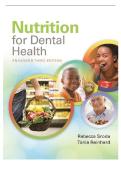
, TESTBANK FOR Nutrition for Dental Health Third Edition Sroda
Important Notes
The file includes the complete test bank, organized chapter by chapter.
A sample of selected pages has been provided for preview.
All available appendices and Excel files (if included in the original resources) are
provided.
Quizzes, Midterm and final exams are included (if available in the original resources).
We continuously update our files to ensure you receive the latest and most accurate
editions.
New editions are added regularly – stay connected for updates!
⚠️Note on Answer Keys: If the answer key is not included within the chapter
questions, you will find the complete answers and solutions at the end of each
chapter.
✅ Why Buy From Us?
📚 Complete & organized chapter-by-chapter – no missing content, no guessing.
⚡ Instant digital delivery – get your file the moment you pay, no waiting.
📅 Always up to date – we track new editions so you always get the latest version.
💬 Friendly support – real humans ready to help, anytime you need us.
🔒 Safe & secure – thousands of satisfied students trust us every semester.
🛡️Our Guarantees
💰 Money-Back Guarantee: Not satisfied? We offer a full refund – no questions asked.
🔄 Wrong File? No Problem: Contact us and we will replace it immediately with the
correct version, free of charge.
⏰ 24/7 Support: We are always here – reach out anytime and expect a fast response.
,Chapter 01: Eating 101
1. Chemicals in food that nourish our body are called:
A. nutrition.
B. nutrients.
C. functional food.
D. enzymes.
Answer: B
Subject: Chapter 01: Eating 101
2. Incidence of obesity has doubled in the last:
A. 5 years.
B. 10 years.
C. 20 years.
D. 100 years.
Answer: C
Subject: Chapter 01: Eating 101
3. Which is NOT a 21st-century lifestyle trend?
A. People are living longer.
B. We have a tendency to eat on the run.
C. We are primarily sedentary.
D. We eat less frequently than 20 years ago.
Answer: D
Subject: Chapter 01: Eating 101
4. Everybody has specific food cravings. Foods high in protein are preferred as comfort foods.
A. Both statements are true.
B. Both statements are false.
C. The first statement is true, the second false.
D. The first statement is false, the second true.
Answer: B
Subject: Chapter 01: Eating 101
5. The single most craved food is:
A. potato chips.
B. caffeinated soda.
C. chocolate.
D. fast food.
Answer: C
Subject: Chapter 01: Eating 101
6. All organs secrete enzymes during the digestive process EXCEPT the:
A. colon.
B. pancreas.
C. stomach.
© Jones & Bartlett Learning, LLC. NOT FOR SALE OR DISTRIBUTION 1-1
,D. small intestines.
Answer: A
Subject: Chapter 01: Eating 101
7. Most nutrients are absorbed by the body through which organ?
A. Esophagus
B. Stomach
C. Colon
D. Small intestines
Answer: D
Subject: Chapter 01: Eating 101
8. Undigested food becomes __________ and passes into the __________.
A. waste/large intestine
B. molecules/rectum
C. a bolus/stomach
D. chime/liver
Answer: A
Subject: Chapter 01: Eating 101
9. Total transit time from mouth to elimination can be anywhere from a day to __________.
A. 3 days
B. 1 week
C. 3 weeks
D. 1 month
Answer: C
Subject: Chapter 01: Eating 101
10. Most people assume “consumption norm” is __________.
A. the amount of food put before them
B. the proper amount of food to eat in one sitting
C. the kind of food consumers purchase
D. fad foods
Answer: B
Subject: Chapter 01: Eating 101
11. Protease aids with digestion of __________ and amylase aids with digestion of __________.
A. fats/sugar
B. protein/lipids
C. carbohydrates/amino acids
D. protein/carbohydrates
Answer: D
Subject: Chapter 01: Eating 101
© Jones & Bartlett Learning, LLC. NOT FOR SALE OR DISTRIBUTION 1-2
,12. Eating fast food and consuming twice as many soft drinks than 40 years ago are common
21st century eating patterns because of the efforts of food manufacturers mass marketing.
A. Both the statement and the reason are correct and related.
B. Both the statement and the reason are correct but NOT related.
C. The statement is correct, but the reason is NOT.
D. The statement is NOT correct, but the reason is correct.
E. Neither the statement NOR the reason are correct.
Answer: A
Subject: Chapter 01: Eating 101
13. Ninety-six percent of human body mass is composed of the elements hydrogen, oxygen,
carbon, and what other element?
A. Sodium
B. Potassium
C. Nitrogen
D. Calcium
Answer: C
Subject: Chapter 01: Eating 101
14. The relationship between food and disease process happens when the body gets too much of
a nutrient. Disease can also manifest when there is too little of a certain nutrient in the diet.
A. Both statements are true.
B. Both statements are false.
C. The first statement is true, the second false.
D. The first statement is false, the second true.
Answer: A
Subject: Chapter 01: Eating 101
15. Disease processes caused by poor nutrition and eating habits includes all EXCEPT:
A. diabetes.
B. colon cancer.
C. anorexia.
D. dental caries.
E. hyperthyroidism.
Answer: E
Subject: Chapter 01: Eating 101
© Jones & Bartlett Learning, LLC. NOT FOR SALE OR DISTRIBUTION 1-3
,Chapter 02: Carbohydrates
1. All of the following are examples of carbohydrates role in the body EXCEPT:
A. repair body tissue.
B. maintain blood glucose levels.
C. supply the body with energy.
D. spare protein.
Answer: A
Subject: Chapter 02: Carbohydrates
2. The chemical building blocks of carbohydrates are called disaccharides. All carbohydrates
derive from plants.
A. Both statements are true.
B. Both statements are false.
C. The first statement is true, the second false.
D. The first statement is false, the second true.
Answer: B
Subject: Chapter 02: Carbohydrates
3. The main unit of carbohydrate is:
A. water.
B. fructose.
C. oligosaccharide.
D. glucose molecule.
Answer: D
Subject: Chapter 02: Carbohydrates
4. A polysaccharide has more than __________ molecules of sugar.
A. 5
B. 7
C. 10
D. 20
Answer: C
Subject: Chapter 02: Carbohydrates
5. Maltose is an example of a(n):
A. monosaccharide.
B. disaccharide.
C. oligosaccharide.
D. polysaccharide.
Answer: B
Subject: Chapter 02: Carbohydrates
6. Glycogen is to storage of energy in animals as starch is to storage of energy in:
A. plants.
B. cells.
© Jones & Bartlett Learning, LLC. NOT FOR SALE OR DISTRIBUTION 2-1
,C. muscle.
D. food.
Answer: A
Subject: Chapter 02: Carbohydrates
7. Fiber is referred to as roughage. Fiber is used by the body for energy.
A. Both statements are true.
B. Both statements are false.
C. The first statement is true, the second false.
D. The first statement is false, the second true.
Answer: C
Subject: Chapter 02: Carbohydrates
8. The difference between a polysaccharide and starch is that a polysaccharide:
A. contains fiber and starch does not.
B. is a simple sugar and starch is a disaccharide.
C. there is no difference as starch is a polysaccharide.
D. is soluble and starch is insoluble.
Answer: C
Subject: Chapter 02: Carbohydrates
9. All of the following statements are true about fiber EXCEPT:
A. chemical links between fiber molecules cannot be separated by digestive enzymes.
B. vitamins and minerals in fiber pass through the body unabsorbed.
C. fiber adds chewy and crunchy texture to foods.
D. fiber is predominantly found in animal protein and dairy products.
Answer: D
Subject: Chapter 02: Carbohydrates
10. Which of the following statements is true about digestion of carbohydrates?
A. Monosaccharides require enzymes to break down into smaller units.
B. Final breakdown of carbohydrates occurs in the stomach.
C. Disaccharides and polysaccharides must be reduced to monosaccharides before they can be
absorbed by the body.
D. Splitting of carbohydrates begins in the stomach when polysaccharides mix with amylase.
Answer: C
Subject: Chapter 02: Carbohydrates
11. Lactose intolerance occurs when there is an absence of the digestive enzyme lactase. One
group of people who are at high risk for lactose intolerance is Hispanics.
A. Both statements are true.
B. Both statements are false.
C. The first statement is true, the second false.
D. The first statement is false, the second true.
© Jones & Bartlett Learning, LLC. NOT FOR SALE OR DISTRIBUTION 2-2
,Answer: C
Subject: Chapter 02: Carbohydrates
12. All of the following statements are true about carbohydrates EXCEPT:
A. complex carbohydrates can cause blood glucose to spike, then drop below normal.
B. simple sugars are most cariogenic.
C. excessive fiber intake can decrease mineral absorption.
D. excess consumption of simple sugars can elevate triglyceride level.
Answer: A
Subject: Chapter 02: Carbohydrates
13. The recommended intake of carbohydrates is:
A. no more than 30% of total daily calorie intake.
B. 10% to 20% of total daily calorie intake.
C. less than 75% of total daily calorie intake.
D. about 55% to 65% of total daily calorie intake.
Answer: D
Subject: Chapter 02: Carbohydrates
14. Sugar can be used as a preservative in processed foods. Sugar will pull water from bacterial
cells and disable them.
A. Both statements are true.
B. Both statements are false.
C. The first statement is true, the second false.
D. The first statement is false, the second true.
Answer: A
Subject: Chapter 02: Carbohydrates
15. When blood glucose is __________ than 80 mg/dL it is called __________.
A. lower/hyperglycemia
B. higher/hypoglycemia
C. lower/hypoglycemia
D. higher/hyperglycemia
Answer: C
Subject: Chapter 02: Carbohydrates
16. Which body organ secretes insulin to assist with homeostasis?
A. Liver
B. Stomach
C. Small intestine
D. Pancreas
Answer: D
Subject: Chapter 02: Carbohydrates
© Jones & Bartlett Learning, LLC. NOT FOR SALE OR DISTRIBUTION 2-3
,17. The storage form of glucose in muscle is called:
A. glycose.
B. glycogen.
C. glucagon.
D. glucogenesis.
Answer: B
Subject: Chapter 02: Carbohydrates
18. The name of the hormone that assists with the conversion of glycogen to glucose is:
A. insulin.
B. glycose.
C. glucagon.
D. glycogen.
Answer: C
Subject: Chapter 02: Carbohydrates
19. All of the following are good suggestions for maintaining blood glucose levels EXCEPT:
A. eat complex carbohydrates throughout the day.
B. choose whole grain versions of food.
C. avoid refined sugar.
D. eat simple sugars between meals.
Answer: D
Subject: Chapter 02: Carbohydrates
20. Refined sugar would be considered which type of carbohydrate?
A. Monosaccharide
B. Simple sugar
C. Polysaccharide
D. Complex carbohydrate
Answer: B
Subject: Chapter 02: Carbohydrates
21. Which carbohydrate is not absorbed by the body and used as fuel?
A. Lactose
B. Sucrose
C. Glucose
D. Fiber
Answer: D
Subject: Chapter 02: Carbohydrates
22. __________ fiber is the type that gives bulk to stools and carries cholesterol out of the body.
A. Insoluble
B. Soluble
C. Gelatinous
D. Crunchy
© Jones & Bartlett Learning, LLC. NOT FOR SALE OR DISTRIBUTION 2-4
, Answer: A
Subject: Chapter 02: Carbohydrates
23. Carbohydrates are an excellent low-fat source of fiber and nutrients. Examples of
carbohydrates are rice, wheat, potatoes, and corn.
A. Both statements are true.
B. Both statements are false.
C. The first statement is true, the second false.
D. The first statement is false, the second true.
Answer: A
Subject: Chapter 02: Carbohydrates
24. The molecular structure of a complex carbohydrate consists of how many monosaccharides?
A. At least two
B. Four or more
C. 10 to 20
D. Over 100
Answer: B
Subject: Chapter 02: Carbohydrates
25. The primary role of carbohydrates in the body is to:
A. provide energy.
B. spare protein.
C. burn fat for fuel.
D. provide the brain with fuel during rest.
Answer: A
Subject: Chapter 02: Carbohydrates
26. A diet high in carbohydrates will increase a person's chance of developing diseases such as
diabetes. Most individuals who eat a diet high in carbohydrates are obese as a result.
A. Both statements are true.
B. Both statements are false.
C. The first statement is true, the second false.
D. The first statement is false, the second true.
Answer: B
Subject: Chapter 02: Carbohydrates
27. What is the daily recommended intake of fiber?
A. 50 to 100 g
B. 55 to 65 g
C. 20 g
D. 25 to 35 g
Answer: D
Subject: Chapter 02: Carbohydrates
© Jones & Bartlett Learning, LLC. NOT FOR SALE OR DISTRIBUTION 2-5
Important Notes
The file includes the complete test bank, organized chapter by chapter.
A sample of selected pages has been provided for preview.
All available appendices and Excel files (if included in the original resources) are
provided.
Quizzes, Midterm and final exams are included (if available in the original resources).
We continuously update our files to ensure you receive the latest and most accurate
editions.
New editions are added regularly – stay connected for updates!
⚠️Note on Answer Keys: If the answer key is not included within the chapter
questions, you will find the complete answers and solutions at the end of each
chapter.
✅ Why Buy From Us?
📚 Complete & organized chapter-by-chapter – no missing content, no guessing.
⚡ Instant digital delivery – get your file the moment you pay, no waiting.
📅 Always up to date – we track new editions so you always get the latest version.
💬 Friendly support – real humans ready to help, anytime you need us.
🔒 Safe & secure – thousands of satisfied students trust us every semester.
🛡️Our Guarantees
💰 Money-Back Guarantee: Not satisfied? We offer a full refund – no questions asked.
🔄 Wrong File? No Problem: Contact us and we will replace it immediately with the
correct version, free of charge.
⏰ 24/7 Support: We are always here – reach out anytime and expect a fast response.
,Chapter 01: Eating 101
1. Chemicals in food that nourish our body are called:
A. nutrition.
B. nutrients.
C. functional food.
D. enzymes.
Answer: B
Subject: Chapter 01: Eating 101
2. Incidence of obesity has doubled in the last:
A. 5 years.
B. 10 years.
C. 20 years.
D. 100 years.
Answer: C
Subject: Chapter 01: Eating 101
3. Which is NOT a 21st-century lifestyle trend?
A. People are living longer.
B. We have a tendency to eat on the run.
C. We are primarily sedentary.
D. We eat less frequently than 20 years ago.
Answer: D
Subject: Chapter 01: Eating 101
4. Everybody has specific food cravings. Foods high in protein are preferred as comfort foods.
A. Both statements are true.
B. Both statements are false.
C. The first statement is true, the second false.
D. The first statement is false, the second true.
Answer: B
Subject: Chapter 01: Eating 101
5. The single most craved food is:
A. potato chips.
B. caffeinated soda.
C. chocolate.
D. fast food.
Answer: C
Subject: Chapter 01: Eating 101
6. All organs secrete enzymes during the digestive process EXCEPT the:
A. colon.
B. pancreas.
C. stomach.
© Jones & Bartlett Learning, LLC. NOT FOR SALE OR DISTRIBUTION 1-1
,D. small intestines.
Answer: A
Subject: Chapter 01: Eating 101
7. Most nutrients are absorbed by the body through which organ?
A. Esophagus
B. Stomach
C. Colon
D. Small intestines
Answer: D
Subject: Chapter 01: Eating 101
8. Undigested food becomes __________ and passes into the __________.
A. waste/large intestine
B. molecules/rectum
C. a bolus/stomach
D. chime/liver
Answer: A
Subject: Chapter 01: Eating 101
9. Total transit time from mouth to elimination can be anywhere from a day to __________.
A. 3 days
B. 1 week
C. 3 weeks
D. 1 month
Answer: C
Subject: Chapter 01: Eating 101
10. Most people assume “consumption norm” is __________.
A. the amount of food put before them
B. the proper amount of food to eat in one sitting
C. the kind of food consumers purchase
D. fad foods
Answer: B
Subject: Chapter 01: Eating 101
11. Protease aids with digestion of __________ and amylase aids with digestion of __________.
A. fats/sugar
B. protein/lipids
C. carbohydrates/amino acids
D. protein/carbohydrates
Answer: D
Subject: Chapter 01: Eating 101
© Jones & Bartlett Learning, LLC. NOT FOR SALE OR DISTRIBUTION 1-2
,12. Eating fast food and consuming twice as many soft drinks than 40 years ago are common
21st century eating patterns because of the efforts of food manufacturers mass marketing.
A. Both the statement and the reason are correct and related.
B. Both the statement and the reason are correct but NOT related.
C. The statement is correct, but the reason is NOT.
D. The statement is NOT correct, but the reason is correct.
E. Neither the statement NOR the reason are correct.
Answer: A
Subject: Chapter 01: Eating 101
13. Ninety-six percent of human body mass is composed of the elements hydrogen, oxygen,
carbon, and what other element?
A. Sodium
B. Potassium
C. Nitrogen
D. Calcium
Answer: C
Subject: Chapter 01: Eating 101
14. The relationship between food and disease process happens when the body gets too much of
a nutrient. Disease can also manifest when there is too little of a certain nutrient in the diet.
A. Both statements are true.
B. Both statements are false.
C. The first statement is true, the second false.
D. The first statement is false, the second true.
Answer: A
Subject: Chapter 01: Eating 101
15. Disease processes caused by poor nutrition and eating habits includes all EXCEPT:
A. diabetes.
B. colon cancer.
C. anorexia.
D. dental caries.
E. hyperthyroidism.
Answer: E
Subject: Chapter 01: Eating 101
© Jones & Bartlett Learning, LLC. NOT FOR SALE OR DISTRIBUTION 1-3
,Chapter 02: Carbohydrates
1. All of the following are examples of carbohydrates role in the body EXCEPT:
A. repair body tissue.
B. maintain blood glucose levels.
C. supply the body with energy.
D. spare protein.
Answer: A
Subject: Chapter 02: Carbohydrates
2. The chemical building blocks of carbohydrates are called disaccharides. All carbohydrates
derive from plants.
A. Both statements are true.
B. Both statements are false.
C. The first statement is true, the second false.
D. The first statement is false, the second true.
Answer: B
Subject: Chapter 02: Carbohydrates
3. The main unit of carbohydrate is:
A. water.
B. fructose.
C. oligosaccharide.
D. glucose molecule.
Answer: D
Subject: Chapter 02: Carbohydrates
4. A polysaccharide has more than __________ molecules of sugar.
A. 5
B. 7
C. 10
D. 20
Answer: C
Subject: Chapter 02: Carbohydrates
5. Maltose is an example of a(n):
A. monosaccharide.
B. disaccharide.
C. oligosaccharide.
D. polysaccharide.
Answer: B
Subject: Chapter 02: Carbohydrates
6. Glycogen is to storage of energy in animals as starch is to storage of energy in:
A. plants.
B. cells.
© Jones & Bartlett Learning, LLC. NOT FOR SALE OR DISTRIBUTION 2-1
,C. muscle.
D. food.
Answer: A
Subject: Chapter 02: Carbohydrates
7. Fiber is referred to as roughage. Fiber is used by the body for energy.
A. Both statements are true.
B. Both statements are false.
C. The first statement is true, the second false.
D. The first statement is false, the second true.
Answer: C
Subject: Chapter 02: Carbohydrates
8. The difference between a polysaccharide and starch is that a polysaccharide:
A. contains fiber and starch does not.
B. is a simple sugar and starch is a disaccharide.
C. there is no difference as starch is a polysaccharide.
D. is soluble and starch is insoluble.
Answer: C
Subject: Chapter 02: Carbohydrates
9. All of the following statements are true about fiber EXCEPT:
A. chemical links between fiber molecules cannot be separated by digestive enzymes.
B. vitamins and minerals in fiber pass through the body unabsorbed.
C. fiber adds chewy and crunchy texture to foods.
D. fiber is predominantly found in animal protein and dairy products.
Answer: D
Subject: Chapter 02: Carbohydrates
10. Which of the following statements is true about digestion of carbohydrates?
A. Monosaccharides require enzymes to break down into smaller units.
B. Final breakdown of carbohydrates occurs in the stomach.
C. Disaccharides and polysaccharides must be reduced to monosaccharides before they can be
absorbed by the body.
D. Splitting of carbohydrates begins in the stomach when polysaccharides mix with amylase.
Answer: C
Subject: Chapter 02: Carbohydrates
11. Lactose intolerance occurs when there is an absence of the digestive enzyme lactase. One
group of people who are at high risk for lactose intolerance is Hispanics.
A. Both statements are true.
B. Both statements are false.
C. The first statement is true, the second false.
D. The first statement is false, the second true.
© Jones & Bartlett Learning, LLC. NOT FOR SALE OR DISTRIBUTION 2-2
,Answer: C
Subject: Chapter 02: Carbohydrates
12. All of the following statements are true about carbohydrates EXCEPT:
A. complex carbohydrates can cause blood glucose to spike, then drop below normal.
B. simple sugars are most cariogenic.
C. excessive fiber intake can decrease mineral absorption.
D. excess consumption of simple sugars can elevate triglyceride level.
Answer: A
Subject: Chapter 02: Carbohydrates
13. The recommended intake of carbohydrates is:
A. no more than 30% of total daily calorie intake.
B. 10% to 20% of total daily calorie intake.
C. less than 75% of total daily calorie intake.
D. about 55% to 65% of total daily calorie intake.
Answer: D
Subject: Chapter 02: Carbohydrates
14. Sugar can be used as a preservative in processed foods. Sugar will pull water from bacterial
cells and disable them.
A. Both statements are true.
B. Both statements are false.
C. The first statement is true, the second false.
D. The first statement is false, the second true.
Answer: A
Subject: Chapter 02: Carbohydrates
15. When blood glucose is __________ than 80 mg/dL it is called __________.
A. lower/hyperglycemia
B. higher/hypoglycemia
C. lower/hypoglycemia
D. higher/hyperglycemia
Answer: C
Subject: Chapter 02: Carbohydrates
16. Which body organ secretes insulin to assist with homeostasis?
A. Liver
B. Stomach
C. Small intestine
D. Pancreas
Answer: D
Subject: Chapter 02: Carbohydrates
© Jones & Bartlett Learning, LLC. NOT FOR SALE OR DISTRIBUTION 2-3
,17. The storage form of glucose in muscle is called:
A. glycose.
B. glycogen.
C. glucagon.
D. glucogenesis.
Answer: B
Subject: Chapter 02: Carbohydrates
18. The name of the hormone that assists with the conversion of glycogen to glucose is:
A. insulin.
B. glycose.
C. glucagon.
D. glycogen.
Answer: C
Subject: Chapter 02: Carbohydrates
19. All of the following are good suggestions for maintaining blood glucose levels EXCEPT:
A. eat complex carbohydrates throughout the day.
B. choose whole grain versions of food.
C. avoid refined sugar.
D. eat simple sugars between meals.
Answer: D
Subject: Chapter 02: Carbohydrates
20. Refined sugar would be considered which type of carbohydrate?
A. Monosaccharide
B. Simple sugar
C. Polysaccharide
D. Complex carbohydrate
Answer: B
Subject: Chapter 02: Carbohydrates
21. Which carbohydrate is not absorbed by the body and used as fuel?
A. Lactose
B. Sucrose
C. Glucose
D. Fiber
Answer: D
Subject: Chapter 02: Carbohydrates
22. __________ fiber is the type that gives bulk to stools and carries cholesterol out of the body.
A. Insoluble
B. Soluble
C. Gelatinous
D. Crunchy
© Jones & Bartlett Learning, LLC. NOT FOR SALE OR DISTRIBUTION 2-4
, Answer: A
Subject: Chapter 02: Carbohydrates
23. Carbohydrates are an excellent low-fat source of fiber and nutrients. Examples of
carbohydrates are rice, wheat, potatoes, and corn.
A. Both statements are true.
B. Both statements are false.
C. The first statement is true, the second false.
D. The first statement is false, the second true.
Answer: A
Subject: Chapter 02: Carbohydrates
24. The molecular structure of a complex carbohydrate consists of how many monosaccharides?
A. At least two
B. Four or more
C. 10 to 20
D. Over 100
Answer: B
Subject: Chapter 02: Carbohydrates
25. The primary role of carbohydrates in the body is to:
A. provide energy.
B. spare protein.
C. burn fat for fuel.
D. provide the brain with fuel during rest.
Answer: A
Subject: Chapter 02: Carbohydrates
26. A diet high in carbohydrates will increase a person's chance of developing diseases such as
diabetes. Most individuals who eat a diet high in carbohydrates are obese as a result.
A. Both statements are true.
B. Both statements are false.
C. The first statement is true, the second false.
D. The first statement is false, the second true.
Answer: B
Subject: Chapter 02: Carbohydrates
27. What is the daily recommended intake of fiber?
A. 50 to 100 g
B. 55 to 65 g
C. 20 g
D. 25 to 35 g
Answer: D
Subject: Chapter 02: Carbohydrates
© Jones & Bartlett Learning, LLC. NOT FOR SALE OR DISTRIBUTION 2-5


