

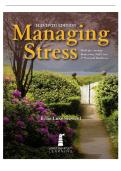
, TESTBANK FOR Managing Stress Eleventh Edition Seaward
Important Notes
The file includes the complete test bank, organized chapter by chapter.
A sample of selected pages has been provided for preview.
All available appendices and Excel files (if included in the original resources) are
provided.
Quizzes, Midterm and final exams are included (if available in the original resources).
We continuously update our files to ensure you receive the latest and most accurate
editions.
New editions are added regularly – stay connected for updates!
⚠️Note on Answer Keys: If the answer key is not included within the chapter
questions, you will find the complete answers and solutions at the end of each
chapter.
✅ Why Buy From Us?
📚 Complete & organized chapter-by-chapter – no missing content, no guessing.
⚡ Instant digital delivery – get your file the moment you pay, no waiting.
📅 Always up to date – we track new editions so you always get the latest version.
💬 Friendly support – real humans ready to help, anytime you need us.
🔒 Safe & secure – thousands of satisfied students trust us every semester.
🛡️Our Guarantees
💰 Money-Back Guarantee: Not satisfied? We offer a full refund – no questions asked.
🔄 Wrong File? No Problem: Contact us and we will replace it immediately with the
correct version, free of charge.
⏰ 24/7 Support: We are always here – reach out anytime and expect a fast response.
,Managing Stress: Skills for Anxiety Reduction, Self-Care, and Personal Resiliency, Eleventh Edition
Brian Luke Seaward
Test Bank
Import Settings:
Base Settings: Brownstone Default
Information Field: Complexity
Information Field: Ahead
Information Field: Subject
Information Field: Title
Information Field: Taxonomy
Highest Answer Letter: D
Multiple Keywords in Same Paragraph: No
NAS ISBN13: 9781284283594, add to Ahead, Title tags
Chapter: Chapter 01 - Living in an Upside Down World
Note to the Instructor:
Based on test-taking research, where students will often choose “C” when in doubt about a multiple-
choice question or go for the choice with the longest answer, these test questions were made so that
each answer seems like a viable answer to those who haven’t studied the text. In this new edition, several
new questions have been created based on new content as well as some questions reworked from
previous content. The best test is where students are able to demonstrate a command of facts and a
synthesis of knowledge, which is why several forms of questions are included for you to use. While every
attempt has been made to ensure the accuracy of these test questions, it is incumbent upon you as the
instructor to review and validate each question and answer before using it as a bona fide test question
(and if you see an error, please kindly let us know). In the age of grade inflation, these test questions are
meant to serve as a platform for you to create your own test questions, and we encourage you to do so.
Multiple Choice
1. As discussed in Chapter 1, all but one of these are considered dramatic issues in our changing world.
A) Climate change
B) Flooding
C) Economic uncertainty
D) A divisive society
Ans: B
Complexity: Easy
Ahead: Colossal Sources of Stress in the Current Landscape
Subject: Chapter 1
Title: Living in an Upside Down World
Taxonomy: Remembering/Understanding
2. This item is considered important to reduce stress in times of an emergency.
A) Screen device
B) Grab and go bag
C) Cash and credit cards
D) Stash of food
Ans: B
Complexity: Easy
Copyright © 2025 by Jones & Bartlett Learning, LLC, an Ascend Learning Company 1
,Managing Stress: Skills for Anxiety Reduction, Self-Care, and Personal Resiliency, Eleventh Edition
Brian Luke Seaward
Test Bank
Ahead: Colossal Sources of Stress in the Current Landscape
Subject: Chapter 1
Title: Living in an Upside Down World
Taxonomy: Remembering/Understanding
3. This is not considered to be included in the model of healthy grieving.
A) Acknowledge your pain
B) Seek out support
C) Be aware of emotional grief triggers
D) Escape with books or movies
Ans: D
Complexity: Moderate
Ahead: Colossal Sources of Stress in the Current Landscape
Subject: Chapter 1
Title: Living in an Upside Down World
Taxonomy: Applying/Analyzing
4. These three topics are highlighted in Chapter 1 as issues in an upside down world.
A) Climate change, economic uncertainty, and a divisive society
B) Political unrest, climate change, and a divisive society
C) Fake news, political unrest, and climate change
D) Ukraine war, suicide rates, and the Opioid epidemic
Ans: A
Complexity: Easy
Ahead: Colossal Sources of Stress in the Current Landscape
Subject: Chapter 1
Title: Living in an Upside Down World
Taxonomy: Applying/Analyzing
5. This type of trauma is associated with multiple traumatic events.
A) Acute trauma
B) Chronic trauma
C) Complex trauma
D) Generational trauma
Ans: C
Complexity: Difficult
Ahead: Trauma: A Colossal Mental Health Crisis on Our Hands
Subject: Chapter 1
Title: Living in an Upside Down World
Taxonomy: Evaluating/Creating
6. This demographic is cited as having the hardest time making and keeping friends.
A) Baby Boomers
B) Gen Z
C) Millennials
D) Gen X
Ans: B
Copyright © 2025 by Jones & Bartlett Learning, LLC, an Ascend Learning Company 2
,Managing Stress: Skills for Anxiety Reduction, Self-Care, and Personal Resiliency, Eleventh Edition
Brian Luke Seaward
Test Bank
Complexity: Easy
Ahead: Trauma: A Colossal Mental Health Crisis on Our Hands
Subject: Chapter 1
Title: Living in an Upside Down World
Taxonomy: Remembering/Understanding
7. Regarding “healthy grieving,” rituals in the grieving process do the following except:
A) rituals help suppress anger.
B) rituals help people cope with anxiety.
C) rituals help increase comfort with the unknown.
D) rituals help promote a sense of community.
Ans: A
Complexity: Difficult
Ahead: Colossal Sources of Stress in the Current Landscape
Subject: Chapter 1
Title: Living in an Upside Down World
Taxonomy: Evaluating/Creating
8. Experts have a new name associated with the stress of climate change, which is:
A) climate adaptation.
B) climate anxiety.
C) climate refugees.
D) climate deniers.
Ans: B
Complexity: Easy
Ahead: Colossal Sources of Stress in the Current Landscape
Subject: Chapter 1
Title: Living in an Upside Down World
Taxonomy: Remembering/Understanding
True/ False
1. As employees returned to work after the pandemic, many chose not to return, leading to what has
become known as the great resignation.
Ans: True
Complexity: Easy
Ahead: Introduction
Subject: Chapter 1
Title: Living in an Upside Down World
Taxonomy: Remembering/Understanding
2. Health experts agree that mental health issues are the same now as before the COVID-19 pandemic.
Ans: False
Complexity: Easy
Ahead: Trauma: A Colossal Mental Health Crisis on Our Hands
Copyright © 2025 by Jones & Bartlett Learning, LLC, an Ascend Learning Company 3
,Managing Stress: Skills for Anxiety Reduction, Self-Care, and Personal Resiliency, Eleventh Edition
Brian Luke Seaward
Test Bank
Subject: Chapter 1
Title: Living in an Upside Down World
Taxonomy: Remembering/Understanding
3. A new term used by stress experts to describe people (and communities) dealing with climate Change
is Climate resiliency.
Ans: True
Complexity: Moderate
Ahead: Colossal Sources of Stress in the Current Landscape
Subject: Chapter 1
Title: Living in an Upside Down World
Taxonomy: Applying/Analyzing
4. Collective trauma is best described as the combination of two acute traumatic events.
Ans: False
Complexity: Moderate
Ahead: Trauma: A Colossal Mental Health Crisis on Our Hands
Subject: Chapter 1
Title: Living in an Upside Down World
Taxonomy: Applying/Analyzing
5. The COVID-19 pandemic is considered by health experts to be a traumatic event.
Ans: True
Complexity: Easy
Ahead: Trauma: A Colossal Mental Health Crisis on Our Hands
Subject: Chapter 1
Title: Living in an Upside Down World
Taxonomy: Remembering/Understanding
Essay
1. Please define the following terms or concepts in no more than two sentences and give an example to
support your definition.
A) Climate resiliency
Complexity: Moderate
Ans: Answers will vary.
Ahead: Colossal Sources of Stress in the Current Landscape
Subject: Chapter 1
Title: Living in an Upside Down World
Taxonomy: Applying/Analyzing
B) Acute trauma
Ans: Answers will vary.
Copyright © 2025 by Jones & Bartlett Learning, LLC, an Ascend Learning Company 4
,Managing Stress: Skills for Anxiety Reduction, Self-Care, and Personal Resiliency, Eleventh Edition
Brian Luke Seaward
Test Bank
Complexity: Moderate
Ahead: Trauma: A Colossal Mental Health Crisis on Our Hands
Subject: Chapter 1
Title: Living in an Upside Down World
Taxonomy: Applying/Analyzing
C) Chronic trauma
Ans: Answers will vary.
Complexity: Moderate
Ahead: Trauma: A Colossal Mental Health Crisis on Our Hands
Subject: Chapter 1
Title: Living in an Upside Down World
Taxonomy: Applying/Analyzing
D) Complex trauma
Ans: Answers will vary.
Complexity: Moderate
Ahead: Trauma: A Colossal Mental Health Crisis on Our Hands
Subject: Chapter 1
Title: Living in an Upside Down World
Taxonomy: Applying/Analyzing
E) Collective trauma
Ans: Answers will vary.
Complexity: Moderate
Ahead: Trauma: A Colossal Mental Health Crisis on Our Hands
Subject: Chapter 1
Title: Living in an Upside Down World
Taxonomy: Applying/Analyzing
F) Intergenerational trauma
Ans: Answers will vary.
Complexity: Moderate
Ahead: Trauma: A Colossal Mental Health Crisis on Our Hands
Subject: Chapter 1
Title: Living in an Upside Down World
Taxonomy: Applying/Analyzing
2. Please answer the following questions as an essay. Begin with an opening statement, document and
outline your content in a clear, succinct manner, and end with a concluding statement. Please explain the
nature of trauma, including the several types of trauma (please give examples).
Ans: Answers will vary.
Complexity: Difficult
Ahead: Trauma: A Colossal Mental Health Crisis on Our Hands
Subject: Chapter 1
Copyright © 2025 by Jones & Bartlett Learning, LLC, an Ascend Learning Company 5
,Managing Stress: Skills for Anxiety Reduction, Self-Care, and Personal Resiliency, Eleventh Edition
Brian Luke Seaward
Test Bank
Title: Living in an Upside Down World
Taxonomy: Evaluating/Creating
Copyright © 2025 by Jones & Bartlett Learning, LLC, an Ascend Learning Company 6
,Managing Stress: Skills for Anxiety Reduction, Self-Care, and Personal Resiliency, Eleventh Edition
Brian Luke Seaward
Test Bank
Import Settings:
Base Settings: Brownstone Default
Information Field: Complexity
Information Field: Ahead
Information Field: Subject
Information Field: Title
Information Field: Taxonomy
Highest Answer Letter: E
Multiple Keywords in Same Paragraph: No
NAS ISBN13: 9781284283594, add to Ahead, Title tags
Chapter: Chapter 02 - The Nature of Stress
Note to the Instructor:
Based on test-taking research, where students will often choose “C” when in doubt about a multiple-
choice question or go for the choice with the longest answer, these test questions were made so that
each answer seems like a viable answer to those who haven’t studied the text. In this new edition, several
new questions have been created based on new content as well as some questions reworked from
previous content. The best test is where students are able to demonstrate a command of facts and a
synthesis of knowledge, which is why several forms of questions are included for you to use. While every
attempt has been made to ensure the accuracy of these test questions, it is incumbent upon you as the
instructor to review and validate each question and answer before using it as a bona fide test question
(and if you see an error, please kindly let us know). In the age of grade inflation, these test questions are
meant to serve as a platform for you to create your own test questions, and we encourage you to do so.
Multiple Choice
1. Which of the following is not in the sequence of the fight-or-flight response?
A) The brain receives and deciphers stimuli from one of the five senses.
B) The limbic system releases ACTH from the hypothalamus.
C) The body stays keyed up until the threat is over.
D) The body returns to homeostasis when the threat is gone.
Ans: B
Complexity: Moderate
Ahead: The Stress Response
Subject: Chapter 2
Title: The Nature of Stress
Taxonomy: Applying/Analyzing
2. This type of stress is most commonly associated with illness and disease.
A) Eustress
B) Neustress
C) Acute stress
D) Chronic stress
Ans: D
Complexity: Easy
Copyright © 2025 by Jones & Bartlett Learning, LLC, an Ascend Learning Company 1
, Managing Stress: Skills for Anxiety Reduction, Self-Care, and Personal Resiliency, Eleventh Edition
Brian Luke Seaward
Test Bank
Ahead: Types of Stress
Subject: Chapter 2
Title: The Nature of Stress
Taxonomy: Remembering/Understanding
3. Which of the following characteristics is not typically experienced in the fight-or-flight response?
A) Increased heart rate
B) Increased blood pressure
C) Increased breathing rate
D) Increased gastric movement
E) Increased serum glucose levels
Ans: D
Complexity: Difficult
Ahead: The Stress Response
Subject: Chapter 2
Title: The Nature of Stress
Taxonomy: Evaluating/Creating
4. The “tend-and-befriend theory,” proposed by Shelley Taylor, speaks best to the coping technique used
by:
A) women.
B) AIDS patients.
C) cancer patients.
D) senior citizens.
E) Iraq War veterans.
Ans: A
Complexity: Easy
Ahead: The Stress Response
Subject: Chapter 2
Title: The Nature of Stress
Taxonomy: Remembering/Understanding
5. What factor(s), above all else, determines one’s degree of stress?
A) One’s support group
B) One’s profile (e.g., race, gender, and socioeconomic status)
C) One’s perception or interpretation
D) One’s age and economic background
Ans: C
Complexity: Moderate
Ahead: Definitions of Stress
Subject: Chapter 2
Title: The Nature of Stress
Taxonomy: Applying/Analyzing
6. This stressor would be classified as a bioecological influence.
A) Poor diet
B) Pessimism
Copyright © 2025 by Jones & Bartlett Learning, LLC, an Ascend Learning Company 2
Important Notes
The file includes the complete test bank, organized chapter by chapter.
A sample of selected pages has been provided for preview.
All available appendices and Excel files (if included in the original resources) are
provided.
Quizzes, Midterm and final exams are included (if available in the original resources).
We continuously update our files to ensure you receive the latest and most accurate
editions.
New editions are added regularly – stay connected for updates!
⚠️Note on Answer Keys: If the answer key is not included within the chapter
questions, you will find the complete answers and solutions at the end of each
chapter.
✅ Why Buy From Us?
📚 Complete & organized chapter-by-chapter – no missing content, no guessing.
⚡ Instant digital delivery – get your file the moment you pay, no waiting.
📅 Always up to date – we track new editions so you always get the latest version.
💬 Friendly support – real humans ready to help, anytime you need us.
🔒 Safe & secure – thousands of satisfied students trust us every semester.
🛡️Our Guarantees
💰 Money-Back Guarantee: Not satisfied? We offer a full refund – no questions asked.
🔄 Wrong File? No Problem: Contact us and we will replace it immediately with the
correct version, free of charge.
⏰ 24/7 Support: We are always here – reach out anytime and expect a fast response.
,Managing Stress: Skills for Anxiety Reduction, Self-Care, and Personal Resiliency, Eleventh Edition
Brian Luke Seaward
Test Bank
Import Settings:
Base Settings: Brownstone Default
Information Field: Complexity
Information Field: Ahead
Information Field: Subject
Information Field: Title
Information Field: Taxonomy
Highest Answer Letter: D
Multiple Keywords in Same Paragraph: No
NAS ISBN13: 9781284283594, add to Ahead, Title tags
Chapter: Chapter 01 - Living in an Upside Down World
Note to the Instructor:
Based on test-taking research, where students will often choose “C” when in doubt about a multiple-
choice question or go for the choice with the longest answer, these test questions were made so that
each answer seems like a viable answer to those who haven’t studied the text. In this new edition, several
new questions have been created based on new content as well as some questions reworked from
previous content. The best test is where students are able to demonstrate a command of facts and a
synthesis of knowledge, which is why several forms of questions are included for you to use. While every
attempt has been made to ensure the accuracy of these test questions, it is incumbent upon you as the
instructor to review and validate each question and answer before using it as a bona fide test question
(and if you see an error, please kindly let us know). In the age of grade inflation, these test questions are
meant to serve as a platform for you to create your own test questions, and we encourage you to do so.
Multiple Choice
1. As discussed in Chapter 1, all but one of these are considered dramatic issues in our changing world.
A) Climate change
B) Flooding
C) Economic uncertainty
D) A divisive society
Ans: B
Complexity: Easy
Ahead: Colossal Sources of Stress in the Current Landscape
Subject: Chapter 1
Title: Living in an Upside Down World
Taxonomy: Remembering/Understanding
2. This item is considered important to reduce stress in times of an emergency.
A) Screen device
B) Grab and go bag
C) Cash and credit cards
D) Stash of food
Ans: B
Complexity: Easy
Copyright © 2025 by Jones & Bartlett Learning, LLC, an Ascend Learning Company 1
,Managing Stress: Skills for Anxiety Reduction, Self-Care, and Personal Resiliency, Eleventh Edition
Brian Luke Seaward
Test Bank
Ahead: Colossal Sources of Stress in the Current Landscape
Subject: Chapter 1
Title: Living in an Upside Down World
Taxonomy: Remembering/Understanding
3. This is not considered to be included in the model of healthy grieving.
A) Acknowledge your pain
B) Seek out support
C) Be aware of emotional grief triggers
D) Escape with books or movies
Ans: D
Complexity: Moderate
Ahead: Colossal Sources of Stress in the Current Landscape
Subject: Chapter 1
Title: Living in an Upside Down World
Taxonomy: Applying/Analyzing
4. These three topics are highlighted in Chapter 1 as issues in an upside down world.
A) Climate change, economic uncertainty, and a divisive society
B) Political unrest, climate change, and a divisive society
C) Fake news, political unrest, and climate change
D) Ukraine war, suicide rates, and the Opioid epidemic
Ans: A
Complexity: Easy
Ahead: Colossal Sources of Stress in the Current Landscape
Subject: Chapter 1
Title: Living in an Upside Down World
Taxonomy: Applying/Analyzing
5. This type of trauma is associated with multiple traumatic events.
A) Acute trauma
B) Chronic trauma
C) Complex trauma
D) Generational trauma
Ans: C
Complexity: Difficult
Ahead: Trauma: A Colossal Mental Health Crisis on Our Hands
Subject: Chapter 1
Title: Living in an Upside Down World
Taxonomy: Evaluating/Creating
6. This demographic is cited as having the hardest time making and keeping friends.
A) Baby Boomers
B) Gen Z
C) Millennials
D) Gen X
Ans: B
Copyright © 2025 by Jones & Bartlett Learning, LLC, an Ascend Learning Company 2
,Managing Stress: Skills for Anxiety Reduction, Self-Care, and Personal Resiliency, Eleventh Edition
Brian Luke Seaward
Test Bank
Complexity: Easy
Ahead: Trauma: A Colossal Mental Health Crisis on Our Hands
Subject: Chapter 1
Title: Living in an Upside Down World
Taxonomy: Remembering/Understanding
7. Regarding “healthy grieving,” rituals in the grieving process do the following except:
A) rituals help suppress anger.
B) rituals help people cope with anxiety.
C) rituals help increase comfort with the unknown.
D) rituals help promote a sense of community.
Ans: A
Complexity: Difficult
Ahead: Colossal Sources of Stress in the Current Landscape
Subject: Chapter 1
Title: Living in an Upside Down World
Taxonomy: Evaluating/Creating
8. Experts have a new name associated with the stress of climate change, which is:
A) climate adaptation.
B) climate anxiety.
C) climate refugees.
D) climate deniers.
Ans: B
Complexity: Easy
Ahead: Colossal Sources of Stress in the Current Landscape
Subject: Chapter 1
Title: Living in an Upside Down World
Taxonomy: Remembering/Understanding
True/ False
1. As employees returned to work after the pandemic, many chose not to return, leading to what has
become known as the great resignation.
Ans: True
Complexity: Easy
Ahead: Introduction
Subject: Chapter 1
Title: Living in an Upside Down World
Taxonomy: Remembering/Understanding
2. Health experts agree that mental health issues are the same now as before the COVID-19 pandemic.
Ans: False
Complexity: Easy
Ahead: Trauma: A Colossal Mental Health Crisis on Our Hands
Copyright © 2025 by Jones & Bartlett Learning, LLC, an Ascend Learning Company 3
,Managing Stress: Skills for Anxiety Reduction, Self-Care, and Personal Resiliency, Eleventh Edition
Brian Luke Seaward
Test Bank
Subject: Chapter 1
Title: Living in an Upside Down World
Taxonomy: Remembering/Understanding
3. A new term used by stress experts to describe people (and communities) dealing with climate Change
is Climate resiliency.
Ans: True
Complexity: Moderate
Ahead: Colossal Sources of Stress in the Current Landscape
Subject: Chapter 1
Title: Living in an Upside Down World
Taxonomy: Applying/Analyzing
4. Collective trauma is best described as the combination of two acute traumatic events.
Ans: False
Complexity: Moderate
Ahead: Trauma: A Colossal Mental Health Crisis on Our Hands
Subject: Chapter 1
Title: Living in an Upside Down World
Taxonomy: Applying/Analyzing
5. The COVID-19 pandemic is considered by health experts to be a traumatic event.
Ans: True
Complexity: Easy
Ahead: Trauma: A Colossal Mental Health Crisis on Our Hands
Subject: Chapter 1
Title: Living in an Upside Down World
Taxonomy: Remembering/Understanding
Essay
1. Please define the following terms or concepts in no more than two sentences and give an example to
support your definition.
A) Climate resiliency
Complexity: Moderate
Ans: Answers will vary.
Ahead: Colossal Sources of Stress in the Current Landscape
Subject: Chapter 1
Title: Living in an Upside Down World
Taxonomy: Applying/Analyzing
B) Acute trauma
Ans: Answers will vary.
Copyright © 2025 by Jones & Bartlett Learning, LLC, an Ascend Learning Company 4
,Managing Stress: Skills for Anxiety Reduction, Self-Care, and Personal Resiliency, Eleventh Edition
Brian Luke Seaward
Test Bank
Complexity: Moderate
Ahead: Trauma: A Colossal Mental Health Crisis on Our Hands
Subject: Chapter 1
Title: Living in an Upside Down World
Taxonomy: Applying/Analyzing
C) Chronic trauma
Ans: Answers will vary.
Complexity: Moderate
Ahead: Trauma: A Colossal Mental Health Crisis on Our Hands
Subject: Chapter 1
Title: Living in an Upside Down World
Taxonomy: Applying/Analyzing
D) Complex trauma
Ans: Answers will vary.
Complexity: Moderate
Ahead: Trauma: A Colossal Mental Health Crisis on Our Hands
Subject: Chapter 1
Title: Living in an Upside Down World
Taxonomy: Applying/Analyzing
E) Collective trauma
Ans: Answers will vary.
Complexity: Moderate
Ahead: Trauma: A Colossal Mental Health Crisis on Our Hands
Subject: Chapter 1
Title: Living in an Upside Down World
Taxonomy: Applying/Analyzing
F) Intergenerational trauma
Ans: Answers will vary.
Complexity: Moderate
Ahead: Trauma: A Colossal Mental Health Crisis on Our Hands
Subject: Chapter 1
Title: Living in an Upside Down World
Taxonomy: Applying/Analyzing
2. Please answer the following questions as an essay. Begin with an opening statement, document and
outline your content in a clear, succinct manner, and end with a concluding statement. Please explain the
nature of trauma, including the several types of trauma (please give examples).
Ans: Answers will vary.
Complexity: Difficult
Ahead: Trauma: A Colossal Mental Health Crisis on Our Hands
Subject: Chapter 1
Copyright © 2025 by Jones & Bartlett Learning, LLC, an Ascend Learning Company 5
,Managing Stress: Skills for Anxiety Reduction, Self-Care, and Personal Resiliency, Eleventh Edition
Brian Luke Seaward
Test Bank
Title: Living in an Upside Down World
Taxonomy: Evaluating/Creating
Copyright © 2025 by Jones & Bartlett Learning, LLC, an Ascend Learning Company 6
,Managing Stress: Skills for Anxiety Reduction, Self-Care, and Personal Resiliency, Eleventh Edition
Brian Luke Seaward
Test Bank
Import Settings:
Base Settings: Brownstone Default
Information Field: Complexity
Information Field: Ahead
Information Field: Subject
Information Field: Title
Information Field: Taxonomy
Highest Answer Letter: E
Multiple Keywords in Same Paragraph: No
NAS ISBN13: 9781284283594, add to Ahead, Title tags
Chapter: Chapter 02 - The Nature of Stress
Note to the Instructor:
Based on test-taking research, where students will often choose “C” when in doubt about a multiple-
choice question or go for the choice with the longest answer, these test questions were made so that
each answer seems like a viable answer to those who haven’t studied the text. In this new edition, several
new questions have been created based on new content as well as some questions reworked from
previous content. The best test is where students are able to demonstrate a command of facts and a
synthesis of knowledge, which is why several forms of questions are included for you to use. While every
attempt has been made to ensure the accuracy of these test questions, it is incumbent upon you as the
instructor to review and validate each question and answer before using it as a bona fide test question
(and if you see an error, please kindly let us know). In the age of grade inflation, these test questions are
meant to serve as a platform for you to create your own test questions, and we encourage you to do so.
Multiple Choice
1. Which of the following is not in the sequence of the fight-or-flight response?
A) The brain receives and deciphers stimuli from one of the five senses.
B) The limbic system releases ACTH from the hypothalamus.
C) The body stays keyed up until the threat is over.
D) The body returns to homeostasis when the threat is gone.
Ans: B
Complexity: Moderate
Ahead: The Stress Response
Subject: Chapter 2
Title: The Nature of Stress
Taxonomy: Applying/Analyzing
2. This type of stress is most commonly associated with illness and disease.
A) Eustress
B) Neustress
C) Acute stress
D) Chronic stress
Ans: D
Complexity: Easy
Copyright © 2025 by Jones & Bartlett Learning, LLC, an Ascend Learning Company 1
, Managing Stress: Skills for Anxiety Reduction, Self-Care, and Personal Resiliency, Eleventh Edition
Brian Luke Seaward
Test Bank
Ahead: Types of Stress
Subject: Chapter 2
Title: The Nature of Stress
Taxonomy: Remembering/Understanding
3. Which of the following characteristics is not typically experienced in the fight-or-flight response?
A) Increased heart rate
B) Increased blood pressure
C) Increased breathing rate
D) Increased gastric movement
E) Increased serum glucose levels
Ans: D
Complexity: Difficult
Ahead: The Stress Response
Subject: Chapter 2
Title: The Nature of Stress
Taxonomy: Evaluating/Creating
4. The “tend-and-befriend theory,” proposed by Shelley Taylor, speaks best to the coping technique used
by:
A) women.
B) AIDS patients.
C) cancer patients.
D) senior citizens.
E) Iraq War veterans.
Ans: A
Complexity: Easy
Ahead: The Stress Response
Subject: Chapter 2
Title: The Nature of Stress
Taxonomy: Remembering/Understanding
5. What factor(s), above all else, determines one’s degree of stress?
A) One’s support group
B) One’s profile (e.g., race, gender, and socioeconomic status)
C) One’s perception or interpretation
D) One’s age and economic background
Ans: C
Complexity: Moderate
Ahead: Definitions of Stress
Subject: Chapter 2
Title: The Nature of Stress
Taxonomy: Applying/Analyzing
6. This stressor would be classified as a bioecological influence.
A) Poor diet
B) Pessimism
Copyright © 2025 by Jones & Bartlett Learning, LLC, an Ascend Learning Company 2


