

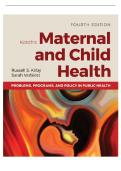
, TESTBANK FOR Kotch's Maternal and Child Health Problems, Programs,
and Policy in Public Health Fourth Edition Kirby
Important Notes
The file includes the complete test bank, organized chapter by chapter.
A sample of selected pages has been provided for preview.
All available appendices and Excel files (if included in the original resources) are
provided.
Quizzes, Midterm and final exams are included (if available in the original resources).
We continuously update our files to ensure you receive the latest and most accurate
editions.
New editions are added regularly – stay connected for updates!
⚠️Note on Answer Keys: If the answer key is not included within the chapter
questions, you will find the complete answers and solutions at the end of each
chapter.
✅ Why Buy From Us?
📚 Complete & organized chapter-by-chapter – no missing content, no guessing.
⚡ Instant digital delivery – get your file the moment you pay, no waiting.
📅 Always up to date – we track new editions so you always get the latest version.
💬 Friendly support – real humans ready to help, anytime you need us.
🔒 Safe & secure – thousands of satisfied students trust us every semester.
🛡️Our Guarantees
💰 Money-Back Guarantee: Not satisfied? We offer a full refund – no questions asked.
🔄 Wrong File? No Problem: Contact us and we will replace it immediately with the
correct version, free of charge.
⏰ 24/7 Support: We are always here – reach out anytime and expect a fast response.
, Kotch’s Maternal and Child Health, 4th Edition
Test Bank
Chapter 1: Rights, Justice and Equity
1.There is no national consensus regarding the rights of children.
A. True
B. False
Ans: True
2. Children were designated as persons under U.S. law in the 1969 Tinker v. Des Moines
Independent Community School District ruling.
A. True
B. False
Ans: True
3. In the past decade children have earned the right to
A. Give valid consent to surgical, medical or dental treatment
B. Stop going to school after they turn 16
C. Not be arrested if they are 16 and younger
D. Purchase tobacco products
Ans: A
4. At a White House ceremony in June of 2000, J. Craig Venter, a pioneer of DNA sequencing,
announced, “The concept of race has no genetic or scientific basis.”
A. True
B. False
Copyright © 2022 by Jones & Bartlett Learning, LLC, an Ascend Learning Company
, Kotch’s Maternal and Child Health, 4th Edition
Test Bank
Chapter 1: Rights, Justice and Equity
Ans: True
5. The Report of the Secretary’s Task Force on Black and Minority Health – known as the
Heckler Report was published in which year
A. 1965
B. 1970
C. 1985
D. 1999
Ans: C
6. Healthy People 2010 was the first national call for tracking health disparities.
A. True
B. False
Ans: B
7. Which of the actions below was NOT a result of the Affordable Care Act.
A. The transfer of the Office of Minority Health to the Office of the Secretary
B. The establishment of individual Offices of Minority Health within AHRQ, CDC, CMS, FDA,
HRSA, and SAMHSA.
C. The creation of Offices of Minority Health within every State Department of Health
D. The elevation of the National Center on Minority Health and Health Disparities to the
Institute on Minority Health and Disparities within the National Institutes of Health.
Copyright © 2022 by Jones & Bartlett Learning, LLC, an Ascend Learning Company
, Kotch’s Maternal and Child Health, 4th Edition
Test Bank
Chapter 1: Rights, Justice and Equity
Ans: C.
8. The Affordable Care Act has narrowed the gaps between racial groups on some indicators.
A. True
B. False
Ans: True
9. Which did the Trump administration NOT attempt to do to the Affordable Care Act.
A. Zero out the individual mandate’s tax penalty
B. Move funds allocated for preventive services to other areas of the ACA
C. Eliminate the requirement that ensures that people with limited English proficiency will
receive information and health care in languages other than English
D. Tell physicians that they could not discuss end of life care options with seniors.
Ans: D
10. The definition of reproductive justice was created by Gloria Steinem.
A. True
B. False
Ans: B
Copyright © 2022 by Jones & Bartlett Learning, LLC, an Ascend Learning Company
, Kotch’s Maternal and Child Health, 4th Edition
Test Bank
Chapter 1: Rights, Justice and Equity
11. Which policy below did not increase health and economic disparities.
A. The Social Security Act
B. Redlining and Restrictive Covenants
C. Paid Family Leave
D. The GI Bill
Ans: C
Short Answers
12. List the 2 principles of John Rawls’ Theory of Justice.
Ans:
1. Justice
2. Difference
13. List 3 social determinants of health
Ans: 1. Housing
2. Education
3. Transportation
4. Safe Neighborhoods
5. Access to health care
Copyright © 2022 by Jones & Bartlett Learning, LLC, an Ascend Learning Company
, Kotch’s Maternal and Child Health, 4th Edition
Test Bank
Chapter 1: Rights, Justice and Equity
6. Access to affordable healthy food
14. What is the World Health Organization’s definition of health?
Ans: Health is a state of complete physical, mental, and social well-being and not merely the
absence of disease or infirmity (World Health Organization [WHO (2005)]
15. Give a one sentence definition of health disparities.
Ans: Health disparities are the differences in health status rates between population groups.
16. Give a one sentence definition of health equity
Ans: Health equity is the absence of avoidable, unfair, or remediable differences among groups
of peoples.
17. Give one example of a health inequity.
Ans: 1. Black women are 4-5 times more likely to die due to pregnancy than White women.
2. Black babies are 2-3 times more likely to die before their first birthday than White
babies.
3. Black children are more likely to suffer from asthma than White children.
18. List policies that may act as structural barriers to health equity in the U.S.
Ans: A. Macroeconomic policies (e.g., labor policies, market structure)
B. Social policies (related to housing and land)
Copyright © 2022 by Jones & Bartlett Learning, LLC, an Ascend Learning Company
, Kotch’s Maternal and Child Health, 4th Edition
Test Bank
Chapter 1: Rights, Justice and Equity
C. Other public policies (education, health, environment)
19. List 4 strategies for MCH Policy and Programs to Advance Equity
Ans:
1. Decolonize funding and research
2. Propose policies and legislation to close equity gaps
3. Prioritize learnings from communities experiencing burdens of inequities
4. Adopt an antiracist stance as an organization
5. Employ respectful maternity care
6. Improve data collection and analyses processes
7. Provide visionary leadership
20. List 6 principles of holistic maternity care for Black Mamas.
1. Addresses gaps in care and ensures continuity of care
2. Is affordable and accessible
3. Is confidential, safe, and trauma-informed
4. Ensures informed consent
5. Is Black Mama-, family-, and parentcentered and patient-led
6. Is culturally informed and includes traditional practices
7. Is provided by culturally competent and culturally congruent providers
8. Respects spirituality and spiritual health
9. Honors and fosters resilience
10. Includes the voices of all Black Mamas
Copyright © 2022 by Jones & Bartlett Learning, LLC, an Ascend Learning Company
, Kotch’s Maternal and Child Health, 4th Edition
Test Bank
Chapter 1: Rights, Justice and Equity
11. Is responsive to the needs of all genders and family relationships
12. Provides wraparound services and connections to social services
Copyright © 2022 by Jones & Bartlett Learning, LLC, an Ascend Learning Company
, Kotch’s Maternal and Child Health, 4th Edition
Test Bank
Chapter 2: A Life Course Perspective on Maternal and Child Health and Health
Inequities
Multiple Choice
1. A hypothetical study that attempts to link birth weight to adult health outcomes reflects the
principle of __________
A. The Principle of Linked Lives
B. The Principle of Timing
C. The Principle of Historical Time and Place
D. The Principle of Life Span Development
Ans: D
2. The impact of childbearing on female educational attainment greatly depends on the mother’s
age at the time of the birth. This statement reflects the principle of ___________
A. The Principle of Human Agency
B. The Principle of Timing
C. The Principle of Historical Time and Place
D. The Principle of Life Span Development
Ans: B
3. A redirection of the life course through changes in situation, meaning, and/or behavior defines
which of the following key concepts in life course theory?
Copyright © 2022 by Jones & Bartlett Learning, LLC, an Ascend Learning Company
1
and Policy in Public Health Fourth Edition Kirby
Important Notes
The file includes the complete test bank, organized chapter by chapter.
A sample of selected pages has been provided for preview.
All available appendices and Excel files (if included in the original resources) are
provided.
Quizzes, Midterm and final exams are included (if available in the original resources).
We continuously update our files to ensure you receive the latest and most accurate
editions.
New editions are added regularly – stay connected for updates!
⚠️Note on Answer Keys: If the answer key is not included within the chapter
questions, you will find the complete answers and solutions at the end of each
chapter.
✅ Why Buy From Us?
📚 Complete & organized chapter-by-chapter – no missing content, no guessing.
⚡ Instant digital delivery – get your file the moment you pay, no waiting.
📅 Always up to date – we track new editions so you always get the latest version.
💬 Friendly support – real humans ready to help, anytime you need us.
🔒 Safe & secure – thousands of satisfied students trust us every semester.
🛡️Our Guarantees
💰 Money-Back Guarantee: Not satisfied? We offer a full refund – no questions asked.
🔄 Wrong File? No Problem: Contact us and we will replace it immediately with the
correct version, free of charge.
⏰ 24/7 Support: We are always here – reach out anytime and expect a fast response.
, Kotch’s Maternal and Child Health, 4th Edition
Test Bank
Chapter 1: Rights, Justice and Equity
1.There is no national consensus regarding the rights of children.
A. True
B. False
Ans: True
2. Children were designated as persons under U.S. law in the 1969 Tinker v. Des Moines
Independent Community School District ruling.
A. True
B. False
Ans: True
3. In the past decade children have earned the right to
A. Give valid consent to surgical, medical or dental treatment
B. Stop going to school after they turn 16
C. Not be arrested if they are 16 and younger
D. Purchase tobacco products
Ans: A
4. At a White House ceremony in June of 2000, J. Craig Venter, a pioneer of DNA sequencing,
announced, “The concept of race has no genetic or scientific basis.”
A. True
B. False
Copyright © 2022 by Jones & Bartlett Learning, LLC, an Ascend Learning Company
, Kotch’s Maternal and Child Health, 4th Edition
Test Bank
Chapter 1: Rights, Justice and Equity
Ans: True
5. The Report of the Secretary’s Task Force on Black and Minority Health – known as the
Heckler Report was published in which year
A. 1965
B. 1970
C. 1985
D. 1999
Ans: C
6. Healthy People 2010 was the first national call for tracking health disparities.
A. True
B. False
Ans: B
7. Which of the actions below was NOT a result of the Affordable Care Act.
A. The transfer of the Office of Minority Health to the Office of the Secretary
B. The establishment of individual Offices of Minority Health within AHRQ, CDC, CMS, FDA,
HRSA, and SAMHSA.
C. The creation of Offices of Minority Health within every State Department of Health
D. The elevation of the National Center on Minority Health and Health Disparities to the
Institute on Minority Health and Disparities within the National Institutes of Health.
Copyright © 2022 by Jones & Bartlett Learning, LLC, an Ascend Learning Company
, Kotch’s Maternal and Child Health, 4th Edition
Test Bank
Chapter 1: Rights, Justice and Equity
Ans: C.
8. The Affordable Care Act has narrowed the gaps between racial groups on some indicators.
A. True
B. False
Ans: True
9. Which did the Trump administration NOT attempt to do to the Affordable Care Act.
A. Zero out the individual mandate’s tax penalty
B. Move funds allocated for preventive services to other areas of the ACA
C. Eliminate the requirement that ensures that people with limited English proficiency will
receive information and health care in languages other than English
D. Tell physicians that they could not discuss end of life care options with seniors.
Ans: D
10. The definition of reproductive justice was created by Gloria Steinem.
A. True
B. False
Ans: B
Copyright © 2022 by Jones & Bartlett Learning, LLC, an Ascend Learning Company
, Kotch’s Maternal and Child Health, 4th Edition
Test Bank
Chapter 1: Rights, Justice and Equity
11. Which policy below did not increase health and economic disparities.
A. The Social Security Act
B. Redlining and Restrictive Covenants
C. Paid Family Leave
D. The GI Bill
Ans: C
Short Answers
12. List the 2 principles of John Rawls’ Theory of Justice.
Ans:
1. Justice
2. Difference
13. List 3 social determinants of health
Ans: 1. Housing
2. Education
3. Transportation
4. Safe Neighborhoods
5. Access to health care
Copyright © 2022 by Jones & Bartlett Learning, LLC, an Ascend Learning Company
, Kotch’s Maternal and Child Health, 4th Edition
Test Bank
Chapter 1: Rights, Justice and Equity
6. Access to affordable healthy food
14. What is the World Health Organization’s definition of health?
Ans: Health is a state of complete physical, mental, and social well-being and not merely the
absence of disease or infirmity (World Health Organization [WHO (2005)]
15. Give a one sentence definition of health disparities.
Ans: Health disparities are the differences in health status rates between population groups.
16. Give a one sentence definition of health equity
Ans: Health equity is the absence of avoidable, unfair, or remediable differences among groups
of peoples.
17. Give one example of a health inequity.
Ans: 1. Black women are 4-5 times more likely to die due to pregnancy than White women.
2. Black babies are 2-3 times more likely to die before their first birthday than White
babies.
3. Black children are more likely to suffer from asthma than White children.
18. List policies that may act as structural barriers to health equity in the U.S.
Ans: A. Macroeconomic policies (e.g., labor policies, market structure)
B. Social policies (related to housing and land)
Copyright © 2022 by Jones & Bartlett Learning, LLC, an Ascend Learning Company
, Kotch’s Maternal and Child Health, 4th Edition
Test Bank
Chapter 1: Rights, Justice and Equity
C. Other public policies (education, health, environment)
19. List 4 strategies for MCH Policy and Programs to Advance Equity
Ans:
1. Decolonize funding and research
2. Propose policies and legislation to close equity gaps
3. Prioritize learnings from communities experiencing burdens of inequities
4. Adopt an antiracist stance as an organization
5. Employ respectful maternity care
6. Improve data collection and analyses processes
7. Provide visionary leadership
20. List 6 principles of holistic maternity care for Black Mamas.
1. Addresses gaps in care and ensures continuity of care
2. Is affordable and accessible
3. Is confidential, safe, and trauma-informed
4. Ensures informed consent
5. Is Black Mama-, family-, and parentcentered and patient-led
6. Is culturally informed and includes traditional practices
7. Is provided by culturally competent and culturally congruent providers
8. Respects spirituality and spiritual health
9. Honors and fosters resilience
10. Includes the voices of all Black Mamas
Copyright © 2022 by Jones & Bartlett Learning, LLC, an Ascend Learning Company
, Kotch’s Maternal and Child Health, 4th Edition
Test Bank
Chapter 1: Rights, Justice and Equity
11. Is responsive to the needs of all genders and family relationships
12. Provides wraparound services and connections to social services
Copyright © 2022 by Jones & Bartlett Learning, LLC, an Ascend Learning Company
, Kotch’s Maternal and Child Health, 4th Edition
Test Bank
Chapter 2: A Life Course Perspective on Maternal and Child Health and Health
Inequities
Multiple Choice
1. A hypothetical study that attempts to link birth weight to adult health outcomes reflects the
principle of __________
A. The Principle of Linked Lives
B. The Principle of Timing
C. The Principle of Historical Time and Place
D. The Principle of Life Span Development
Ans: D
2. The impact of childbearing on female educational attainment greatly depends on the mother’s
age at the time of the birth. This statement reflects the principle of ___________
A. The Principle of Human Agency
B. The Principle of Timing
C. The Principle of Historical Time and Place
D. The Principle of Life Span Development
Ans: B
3. A redirection of the life course through changes in situation, meaning, and/or behavior defines
which of the following key concepts in life course theory?
Copyright © 2022 by Jones & Bartlett Learning, LLC, an Ascend Learning Company
1


