

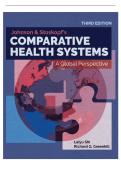
, TESTBANK FOR Johnson & Stoskopf's Comparative Health Systems Third
Edition Shi
Important Notes
The file includes the complete test bank, organized chapter by chapter.
A sample of selected pages has been provided for preview.
All available appendices and Excel files (if included in the original resources) are
provided.
Quizzes, Midterm and final exams are included (if available in the original resources).
We continuously update our files to ensure you receive the latest and most accurate
editions.
New editions are added regularly – stay connected for updates!
⚠️Note on Answer Keys: If the answer key is not included within the chapter
questions, you will find the complete answers and solutions at the end of each
chapter.
✅ Why Buy From Us?
📚 Complete & organized chapter-by-chapter – no missing content, no guessing.
⚡ Instant digital delivery – get your file the moment you pay, no waiting.
📅 Always up to date – we track new editions so you always get the latest version.
💬 Friendly support – real humans ready to help, anytime you need us.
🔒 Safe & secure – thousands of satisfied students trust us every semester.
🛡️Our Guarantees
💰 Money-Back Guarantee: Not satisfied? We offer a full refund – no questions asked.
🔄 Wrong File? No Problem: Contact us and we will replace it immediately with the
correct version, free of charge.
⏰ 24/7 Support: We are always here – reach out anytime and expect a fast response.
,Johnson & Stoskopf’s Comparative Health Systems: A Global Perspective, Third Edition
Leiyu Shi and Richard Greenhill
Test Bank
Chapter 1
Multiple Choice
1. The most widely dispersed systems devised by humans are:
A) families.
B) nation-states.
C) organizations.
D) languages.
Ans: C
Subject: Chapter 1
Title: Introduction to Health Systems
2. Which of the following accurately characterizes larger social systems?
A) They possess a structure that is independent of their parts and processes.
B) They consist largely of highly specific aspects of reality.
C) They vary widely in the way they function.
D) Their various components display both functional and structural relationships.
Ans: D
Subject: Chapter 1
Title: Introduction to Health Systems
3. In addition to cost, quality, and access, which of the following can be considered a building block of health
systems?
A) Culture
B) Innovation
C) Politics
D) Religion
Ans: B
Subject: Chapter 1
Title: Introduction to Health Systems
4. According to the Behavioral Model for Vulnerable Populations, illness is considered a(n) _______ factor.
A) predisposing
B) pre-existing
C) enabling
D) need
Ans: D
Subject: Chapter 1
Title: Introduction to Health Systems
5. Which of the following statements characterizes the Health in All Policies approach to public policies?
A) It considers health implications of decisions.
B) It avoids synergies.
C) It emphasizes the consequences of health systems on public policies.
Copyright © 2027 by Jones & Bartlett Learning, LLC, an Ascend Learning Company 1
,Johnson & Stoskopf’s Comparative Health Systems: A Global Perspective, Third Edition
Leiyu Shi and Richard Greenhill
Test Bank
D) It de-emphasizes determinants of well-being.
Ans: A
Subject: Chapter 1
Title: Introduction to Health Systems
6. Which of the following statements regarding social determinants of health is accurate?
A) Effects of fetal undernutrition can be corrected if addressed within the first 6 weeks of life.
B) Low birth weight has little correlation to adult health status.
C) Social accumulation can be transgenerational.
D) Crossing socioeconomic boundaries has little overall influence on health status.
Ans: C
Subject: Chapter 1
Title: Introduction to Health Systems
7. Regardless of which health model a country embraces, the WHO identifies the qualities of a good healthcare
system to include:
A) safe and effective.
B) timely and efficient.
C) equitable and integrated.
D) All of these are correct.
Ans: D
Subject: Chapter 1
Title: Introduction to Health Systems
8. As health systems evolve throughout the world, which of the following outcomes is likely?
A) Health systems will become less diverse.
B) Government structure will exert increasing effects on the majority of health systems.
C) Cultural and social forces will be de-emphasized in most systems.
D) Health systems will become more sustainable.
Ans: D
Subject: Chapter 1
Title: Introduction to Health Systems
9. Which of the following is not a Sustainable Development Goal of the WHO?
A) No poverty
B) Good health and well-being
C) Affordable health care for all
D) Clean water and sanitation
Ans: C
Subject: Chapter 1
Title: Introduction to Health Systems
True/False
Copyright © 2027 by Jones & Bartlett Learning, LLC, an Ascend Learning Company 2
,Johnson & Stoskopf’s Comparative Health Systems: A Global Perspective, Third Edition
Leiyu Shi and Richard Greenhill
Test Bank
1. True or False? Social policies regarding education, housing, and infrastructure are regarded as exclusive to
health policy.
Ans: False
Subject: Chapter 1
Title: Introduction to Health Systems
2. True or False? The psychobiological stress response can lead to cognitive decline.
Ans: True
Subject: Chapter 1
Title: Introduction to Health Systems
3. True or False? Public health research over the past 50 years has underscored the importance of the
traditional healthcare delivery system as a key determinant of health of individuals and populations.
Ans: False
Subject: Chapter 1
Title: Introduction to Health Systems
4. True or False? In the coming decades, the increase in old-age dependency ratios will make the economic
contributions of older people more important.
Ans: True
Subject: Chapter 1
Title: Introduction to Health Systems
5. True or False? A large proportion of individuals do not receive any health care for their condition because the
mental health infrastructure and services in most countries are grossly insufficient for the large and growing
needs and widely prevalent stigma and discrimination prevent them from seeking help.
Ans: True
Subject: Chapter 1
Title: Introduction to Health Systems
Copyright © 2027 by Jones & Bartlett Learning, LLC, an Ascend Learning Company 3
,Johnson & Stoskopf’s Comparative Health Systems: A Global Perspective, Third Edition
Leiyu Shi and Richard Greenhill
Test Bank
Chapter 2
True/False
1. True or False? The Spanish Flu was a key driver in pushing global leaders to conceptualize and plan
for future disease outbreaks.
Ans: True
Subject: Chapter 2
Title: Global and International Frameworks
2. True or False? Frameworks are meant to be overly prescriptive in their implementation with little
flexibility for country needs.
Ans: False
Subject: Chapter 2
Title: Global and International Frameworks
3. True or False? The OneHealth approach only involves medical doctors working together to monitor
public health threats.
Ans: False
Subject: Chapter 2
Title: Global and International Frameworks
4. True or False? The National Incident Management System (NIMS) was first published by FEMA in
2004.
Ans: True
Subject: Chapter 2
Title: Global and International Frameworks
5. True or False? Hospital resilience happens naturally without requiring deliberate coordination.
Ans: False
Subject: Chapter 2
Title: Global and International Frameworks
Multiple Choice
1. What are the three main components of the Hospital Resilience Framework?
A) Plan, Execute, Review
B) Absorb, Adapt, Transform
C) Detect, Assess, Respond
Copyright © 2027 by Jones & Bartlett Learning, LLC, an Ascend Learning Company 1
,Johnson & Stoskopf’s Comparative Health Systems: A Global Perspective, Third Edition
Leiyu Shi and Richard Greenhill
Test Bank
D) Prepare, React, Recover
Ans: B
Subject: Chapter 2
Title: Global and International Frameworks
2. According to the OECD, mental health costs average what percentage of Gross Domestic Product?
A) 1.5% to 2%
B) 2.5% to 3%
C) 3.5% to 4%
D) 4.5% to 5%
Ans: C
Subject: Chapter 2
Title: Global and International Frameworks
3. How many major functional areas does NIMS include?
A) Four
B) Five
C) Six
D) Seven
Ans: C
Subject: Chapter 2
Title: Global and International Frameworks
4. Which organization defines the International Health Regulations (IHR)?
A) CDC
B) WHO
C) FEMA
D) OECD
Ans: B
Subject: Chapter 2
Title: Global and International Frameworks
5. Which of the following is not one of the four main categories of frameworks?
A) Disease
B) Preparedness and Response
C) Economic Development
D) Monitoring and Evaluation
Ans: C
Subject: Chapter 2
Title: Global and International Frameworks
6. The Risk Identification and Site Criticality (RISC) Toolkit consists of how many modules?
A) Two
B) Three
C) Four
Copyright © 2027 by Jones & Bartlett Learning, LLC, an Ascend Learning Company 2
,Johnson & Stoskopf’s Comparative Health Systems: A Global Perspective, Third Edition
Leiyu Shi and Richard Greenhill
Test Bank
D) Five
Ans: B
Subject: Chapter 2
Title: Global and International Frameworks
7. When was the first NIMS document published?
A) 2001
B) 2004
C) 2008
D) 2017
Ans: B
Subject: Chapter 2
Title: Global and International Frameworks
8. According to the chapter, which of the following is not a zoonotic disease?
A) West Nile virus
B) Malaria
C) Ebola
D) Salmonella
Ans: B
Subject: Chapter 2
Title: Global and International Frameworks
9. How many principles define a high-performing mental health sector according to OECD experts?
A) Four
B) Five
C) Six
D) Seven
Ans: C
Subject: Chapter 2
Title: Global and International Frameworks
10. The NIMS Intelligence/Investigations Function is typically performed by which other function?
A) Command Function
B) Operations Function
C) Planning Function
D) Logistics Function
Ans: C
Subject: Chapter 2
Title: Global and International Frameworks
Copyright © 2027 by Jones & Bartlett Learning, LLC, an Ascend Learning Company 3
,Johnson & Stoskopf’s Comparative Health Systems: A Global Perspective, Third Edition
Leiyu Shi and Richard Greenhill
Test Bank
Chapter 3
True/False
1. True or False? Prevalence measures the number of new cases of a disease in a population over a
specified period of time.
Ans: False
Subject: Chapter 3
Title: Global Health and Disease
2. True or False? According to the chapter, 80% of NCD deaths occur in low-middle-income countries.
Ans: True
Subject: Chapter 3
Title: Global Health and Disease
3. True or False? Vector-borne diseases require a blood-sucking agent (arthropod) to transmit the
pathogen among vertebrate hosts.
Ans: True
Subject: Chapter 3
Title: Global Health and Disease
4. True or False? Type 2 diabetes accounts for approximately 5–10% of all diabetes cases.
Ans: False
Subject: Chapter 3
Title: Global Health and Disease
5. True or False? Climate change has no significant impact on the spread of infectious diseases.
Ans: False
Subject: Chapter 3
Title: Global Health and Disease
Multiple Choice
1. Which of the following is not one of the 10 essential public health functions mentioned in the chapter?
A) Monitor health statuses
B) Diagnose and investigate health problems
C) Provide direct medical treatment to all citizens
D) Develop policies and plans that support health efforts
Ans: C
Copyright © 2027 by Jones & Bartlett Learning, LLC, an Ascend Learning Company 1
, Johnson & Stoskopf’s Comparative Health Systems: A Global Perspective, Third Edition
Leiyu Shi and Richard Greenhill
Test Bank
Subject: Chapter 3
Title: Global Health and Disease
2. According to the text, what is the world's leading cause of death?
A) Cancer
B) Cardiovascular disease (CVD)
C) Stroke
D) Respiratory infections
Ans: B
Subject: Chapter 3
Title: Global Health and Disease
3. What percentage of the world's population was at risk for malaria as of 2022?
A) 28%
B) 38%
C) 48%
D) 58%
Ans: C
Subject: Chapter 3
Title: Global Health and Disease
4. Which of the following is a key characteristic of noncommunicable diseases (NCDs)?
A) They are highly contagious.
B) They are typically of short duration.
C) They are non-transmissible and often of long duration.
D) They only affect developed countries.
Ans: C
Subject: Chapter 3
Title: Global Health and Disease
5. What is the primary mode of transmission for diarrheal illnesses, according to the chapter?
A) Airborne transmission
B) Contaminated water
C) Direct contact
D) Vector-borne transmission
Ans: B
Subject: Chapter 3
Title: Global Health and Disease
6. Which age group experiences the highest mortality rate from malaria in Africa?
A) Elderly adults
B) Middle-aged adults
C) Teenagers
D) Children under 5 years
Ans: D
Copyright © 2027 by Jones & Bartlett Learning, LLC, an Ascend Learning Company 2
Edition Shi
Important Notes
The file includes the complete test bank, organized chapter by chapter.
A sample of selected pages has been provided for preview.
All available appendices and Excel files (if included in the original resources) are
provided.
Quizzes, Midterm and final exams are included (if available in the original resources).
We continuously update our files to ensure you receive the latest and most accurate
editions.
New editions are added regularly – stay connected for updates!
⚠️Note on Answer Keys: If the answer key is not included within the chapter
questions, you will find the complete answers and solutions at the end of each
chapter.
✅ Why Buy From Us?
📚 Complete & organized chapter-by-chapter – no missing content, no guessing.
⚡ Instant digital delivery – get your file the moment you pay, no waiting.
📅 Always up to date – we track new editions so you always get the latest version.
💬 Friendly support – real humans ready to help, anytime you need us.
🔒 Safe & secure – thousands of satisfied students trust us every semester.
🛡️Our Guarantees
💰 Money-Back Guarantee: Not satisfied? We offer a full refund – no questions asked.
🔄 Wrong File? No Problem: Contact us and we will replace it immediately with the
correct version, free of charge.
⏰ 24/7 Support: We are always here – reach out anytime and expect a fast response.
,Johnson & Stoskopf’s Comparative Health Systems: A Global Perspective, Third Edition
Leiyu Shi and Richard Greenhill
Test Bank
Chapter 1
Multiple Choice
1. The most widely dispersed systems devised by humans are:
A) families.
B) nation-states.
C) organizations.
D) languages.
Ans: C
Subject: Chapter 1
Title: Introduction to Health Systems
2. Which of the following accurately characterizes larger social systems?
A) They possess a structure that is independent of their parts and processes.
B) They consist largely of highly specific aspects of reality.
C) They vary widely in the way they function.
D) Their various components display both functional and structural relationships.
Ans: D
Subject: Chapter 1
Title: Introduction to Health Systems
3. In addition to cost, quality, and access, which of the following can be considered a building block of health
systems?
A) Culture
B) Innovation
C) Politics
D) Religion
Ans: B
Subject: Chapter 1
Title: Introduction to Health Systems
4. According to the Behavioral Model for Vulnerable Populations, illness is considered a(n) _______ factor.
A) predisposing
B) pre-existing
C) enabling
D) need
Ans: D
Subject: Chapter 1
Title: Introduction to Health Systems
5. Which of the following statements characterizes the Health in All Policies approach to public policies?
A) It considers health implications of decisions.
B) It avoids synergies.
C) It emphasizes the consequences of health systems on public policies.
Copyright © 2027 by Jones & Bartlett Learning, LLC, an Ascend Learning Company 1
,Johnson & Stoskopf’s Comparative Health Systems: A Global Perspective, Third Edition
Leiyu Shi and Richard Greenhill
Test Bank
D) It de-emphasizes determinants of well-being.
Ans: A
Subject: Chapter 1
Title: Introduction to Health Systems
6. Which of the following statements regarding social determinants of health is accurate?
A) Effects of fetal undernutrition can be corrected if addressed within the first 6 weeks of life.
B) Low birth weight has little correlation to adult health status.
C) Social accumulation can be transgenerational.
D) Crossing socioeconomic boundaries has little overall influence on health status.
Ans: C
Subject: Chapter 1
Title: Introduction to Health Systems
7. Regardless of which health model a country embraces, the WHO identifies the qualities of a good healthcare
system to include:
A) safe and effective.
B) timely and efficient.
C) equitable and integrated.
D) All of these are correct.
Ans: D
Subject: Chapter 1
Title: Introduction to Health Systems
8. As health systems evolve throughout the world, which of the following outcomes is likely?
A) Health systems will become less diverse.
B) Government structure will exert increasing effects on the majority of health systems.
C) Cultural and social forces will be de-emphasized in most systems.
D) Health systems will become more sustainable.
Ans: D
Subject: Chapter 1
Title: Introduction to Health Systems
9. Which of the following is not a Sustainable Development Goal of the WHO?
A) No poverty
B) Good health and well-being
C) Affordable health care for all
D) Clean water and sanitation
Ans: C
Subject: Chapter 1
Title: Introduction to Health Systems
True/False
Copyright © 2027 by Jones & Bartlett Learning, LLC, an Ascend Learning Company 2
,Johnson & Stoskopf’s Comparative Health Systems: A Global Perspective, Third Edition
Leiyu Shi and Richard Greenhill
Test Bank
1. True or False? Social policies regarding education, housing, and infrastructure are regarded as exclusive to
health policy.
Ans: False
Subject: Chapter 1
Title: Introduction to Health Systems
2. True or False? The psychobiological stress response can lead to cognitive decline.
Ans: True
Subject: Chapter 1
Title: Introduction to Health Systems
3. True or False? Public health research over the past 50 years has underscored the importance of the
traditional healthcare delivery system as a key determinant of health of individuals and populations.
Ans: False
Subject: Chapter 1
Title: Introduction to Health Systems
4. True or False? In the coming decades, the increase in old-age dependency ratios will make the economic
contributions of older people more important.
Ans: True
Subject: Chapter 1
Title: Introduction to Health Systems
5. True or False? A large proportion of individuals do not receive any health care for their condition because the
mental health infrastructure and services in most countries are grossly insufficient for the large and growing
needs and widely prevalent stigma and discrimination prevent them from seeking help.
Ans: True
Subject: Chapter 1
Title: Introduction to Health Systems
Copyright © 2027 by Jones & Bartlett Learning, LLC, an Ascend Learning Company 3
,Johnson & Stoskopf’s Comparative Health Systems: A Global Perspective, Third Edition
Leiyu Shi and Richard Greenhill
Test Bank
Chapter 2
True/False
1. True or False? The Spanish Flu was a key driver in pushing global leaders to conceptualize and plan
for future disease outbreaks.
Ans: True
Subject: Chapter 2
Title: Global and International Frameworks
2. True or False? Frameworks are meant to be overly prescriptive in their implementation with little
flexibility for country needs.
Ans: False
Subject: Chapter 2
Title: Global and International Frameworks
3. True or False? The OneHealth approach only involves medical doctors working together to monitor
public health threats.
Ans: False
Subject: Chapter 2
Title: Global and International Frameworks
4. True or False? The National Incident Management System (NIMS) was first published by FEMA in
2004.
Ans: True
Subject: Chapter 2
Title: Global and International Frameworks
5. True or False? Hospital resilience happens naturally without requiring deliberate coordination.
Ans: False
Subject: Chapter 2
Title: Global and International Frameworks
Multiple Choice
1. What are the three main components of the Hospital Resilience Framework?
A) Plan, Execute, Review
B) Absorb, Adapt, Transform
C) Detect, Assess, Respond
Copyright © 2027 by Jones & Bartlett Learning, LLC, an Ascend Learning Company 1
,Johnson & Stoskopf’s Comparative Health Systems: A Global Perspective, Third Edition
Leiyu Shi and Richard Greenhill
Test Bank
D) Prepare, React, Recover
Ans: B
Subject: Chapter 2
Title: Global and International Frameworks
2. According to the OECD, mental health costs average what percentage of Gross Domestic Product?
A) 1.5% to 2%
B) 2.5% to 3%
C) 3.5% to 4%
D) 4.5% to 5%
Ans: C
Subject: Chapter 2
Title: Global and International Frameworks
3. How many major functional areas does NIMS include?
A) Four
B) Five
C) Six
D) Seven
Ans: C
Subject: Chapter 2
Title: Global and International Frameworks
4. Which organization defines the International Health Regulations (IHR)?
A) CDC
B) WHO
C) FEMA
D) OECD
Ans: B
Subject: Chapter 2
Title: Global and International Frameworks
5. Which of the following is not one of the four main categories of frameworks?
A) Disease
B) Preparedness and Response
C) Economic Development
D) Monitoring and Evaluation
Ans: C
Subject: Chapter 2
Title: Global and International Frameworks
6. The Risk Identification and Site Criticality (RISC) Toolkit consists of how many modules?
A) Two
B) Three
C) Four
Copyright © 2027 by Jones & Bartlett Learning, LLC, an Ascend Learning Company 2
,Johnson & Stoskopf’s Comparative Health Systems: A Global Perspective, Third Edition
Leiyu Shi and Richard Greenhill
Test Bank
D) Five
Ans: B
Subject: Chapter 2
Title: Global and International Frameworks
7. When was the first NIMS document published?
A) 2001
B) 2004
C) 2008
D) 2017
Ans: B
Subject: Chapter 2
Title: Global and International Frameworks
8. According to the chapter, which of the following is not a zoonotic disease?
A) West Nile virus
B) Malaria
C) Ebola
D) Salmonella
Ans: B
Subject: Chapter 2
Title: Global and International Frameworks
9. How many principles define a high-performing mental health sector according to OECD experts?
A) Four
B) Five
C) Six
D) Seven
Ans: C
Subject: Chapter 2
Title: Global and International Frameworks
10. The NIMS Intelligence/Investigations Function is typically performed by which other function?
A) Command Function
B) Operations Function
C) Planning Function
D) Logistics Function
Ans: C
Subject: Chapter 2
Title: Global and International Frameworks
Copyright © 2027 by Jones & Bartlett Learning, LLC, an Ascend Learning Company 3
,Johnson & Stoskopf’s Comparative Health Systems: A Global Perspective, Third Edition
Leiyu Shi and Richard Greenhill
Test Bank
Chapter 3
True/False
1. True or False? Prevalence measures the number of new cases of a disease in a population over a
specified period of time.
Ans: False
Subject: Chapter 3
Title: Global Health and Disease
2. True or False? According to the chapter, 80% of NCD deaths occur in low-middle-income countries.
Ans: True
Subject: Chapter 3
Title: Global Health and Disease
3. True or False? Vector-borne diseases require a blood-sucking agent (arthropod) to transmit the
pathogen among vertebrate hosts.
Ans: True
Subject: Chapter 3
Title: Global Health and Disease
4. True or False? Type 2 diabetes accounts for approximately 5–10% of all diabetes cases.
Ans: False
Subject: Chapter 3
Title: Global Health and Disease
5. True or False? Climate change has no significant impact on the spread of infectious diseases.
Ans: False
Subject: Chapter 3
Title: Global Health and Disease
Multiple Choice
1. Which of the following is not one of the 10 essential public health functions mentioned in the chapter?
A) Monitor health statuses
B) Diagnose and investigate health problems
C) Provide direct medical treatment to all citizens
D) Develop policies and plans that support health efforts
Ans: C
Copyright © 2027 by Jones & Bartlett Learning, LLC, an Ascend Learning Company 1
, Johnson & Stoskopf’s Comparative Health Systems: A Global Perspective, Third Edition
Leiyu Shi and Richard Greenhill
Test Bank
Subject: Chapter 3
Title: Global Health and Disease
2. According to the text, what is the world's leading cause of death?
A) Cancer
B) Cardiovascular disease (CVD)
C) Stroke
D) Respiratory infections
Ans: B
Subject: Chapter 3
Title: Global Health and Disease
3. What percentage of the world's population was at risk for malaria as of 2022?
A) 28%
B) 38%
C) 48%
D) 58%
Ans: C
Subject: Chapter 3
Title: Global Health and Disease
4. Which of the following is a key characteristic of noncommunicable diseases (NCDs)?
A) They are highly contagious.
B) They are typically of short duration.
C) They are non-transmissible and often of long duration.
D) They only affect developed countries.
Ans: C
Subject: Chapter 3
Title: Global Health and Disease
5. What is the primary mode of transmission for diarrheal illnesses, according to the chapter?
A) Airborne transmission
B) Contaminated water
C) Direct contact
D) Vector-borne transmission
Ans: B
Subject: Chapter 3
Title: Global Health and Disease
6. Which age group experiences the highest mortality rate from malaria in Africa?
A) Elderly adults
B) Middle-aged adults
C) Teenagers
D) Children under 5 years
Ans: D
Copyright © 2027 by Jones & Bartlett Learning, LLC, an Ascend Learning Company 2


