

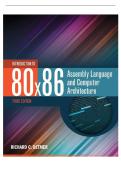
, TESTBANK FOR Introduction to 80x86 Assembly Language and Computer
Architecture Third Edition Detmer
Important Notes
The file includes the complete test bank, organized chapter by chapter.
A sample of selected pages has been provided for preview.
All available appendices and Excel files (if included in the original resources) are
provided.
Quizzes, Midterm and final exams are included (if available in the original resources).
We continuously update our files to ensure you receive the latest and most accurate
editions.
New editions are added regularly – stay connected for updates!
⚠️Note on Answer Keys: If the answer key is not included within the chapter
questions, you will find the complete answers and solutions at the end of each
chapter.
✅ Why Buy From Us?
📚 Complete & organized chapter-by-chapter – no missing content, no guessing.
⚡ Instant digital delivery – get your file the moment you pay, no waiting.
📅 Always up to date – we track new editions so you always get the latest version.
💬 Friendly support – real humans ready to help, anytime you need us.
🔒 Safe & secure – thousands of satisfied students trust us every semester.
🛡️Our Guarantees
💰 Money-Back Guarantee: Not satisfied? We offer a full refund – no questions asked.
🔄 Wrong File? No Problem: Contact us and we will replace it immediately with the
correct version, free of charge.
⏰ 24/7 Support: We are always here – reach out anytime and expect a fast response.
,Chapter 1 Sample Examination Questions
Students may use a calculator but no book or notes for these questions.
1. In a PC using an Intel 80x86 microprocessor, the number of
(a) bits in a byte is ______
(b) bits in a hex digit is ______
(c) bits in a doubleword is ______
(d) bits in a single precision floation point number is ______
(e) bytes in a word is ______
(f) bytes in a quadword is ______
(g) hex digits in a byte is ______
(h) hex digits in a doubleword is ______
(i) hex digits in a single precision floation point number is ______
2. Suppose that a word contains FF C8.
(a) Given that this word represents an unsigned decimal number, what is the decimal
number?
(b) Given that this word is the 2's complement representation for a signed decimal
number, what is the decimal number?
(c) Give the 2’s complement of FF C8.
3. Suppose that a word contains EC F9.
(a) Given that this word represents an unsigned decimal number, what is the decimal
number?
(b) Given that this word is the 2's complement representation for a signed decimal
number, what is the decimal number?
(c) Give the 2’s complement of EC F9.
4. Suppose that a byte contains 20 (in hex).
, (a) Given that this byte is the ASCII code for a character, what is the character?
(b) Given that this byte represents an unsigned decimal number, what is the decimal
number?
(c) Given that this byte is the 2's complement representation for a signed decimal
number, what is the decimal number?
5. Perform each of the following additions of word size numbers. Give the sum in hex as a word
size number. State whether or not overflow occurs. State whether or not there is a carry.
Check each answer by converting the problem to both decimal interpretations (unsigned and
2's complement); show that the unsigned interpretation is correct when there is no carry,
and the signed interpretation is correct when there is no overflow.
(a) 4E35 + 71CA
(b) FFFA + 03B1
(c) FFFA + FFFB
(d) 03B7 + 3FDC
6. Suppose you have a "binary clock," the display of which is
an array of LEDs where the first two columns give the 10s
and 1s digits of the hour, the next two columns give the
minutes, and the last two give the seconds, each in binary
where a lit LED means 1 and an unlit LED means 0. Identify
the time shown on each clock display to the right.
7. Find the single precdision floating point representation of the decimal number -53.75. Give
your answer as 8 hex digits.
8. Given that the ASCII code for the uppercase letter C is 43 in hex, what is the ASCiI code for a
lowercase c?
9. Given that the ASCII code for the numeral 0 is 30 in hex, what is the ASCiI code for the
numeral 6?
10. Give an example of an ASCII control character.
11. Starting with the decimal number -2
(a) Give the byte-length 2’s complement representation of the number in hex.
,(b) Give the word-length 2’s complement representation of the number in binary.
(c) Give the doubleword-length 2’s complement representation of the number in hex.
(d) Give the quadword-length 2’s complement representation of the number in hex.
,Chapter 2 Sample Examination Questions
Students may use a calculator but no book or notes for these questions.
1. In a PC using an Intel 80x86 microprocessor, the number of bits in the EBX register is ______
2. In a PC using an Intel Pentium microprocessor, the number of bits in a physical memory
address is ______
3. In a PC using an Intel Core 2 microprocessor, the number of bits in the RBP register is
______
4. In a PC using an Intel 8086, the number of bytes in a memory segment was ______
5. Briefly explain why you should use a text editor instead of a word processor to create an
assembly language source program.
6. Suppose that the EAX register contains FFFFFFC8 and the instrucution add eax, 211 is
executed. What will be in the EAX register, and what will be the values of SF, ZF, CF and OF?
7. Name and give the length (in bits) of a register that is new to the Intel 64-bit architecture.
8. What is the name of the register in which 80x86 flags are stored?
9. Draw a diagram showing the relationship of the EDX, DX, DL and DH registers.
10. Briefly explain the difference between a compiler and an interpreter.
11. Give one reason why the accumulator EAX is "special" in current Intel chips.
12. Suppose that you buy a 64-bit PC with 8 GB of RAM. What is the 16-hex-digit of the “last”
byte of installed memory?
,Chapter 3 Sample Examination Questions
Students may use a calculator, the textbook and their notes for these questions.
1. For each of the four operands below, identify its mode as the correct choice of immediate,
register, direct, or register indirect. Assume that the program contains the directive
result DWORD ?
(a) mov DWORD Ptr [ebx], 100
________________ ________________
(b) mov result, ebx
________________ ________________
2. Find the initial values that the assembler will generate for each directive below. Write your
answers using two hex digits for each byte generated.
(a) byteA BYTE 0ah
(b) byteB BYTE "xyz", 0
(c) dwordC DWORD 101011h, 101011b
(d) dwordD DWORD 3 DUP (101011)
(e) quadE QWORD -1
3. Suppose that the EDX register contains FF FF F6 E5 and that the data segment of a
windows32 program contains
areaLbl BYTE "Area ="
area BYTE 11 DUP (?), 0dh, 0ah, 0
(a) Assuming that the statement dtoa area, edx is executed, show (in hex) what
will be in the 20 memory bytes starting at areaLbl.
(b) Assuming that the dtoa statement in part (a) is followed by the statement
output areaLbl
show what will be displayed. Show white space (spaces and newlines) clearly.
,4. Below is a listing file from which some items (marked a, b and c) have been edited out. Add
the missing items, and answer the questions following the listing file.
; Program to add three numbers
.586
.MODEL FLAT
.STACK 4096 ; reserve 4096-byte stack
00000000 .DATA ; reserve storage for data
00000000 00000055 number1 DWORD 85
00000004 FFFFFFD1 number2 DWORD -47
(a)
00000008 ________ number3 DWORD 91
(b)
________ 00000000 sum DWORD ?
00000000 .CODE ; start of main pgm code
00000000 main PROC
00000000 A1 00000000 R mov eax, number1 ; first number to EAX
(c)
________ 03 05 00000004 R add eax, number2 ; add second number
0000000B 03 05 00000008 R add eax, number3 ; add third number
00000011 A3 0000000C R mov sum, eax ; sum to memory
00000016 B8 00000000 mov eax, 0 ; exit w/ return code 0
0000001B C3 ret
0000001C main ENDP
END ; end of source code
(d) What is the opcode for the instruction add eax, number3 ?
(e) What is the object code for the instruction add eax, number3 ?
(f) "R" in the listing file stands for "relocatable." Explain what this means.
(g) Identify three directives in the program.
(h) How many bytes of object code are used by the entire program? (answer in decimal)
,Chapter 4 Sample Examination Questions
Students may use a calculator, the textbook and their notes for these questions.
1. Give the op code and number of bytes of code for each of these instructions.
(a) mov ecx, 984 Op Code______ Number of Bytes _____
(b) xchg eax, ecx Op Code______ Number of Bytes _____
(c) add eax, ecx Op Code______ Number of Bytes _____
(d) add eax, value Op Code______ Number of Bytes _____
(assume value references a doubleword in memory)
(e) inc edx Op Code______ Number of Bytes _____
(f) inc DWORD PTR [edx] Op Code______ Number of Bytes _____
(g) neg value Op Code______ Number of Bytes _____
(assume value references a doubleword in memory)
(h) neg edx Op Code______ Number of Bytes _____
(i) neg DWORD PTR [edx] Op Code______ Number of Bytes _____
(j) add ecx, 894 Op Code______ Number of Bytes _____
(k) imul eax, ecx Op Code______ Number of Bytes _____
(l) div value Op Code______ Number of Bytes _____
(assume value references a doubleword in memory)
(m) div DWORD PTR [edx] Op Code______ Number of Bytes _____
(n) cdq Op Code______ Number of Bytes _____
, 2. Each of these problems gives "before" conditions and an instruction. Give the indicated
"after" state.
Before Instruction executed After
(a) ECX: 00 00 BF 7A mov ecx, -89 ECX
(b) ECX: 00 00 BF 7A mov ecx, 984 ECX
(c) EAX: 12 34 56 78 xchg ax, dx EAX
EDX: 9A BC DE F0
EDX
(d) EAX: FF FF FF C8 add eax, 56 EAX
SF __ ZF__ CF__ OF__
(e) EDX: 00 00 02 E9 inc edx EDX
SF __ ZF__
(f) EBX: FF FF FF 3B neg ebx EBX
SF __ ZF__
(g) EAX: 01 23 45 67 sub eax, ecx EAX
ECX: 89 AB CD EF
SF __ ZF__ CF__ OF__
AX: 12 34
(h) adc ax, cx AX
CX: 7A BC
CF: 1
CX
SF __ ZF__ CF__ OF__
Architecture Third Edition Detmer
Important Notes
The file includes the complete test bank, organized chapter by chapter.
A sample of selected pages has been provided for preview.
All available appendices and Excel files (if included in the original resources) are
provided.
Quizzes, Midterm and final exams are included (if available in the original resources).
We continuously update our files to ensure you receive the latest and most accurate
editions.
New editions are added regularly – stay connected for updates!
⚠️Note on Answer Keys: If the answer key is not included within the chapter
questions, you will find the complete answers and solutions at the end of each
chapter.
✅ Why Buy From Us?
📚 Complete & organized chapter-by-chapter – no missing content, no guessing.
⚡ Instant digital delivery – get your file the moment you pay, no waiting.
📅 Always up to date – we track new editions so you always get the latest version.
💬 Friendly support – real humans ready to help, anytime you need us.
🔒 Safe & secure – thousands of satisfied students trust us every semester.
🛡️Our Guarantees
💰 Money-Back Guarantee: Not satisfied? We offer a full refund – no questions asked.
🔄 Wrong File? No Problem: Contact us and we will replace it immediately with the
correct version, free of charge.
⏰ 24/7 Support: We are always here – reach out anytime and expect a fast response.
,Chapter 1 Sample Examination Questions
Students may use a calculator but no book or notes for these questions.
1. In a PC using an Intel 80x86 microprocessor, the number of
(a) bits in a byte is ______
(b) bits in a hex digit is ______
(c) bits in a doubleword is ______
(d) bits in a single precision floation point number is ______
(e) bytes in a word is ______
(f) bytes in a quadword is ______
(g) hex digits in a byte is ______
(h) hex digits in a doubleword is ______
(i) hex digits in a single precision floation point number is ______
2. Suppose that a word contains FF C8.
(a) Given that this word represents an unsigned decimal number, what is the decimal
number?
(b) Given that this word is the 2's complement representation for a signed decimal
number, what is the decimal number?
(c) Give the 2’s complement of FF C8.
3. Suppose that a word contains EC F9.
(a) Given that this word represents an unsigned decimal number, what is the decimal
number?
(b) Given that this word is the 2's complement representation for a signed decimal
number, what is the decimal number?
(c) Give the 2’s complement of EC F9.
4. Suppose that a byte contains 20 (in hex).
, (a) Given that this byte is the ASCII code for a character, what is the character?
(b) Given that this byte represents an unsigned decimal number, what is the decimal
number?
(c) Given that this byte is the 2's complement representation for a signed decimal
number, what is the decimal number?
5. Perform each of the following additions of word size numbers. Give the sum in hex as a word
size number. State whether or not overflow occurs. State whether or not there is a carry.
Check each answer by converting the problem to both decimal interpretations (unsigned and
2's complement); show that the unsigned interpretation is correct when there is no carry,
and the signed interpretation is correct when there is no overflow.
(a) 4E35 + 71CA
(b) FFFA + 03B1
(c) FFFA + FFFB
(d) 03B7 + 3FDC
6. Suppose you have a "binary clock," the display of which is
an array of LEDs where the first two columns give the 10s
and 1s digits of the hour, the next two columns give the
minutes, and the last two give the seconds, each in binary
where a lit LED means 1 and an unlit LED means 0. Identify
the time shown on each clock display to the right.
7. Find the single precdision floating point representation of the decimal number -53.75. Give
your answer as 8 hex digits.
8. Given that the ASCII code for the uppercase letter C is 43 in hex, what is the ASCiI code for a
lowercase c?
9. Given that the ASCII code for the numeral 0 is 30 in hex, what is the ASCiI code for the
numeral 6?
10. Give an example of an ASCII control character.
11. Starting with the decimal number -2
(a) Give the byte-length 2’s complement representation of the number in hex.
,(b) Give the word-length 2’s complement representation of the number in binary.
(c) Give the doubleword-length 2’s complement representation of the number in hex.
(d) Give the quadword-length 2’s complement representation of the number in hex.
,Chapter 2 Sample Examination Questions
Students may use a calculator but no book or notes for these questions.
1. In a PC using an Intel 80x86 microprocessor, the number of bits in the EBX register is ______
2. In a PC using an Intel Pentium microprocessor, the number of bits in a physical memory
address is ______
3. In a PC using an Intel Core 2 microprocessor, the number of bits in the RBP register is
______
4. In a PC using an Intel 8086, the number of bytes in a memory segment was ______
5. Briefly explain why you should use a text editor instead of a word processor to create an
assembly language source program.
6. Suppose that the EAX register contains FFFFFFC8 and the instrucution add eax, 211 is
executed. What will be in the EAX register, and what will be the values of SF, ZF, CF and OF?
7. Name and give the length (in bits) of a register that is new to the Intel 64-bit architecture.
8. What is the name of the register in which 80x86 flags are stored?
9. Draw a diagram showing the relationship of the EDX, DX, DL and DH registers.
10. Briefly explain the difference between a compiler and an interpreter.
11. Give one reason why the accumulator EAX is "special" in current Intel chips.
12. Suppose that you buy a 64-bit PC with 8 GB of RAM. What is the 16-hex-digit of the “last”
byte of installed memory?
,Chapter 3 Sample Examination Questions
Students may use a calculator, the textbook and their notes for these questions.
1. For each of the four operands below, identify its mode as the correct choice of immediate,
register, direct, or register indirect. Assume that the program contains the directive
result DWORD ?
(a) mov DWORD Ptr [ebx], 100
________________ ________________
(b) mov result, ebx
________________ ________________
2. Find the initial values that the assembler will generate for each directive below. Write your
answers using two hex digits for each byte generated.
(a) byteA BYTE 0ah
(b) byteB BYTE "xyz", 0
(c) dwordC DWORD 101011h, 101011b
(d) dwordD DWORD 3 DUP (101011)
(e) quadE QWORD -1
3. Suppose that the EDX register contains FF FF F6 E5 and that the data segment of a
windows32 program contains
areaLbl BYTE "Area ="
area BYTE 11 DUP (?), 0dh, 0ah, 0
(a) Assuming that the statement dtoa area, edx is executed, show (in hex) what
will be in the 20 memory bytes starting at areaLbl.
(b) Assuming that the dtoa statement in part (a) is followed by the statement
output areaLbl
show what will be displayed. Show white space (spaces and newlines) clearly.
,4. Below is a listing file from which some items (marked a, b and c) have been edited out. Add
the missing items, and answer the questions following the listing file.
; Program to add three numbers
.586
.MODEL FLAT
.STACK 4096 ; reserve 4096-byte stack
00000000 .DATA ; reserve storage for data
00000000 00000055 number1 DWORD 85
00000004 FFFFFFD1 number2 DWORD -47
(a)
00000008 ________ number3 DWORD 91
(b)
________ 00000000 sum DWORD ?
00000000 .CODE ; start of main pgm code
00000000 main PROC
00000000 A1 00000000 R mov eax, number1 ; first number to EAX
(c)
________ 03 05 00000004 R add eax, number2 ; add second number
0000000B 03 05 00000008 R add eax, number3 ; add third number
00000011 A3 0000000C R mov sum, eax ; sum to memory
00000016 B8 00000000 mov eax, 0 ; exit w/ return code 0
0000001B C3 ret
0000001C main ENDP
END ; end of source code
(d) What is the opcode for the instruction add eax, number3 ?
(e) What is the object code for the instruction add eax, number3 ?
(f) "R" in the listing file stands for "relocatable." Explain what this means.
(g) Identify three directives in the program.
(h) How many bytes of object code are used by the entire program? (answer in decimal)
,Chapter 4 Sample Examination Questions
Students may use a calculator, the textbook and their notes for these questions.
1. Give the op code and number of bytes of code for each of these instructions.
(a) mov ecx, 984 Op Code______ Number of Bytes _____
(b) xchg eax, ecx Op Code______ Number of Bytes _____
(c) add eax, ecx Op Code______ Number of Bytes _____
(d) add eax, value Op Code______ Number of Bytes _____
(assume value references a doubleword in memory)
(e) inc edx Op Code______ Number of Bytes _____
(f) inc DWORD PTR [edx] Op Code______ Number of Bytes _____
(g) neg value Op Code______ Number of Bytes _____
(assume value references a doubleword in memory)
(h) neg edx Op Code______ Number of Bytes _____
(i) neg DWORD PTR [edx] Op Code______ Number of Bytes _____
(j) add ecx, 894 Op Code______ Number of Bytes _____
(k) imul eax, ecx Op Code______ Number of Bytes _____
(l) div value Op Code______ Number of Bytes _____
(assume value references a doubleword in memory)
(m) div DWORD PTR [edx] Op Code______ Number of Bytes _____
(n) cdq Op Code______ Number of Bytes _____
, 2. Each of these problems gives "before" conditions and an instruction. Give the indicated
"after" state.
Before Instruction executed After
(a) ECX: 00 00 BF 7A mov ecx, -89 ECX
(b) ECX: 00 00 BF 7A mov ecx, 984 ECX
(c) EAX: 12 34 56 78 xchg ax, dx EAX
EDX: 9A BC DE F0
EDX
(d) EAX: FF FF FF C8 add eax, 56 EAX
SF __ ZF__ CF__ OF__
(e) EDX: 00 00 02 E9 inc edx EDX
SF __ ZF__
(f) EBX: FF FF FF 3B neg ebx EBX
SF __ ZF__
(g) EAX: 01 23 45 67 sub eax, ecx EAX
ECX: 89 AB CD EF
SF __ ZF__ CF__ OF__
AX: 12 34
(h) adc ax, cx AX
CX: 7A BC
CF: 1
CX
SF __ ZF__ CF__ OF__


