

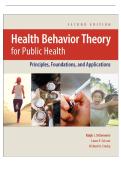
, TESTBANK FOR Health Behavior Theory for Public Health Second Edition
DiClemente
Important Notes
The file includes the complete test bank, organized chapter by chapter.
A sample of selected pages has been provided for preview.
All available appendices and Excel files (if included in the original resources) are
provided.
Quizzes, Midterm and final exams are included (if available in the original resources).
We continuously update our files to ensure you receive the latest and most accurate
editions.
New editions are added regularly – stay connected for updates!
⚠️Note on Answer Keys: If the answer key is not included within the chapter
questions, you will find the complete answers and solutions at the end of each
chapter.
✅ Why Buy From Us?
📚 Complete & organized chapter-by-chapter – no missing content, no guessing.
⚡ Instant digital delivery – get your file the moment you pay, no waiting.
📅 Always up to date – we track new editions so you always get the latest version.
💬 Friendly support – real humans ready to help, anytime you need us.
🔒 Safe & secure – thousands of satisfied students trust us every semester.
🛡️Our Guarantees
💰 Money-Back Guarantee: Not satisfied? We offer a full refund – no questions asked.
🔄 Wrong File? No Problem: Contact us and we will replace it immediately with the
correct version, free of charge.
⏰ 24/7 Support: We are always here – reach out anytime and expect a fast response.
,True/False
1. The definition of health, as defined by the World Health Organization, is merely the absence
of disease.
Answer: False
2. Currently, public health in the United States is more focused on infectious diseases than
chronic diseases.
Answer: False
3. The United States spends considerably more on health care costs than other industrialized
countries.
Answer: True
4. One problem with a medical approach to disease is that by starting with a medical diagnosis,
you can only change one person at a time.
Answer: True
5. Public health is considered a downstream approach.
Answer: False
6. Secondary prevention in public health targets people who can treat the disease and/or people
who have the disease with the goal of mitigating the disease’s effects.
Answer: False
,7. The Rose Curve focuses on the idea that if you target high-risk populations, then you will
make the most change in a population.
Answer: False
8. Public health seeks to shift the mean of the Rose Curve to the left.
Answer: True
9. A colonoscopy is a secondary preventative measure.
Answer: True
10. Advocacy as a health promotion strategy is mainly focused on lobbying for universal health
care.
Answer: False
Multiple Choice
11. Despite being a world “super-power,” the United States ranks poorly – compared to other
industrialized nations – on multiple health indicators. Which statement best explains why this is
true?
A. There are over 40 million U.S. residents do not have health insurance.
B. Technological advances have created so many environmental carcinogens (cancer-causing
agents) making cancer an epidemic.
C. The U.S. education system has failed resulting in poor public health.
D. There are more investments in medical treatment rather than prevention, coupled with
escalating rates of chronic disease.
Answer: D
12. The “Rose Curve” has multiple implications for public health. Identify which statement
below is incorrect regarding the Rose Curve:
,A. Population health may be achieved through small changes in daily behavior among the
masses.
B. Interventions designed for high-risk populations should be the main focus of public health
efforts.
C. Cutting off the tail of the curve does nothing to change the distribution of the disease in the
population.
D. Moving the mean of the distribution corresponds with a prevention orientation.
Answer: B
13. Generally, which of the following factors can contribute to community capacity.
A. Knowledge and skills
B. Collaboration
C. Leadership
D. Resources
E. All of these
Answer: E
14. An example of primary prevention is:
A. Fluoride in drinking water
B. Health screenings
C. Rehabilitation
D. Antibiotic usage
Answer: A
15. What caused the shift from infectious diseases to chronic diseases from the 1800s to now?
A. Behavioral and lifestyle changes
B. Better public health practices regarding infectious diseases
C. Better medical care and technology
D. Behavioral and lifestyle changes and Better public health practices regarding infectious
diseases
E. None of these
Answer: D
16. Illness behavior is most often associated with which level of prevention?
,A. Primary
B. Secondary
C. Tertiary
D. None of these
Answer: B
17. Which of the following is considered a sick-role behavior?
A. Attending alcohol anonymous meetings
B. Getting annual mammogram
C. Adherence to statin (cholesterol-lowering) medication for patients with cardiovascular disease
D. Taking highly active antiretroviral medication prophylactically
E. None of these
Answer: C
18. The theory of the solution asserts that:
A. No one theory alone can explain a health issue.
B. Every health issue is best approached using the most relevant theory to guide the intervention
activities.
C. The best approach to a health issue requires applying different strategies at multiple levels
with each affected population.
D. Using multiple theories is too daunting and should not be considered.
Answer: C
19. The new public health emphasizes which of the following?
A. The medical paradigm
B. An ecological approach
C. The role of individual behavior in shaping health
D. A downstream approach
E. Both An ecological approach and The role of individual behavior in shaping health
Answer: E
20. Theory in the context of health promotion does NOT:
A. Enhance understanding of the determinants of a particular health behavior
B. Inform what variables should be measured in health promotion research
,C. Provide universal explanations for complex problems
D. Help guide specific activities and strategies
Answer: C
Essay Questions
21. Explain the significance of the World Health Organization’s definition of health.
Answer: A complete answer would include the following:
The WHO defines health as the overall social, mental, and physical well-being, not just
the absence of disease.
This definition explains that health is a human right for all people, no matter the location,
religion, race, sex, or socioeconomic status.
There is an emphasis on health not being an end to itself, but an everyday resource.
22. Explain the differences between primary, secondary, and tertiary prevention and provide
examples of each.
Answer: A complete answer would include the following:
Primary prevention is risk reduction and health problems avoidance in the first place.
Efforts are made to intercept the onset or occurrence of the disease, injury or behavior.
o Examples of primary prevention are fluoride in the drinking water, helmet and seatbelt
laws, and vaccines.
Secondary prevention is a disease process is diagnosed in an early stage of progression,
thereby enhancing the odds of treatment success. It is possible to minimize the
consequences through early detection and intervention.
o Examples of secondary prevention are health screenings (PAP tests, colon cancer
screenings, mammograms, and STD tests)
Tertiary prevention is the provision of treatment or rehabilitation after the event has
already occurred in order to reduce its complications. It is the difference between early
and late diagnosis.
o Examples of tertiary prevention are rehabilitation, medication, and antibiotics.
23. Briefly discuss the theory of the problem and the theory of the solution and how these
concepts tie into the new public health.
Answer: A complete answer would include the following:
, Theory of the problem is not an actual theory per se; but rather it emphasizes the need for
multiple theoretical approaches when approached health issues.
No one theory alone can account for the complexities surrounding health behaviors and
corresponding determinants situated within multiple levels of influence.
Theory of the solution refers to the development of “intervention theories” and involves
gauging the effectiveness of different intervention strategies at different levels of analysis
and with different populations.
The intervention strategies should be guided by multiple theories.
This theory of the problem and theory of the solution perspective is presented in response
to previous critiques that emphasized a “theory of the week” approach, which, while an
overly simplistic view of choosing one theory to understand and change health behavior,
is not uncommon in the literature.
This theory of problem/solution perspective ties into the “new” public health because of
the emphasis on the environmental or ecological influences of individual health
behaviors.
,True/False
1. Distal influences demonstrate an immediate and noticeable influence on health behaviors.
Answer: False
2. A highly complex health behavior has few components.
Answer: False
3. A behavior that is more frequent and repetitive is more difficult to adhere to over time.
Answer: True
4. Proximal influences are synonymous with distal influences.
Answer: False
5. Health policies serve as a proximal influence on health behavior.
Answer: False
6. Theory only serves to assess hypothesized mediators.
Answer: False
7. Theory allows for more successful and effective health interventions.
Answer: True
, 8. The frequency of a health behavior has no impact on the difficulties of changing it.
Answer: False
Multiple Choice
9. Based on your understanding of this chapter, which health behavior would you consider to be
“complex”?
A. Quitting smoking
B. Brushing your teeth
C. Getting a flu shot
D. Wearing your seat belt
Answer: A
10. Which health behavior is frequent and repetitive, therefore potentially harder to
change/adhere to?
A. Getting a tetanus shot
B. Getting a mammogram
C. Maintaining a low fat, low sodium diet
D. Having your vision tested
Answer: C
11. You identify a behavior that is non-volitional. Which type of intervention are you more likely
to focus on to change that behavior?
A. Individual-level
B. Environmental-level
C. Familial-level
D. Societal-level
Answer: B
12. A countywide smoking ordinance which restricts smoking in restaurants and bars would be
considered a ______ factor to changing smoking-related behavior.
A. Proximal
DiClemente
Important Notes
The file includes the complete test bank, organized chapter by chapter.
A sample of selected pages has been provided for preview.
All available appendices and Excel files (if included in the original resources) are
provided.
Quizzes, Midterm and final exams are included (if available in the original resources).
We continuously update our files to ensure you receive the latest and most accurate
editions.
New editions are added regularly – stay connected for updates!
⚠️Note on Answer Keys: If the answer key is not included within the chapter
questions, you will find the complete answers and solutions at the end of each
chapter.
✅ Why Buy From Us?
📚 Complete & organized chapter-by-chapter – no missing content, no guessing.
⚡ Instant digital delivery – get your file the moment you pay, no waiting.
📅 Always up to date – we track new editions so you always get the latest version.
💬 Friendly support – real humans ready to help, anytime you need us.
🔒 Safe & secure – thousands of satisfied students trust us every semester.
🛡️Our Guarantees
💰 Money-Back Guarantee: Not satisfied? We offer a full refund – no questions asked.
🔄 Wrong File? No Problem: Contact us and we will replace it immediately with the
correct version, free of charge.
⏰ 24/7 Support: We are always here – reach out anytime and expect a fast response.
,True/False
1. The definition of health, as defined by the World Health Organization, is merely the absence
of disease.
Answer: False
2. Currently, public health in the United States is more focused on infectious diseases than
chronic diseases.
Answer: False
3. The United States spends considerably more on health care costs than other industrialized
countries.
Answer: True
4. One problem with a medical approach to disease is that by starting with a medical diagnosis,
you can only change one person at a time.
Answer: True
5. Public health is considered a downstream approach.
Answer: False
6. Secondary prevention in public health targets people who can treat the disease and/or people
who have the disease with the goal of mitigating the disease’s effects.
Answer: False
,7. The Rose Curve focuses on the idea that if you target high-risk populations, then you will
make the most change in a population.
Answer: False
8. Public health seeks to shift the mean of the Rose Curve to the left.
Answer: True
9. A colonoscopy is a secondary preventative measure.
Answer: True
10. Advocacy as a health promotion strategy is mainly focused on lobbying for universal health
care.
Answer: False
Multiple Choice
11. Despite being a world “super-power,” the United States ranks poorly – compared to other
industrialized nations – on multiple health indicators. Which statement best explains why this is
true?
A. There are over 40 million U.S. residents do not have health insurance.
B. Technological advances have created so many environmental carcinogens (cancer-causing
agents) making cancer an epidemic.
C. The U.S. education system has failed resulting in poor public health.
D. There are more investments in medical treatment rather than prevention, coupled with
escalating rates of chronic disease.
Answer: D
12. The “Rose Curve” has multiple implications for public health. Identify which statement
below is incorrect regarding the Rose Curve:
,A. Population health may be achieved through small changes in daily behavior among the
masses.
B. Interventions designed for high-risk populations should be the main focus of public health
efforts.
C. Cutting off the tail of the curve does nothing to change the distribution of the disease in the
population.
D. Moving the mean of the distribution corresponds with a prevention orientation.
Answer: B
13. Generally, which of the following factors can contribute to community capacity.
A. Knowledge and skills
B. Collaboration
C. Leadership
D. Resources
E. All of these
Answer: E
14. An example of primary prevention is:
A. Fluoride in drinking water
B. Health screenings
C. Rehabilitation
D. Antibiotic usage
Answer: A
15. What caused the shift from infectious diseases to chronic diseases from the 1800s to now?
A. Behavioral and lifestyle changes
B. Better public health practices regarding infectious diseases
C. Better medical care and technology
D. Behavioral and lifestyle changes and Better public health practices regarding infectious
diseases
E. None of these
Answer: D
16. Illness behavior is most often associated with which level of prevention?
,A. Primary
B. Secondary
C. Tertiary
D. None of these
Answer: B
17. Which of the following is considered a sick-role behavior?
A. Attending alcohol anonymous meetings
B. Getting annual mammogram
C. Adherence to statin (cholesterol-lowering) medication for patients with cardiovascular disease
D. Taking highly active antiretroviral medication prophylactically
E. None of these
Answer: C
18. The theory of the solution asserts that:
A. No one theory alone can explain a health issue.
B. Every health issue is best approached using the most relevant theory to guide the intervention
activities.
C. The best approach to a health issue requires applying different strategies at multiple levels
with each affected population.
D. Using multiple theories is too daunting and should not be considered.
Answer: C
19. The new public health emphasizes which of the following?
A. The medical paradigm
B. An ecological approach
C. The role of individual behavior in shaping health
D. A downstream approach
E. Both An ecological approach and The role of individual behavior in shaping health
Answer: E
20. Theory in the context of health promotion does NOT:
A. Enhance understanding of the determinants of a particular health behavior
B. Inform what variables should be measured in health promotion research
,C. Provide universal explanations for complex problems
D. Help guide specific activities and strategies
Answer: C
Essay Questions
21. Explain the significance of the World Health Organization’s definition of health.
Answer: A complete answer would include the following:
The WHO defines health as the overall social, mental, and physical well-being, not just
the absence of disease.
This definition explains that health is a human right for all people, no matter the location,
religion, race, sex, or socioeconomic status.
There is an emphasis on health not being an end to itself, but an everyday resource.
22. Explain the differences between primary, secondary, and tertiary prevention and provide
examples of each.
Answer: A complete answer would include the following:
Primary prevention is risk reduction and health problems avoidance in the first place.
Efforts are made to intercept the onset or occurrence of the disease, injury or behavior.
o Examples of primary prevention are fluoride in the drinking water, helmet and seatbelt
laws, and vaccines.
Secondary prevention is a disease process is diagnosed in an early stage of progression,
thereby enhancing the odds of treatment success. It is possible to minimize the
consequences through early detection and intervention.
o Examples of secondary prevention are health screenings (PAP tests, colon cancer
screenings, mammograms, and STD tests)
Tertiary prevention is the provision of treatment or rehabilitation after the event has
already occurred in order to reduce its complications. It is the difference between early
and late diagnosis.
o Examples of tertiary prevention are rehabilitation, medication, and antibiotics.
23. Briefly discuss the theory of the problem and the theory of the solution and how these
concepts tie into the new public health.
Answer: A complete answer would include the following:
, Theory of the problem is not an actual theory per se; but rather it emphasizes the need for
multiple theoretical approaches when approached health issues.
No one theory alone can account for the complexities surrounding health behaviors and
corresponding determinants situated within multiple levels of influence.
Theory of the solution refers to the development of “intervention theories” and involves
gauging the effectiveness of different intervention strategies at different levels of analysis
and with different populations.
The intervention strategies should be guided by multiple theories.
This theory of the problem and theory of the solution perspective is presented in response
to previous critiques that emphasized a “theory of the week” approach, which, while an
overly simplistic view of choosing one theory to understand and change health behavior,
is not uncommon in the literature.
This theory of problem/solution perspective ties into the “new” public health because of
the emphasis on the environmental or ecological influences of individual health
behaviors.
,True/False
1. Distal influences demonstrate an immediate and noticeable influence on health behaviors.
Answer: False
2. A highly complex health behavior has few components.
Answer: False
3. A behavior that is more frequent and repetitive is more difficult to adhere to over time.
Answer: True
4. Proximal influences are synonymous with distal influences.
Answer: False
5. Health policies serve as a proximal influence on health behavior.
Answer: False
6. Theory only serves to assess hypothesized mediators.
Answer: False
7. Theory allows for more successful and effective health interventions.
Answer: True
, 8. The frequency of a health behavior has no impact on the difficulties of changing it.
Answer: False
Multiple Choice
9. Based on your understanding of this chapter, which health behavior would you consider to be
“complex”?
A. Quitting smoking
B. Brushing your teeth
C. Getting a flu shot
D. Wearing your seat belt
Answer: A
10. Which health behavior is frequent and repetitive, therefore potentially harder to
change/adhere to?
A. Getting a tetanus shot
B. Getting a mammogram
C. Maintaining a low fat, low sodium diet
D. Having your vision tested
Answer: C
11. You identify a behavior that is non-volitional. Which type of intervention are you more likely
to focus on to change that behavior?
A. Individual-level
B. Environmental-level
C. Familial-level
D. Societal-level
Answer: B
12. A countywide smoking ordinance which restricts smoking in restaurants and bars would be
considered a ______ factor to changing smoking-related behavior.
A. Proximal


