

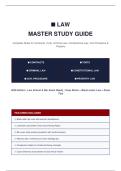
■ LAW
MASTER STUDY GUIDE
Complete Notes for Contracts, Torts, Criminal Law, Constitutional Law, Civil Procedure &
Property
■ CONTRACTS ■ TORTS
■ CRIMINAL LAW ■ CONSTITUTIONAL LAW
■ CIVIL PROCEDURE ■ PROPERTY LAW
2026 Edition | Law School & Bar Exam Ready | Case Briefs + Black-Letter Law + Exam
Tips
FEATURES INCLUDED
✓ Black-letter law rules with element breakdowns
✓ Landmark case briefs (Facts-Issue-Ruling-Ratio)
✓ Bar exam-style practice questions with model answers
✓ Memory aids, mnemonics & exam strategy tips
✓ Comparison tables for similar/confusing concepts
✓ Quick reference cheat sheets for last-minute review
,■ TABLE OF CONTENTS
1. Contracts 3
1.1 Formation of Contracts 3
1.2 Consideration 4
1.3 Defenses to Formation 5
1.4 Breach & Remedies 6
1.5 Third-Party Rights 7
2. Torts 8
2.1 Intentional Torts 8
2.2 Negligence 9
2.3 Strict Liability & Defenses 10
3. Criminal Law 11
3.1 Elements of Crimes 11
3.2 Inchoate Offenses & Parties to Crime 12
3.3 Defenses 13
4. Constitutional Law 14
4.1 Structure of Government 14
4.2 Individual Rights 15
4.3 Equal Protection & Due Process 16
5. Civil Procedure 17
5.1 Jurisdiction & Venue 17
5.2 Pleadings & Discovery 18
5.3 Trial & Judgment 19
6. Property Law 20
6.1 Present Estates & Future Interests 20
6.2 Landlord & Tenant 21
6.3 Easements & Covenants 22
7. Exam Cheat Sheets & Quick Reference 23
, 1. CONTRACTS
Contracts form the foundation of commercial law. A contract is a legally enforceable
agreement between two or more parties. Mastery of contract law is essential for the bar exam
and practice.
1.1 Formation of Contracts
A valid contract requires: (1) Offer, (2) Acceptance, (3) Consideration, and (4) No defenses to formation.
Additionally, the parties must have capacity and the purpose must be legal.
KEY CONCEPT - The Offer:
An offer is a manifestation of willingness to enter into a bargain, made in a way that justifies another person in
understanding that their assent is invited and will conclude the bargain. Requirements of a Valid Offer: - Intent
to be bound (objective standard - would a reasonable person believe an offer was made?) - Definite and certain
terms (parties, subject matter, price, quantity) - Communication to the offeree Not an Offer: - Invitations to
bid/negotiate: Advertisements, price quotes, invitations to make an offer - Preliminary negotiations:
Statements like "I might sell for $500" or "I am thinking about..." - Statements of opinion: "This car is worth
$10,000" (not a promise to sell) Termination of Offers: - Revocation: Offeror withdraws before acceptance
(effective when received) - Rejection: Offeree declines (effective when received) - Counteroffer: Offeree
proposes different terms (rejects original offer) - Lapse of time: Offer expires after stated time or reasonable
time - Death or incapacity: Of offeror (automatic termination) - Destruction of subject matter: Before
acceptance Irrevocable Offers: - Option contracts: Separate consideration paid to keep offer open - Firm
offers (UCC): Merchant's signed written offer to buy/sell goods, irrevocable for up to 90 days - Detrimental
reliance (Promissory Estoppel): Offeree reasonably relies to their detriment
KEY CONCEPT - Acceptance:
Acceptance is an unequivocal assent to the terms of the offer. The acceptance must be the "mirror image" of the
offer (common law). Methods of Acceptance: - Express: Oral or written "I accept" - Implied: By conduct (e.g.,
shipping goods in response to an order) - Silence: Generally NOT acceptance, unless: (1) Offeree takes benefit
of services with reasonable opportunity to reject (2) Parties have prior course of dealing where silence =
acceptance Mailbox Rule: - Acceptance is effective when dispatched (placed in mailbox, sent by reasonable
means) - Revocation is effective when received - Rejection is effective when received - Exception: If offeree
sends rejection THEN acceptance, whichever arrives first controls UCC Battle of the Forms (UCC 2-207): -
Between merchants, additional terms become part of the contract UNLESS: (1) They materially alter the contract,
OR (2) The offeror objects - Different terms: knock out rule (both terms fall out, gap-fillers apply)
Case Brief: Lucy v. Zehmer (1954)
Facts: Zehmer wrote a contract to sell his farm to Lucy on a napkin while drinking at a bar. Zehmer later claimed
he was joking and too drunk to be serious. Issue: Was there a valid contract despite Zehmer's subjective intent
to joke? Ruling: YES - valid contract enforceable. Ratio: Contract formation is determined by the objective
theory of contracts - what a reasonable person would believe, not the subjective intent of the parties. Zehmer's
outward manifestations (writing, discussing terms for 40 minutes) indicated serious intent.
MASTER STUDY GUIDE
Complete Notes for Contracts, Torts, Criminal Law, Constitutional Law, Civil Procedure &
Property
■ CONTRACTS ■ TORTS
■ CRIMINAL LAW ■ CONSTITUTIONAL LAW
■ CIVIL PROCEDURE ■ PROPERTY LAW
2026 Edition | Law School & Bar Exam Ready | Case Briefs + Black-Letter Law + Exam
Tips
FEATURES INCLUDED
✓ Black-letter law rules with element breakdowns
✓ Landmark case briefs (Facts-Issue-Ruling-Ratio)
✓ Bar exam-style practice questions with model answers
✓ Memory aids, mnemonics & exam strategy tips
✓ Comparison tables for similar/confusing concepts
✓ Quick reference cheat sheets for last-minute review
,■ TABLE OF CONTENTS
1. Contracts 3
1.1 Formation of Contracts 3
1.2 Consideration 4
1.3 Defenses to Formation 5
1.4 Breach & Remedies 6
1.5 Third-Party Rights 7
2. Torts 8
2.1 Intentional Torts 8
2.2 Negligence 9
2.3 Strict Liability & Defenses 10
3. Criminal Law 11
3.1 Elements of Crimes 11
3.2 Inchoate Offenses & Parties to Crime 12
3.3 Defenses 13
4. Constitutional Law 14
4.1 Structure of Government 14
4.2 Individual Rights 15
4.3 Equal Protection & Due Process 16
5. Civil Procedure 17
5.1 Jurisdiction & Venue 17
5.2 Pleadings & Discovery 18
5.3 Trial & Judgment 19
6. Property Law 20
6.1 Present Estates & Future Interests 20
6.2 Landlord & Tenant 21
6.3 Easements & Covenants 22
7. Exam Cheat Sheets & Quick Reference 23
, 1. CONTRACTS
Contracts form the foundation of commercial law. A contract is a legally enforceable
agreement between two or more parties. Mastery of contract law is essential for the bar exam
and practice.
1.1 Formation of Contracts
A valid contract requires: (1) Offer, (2) Acceptance, (3) Consideration, and (4) No defenses to formation.
Additionally, the parties must have capacity and the purpose must be legal.
KEY CONCEPT - The Offer:
An offer is a manifestation of willingness to enter into a bargain, made in a way that justifies another person in
understanding that their assent is invited and will conclude the bargain. Requirements of a Valid Offer: - Intent
to be bound (objective standard - would a reasonable person believe an offer was made?) - Definite and certain
terms (parties, subject matter, price, quantity) - Communication to the offeree Not an Offer: - Invitations to
bid/negotiate: Advertisements, price quotes, invitations to make an offer - Preliminary negotiations:
Statements like "I might sell for $500" or "I am thinking about..." - Statements of opinion: "This car is worth
$10,000" (not a promise to sell) Termination of Offers: - Revocation: Offeror withdraws before acceptance
(effective when received) - Rejection: Offeree declines (effective when received) - Counteroffer: Offeree
proposes different terms (rejects original offer) - Lapse of time: Offer expires after stated time or reasonable
time - Death or incapacity: Of offeror (automatic termination) - Destruction of subject matter: Before
acceptance Irrevocable Offers: - Option contracts: Separate consideration paid to keep offer open - Firm
offers (UCC): Merchant's signed written offer to buy/sell goods, irrevocable for up to 90 days - Detrimental
reliance (Promissory Estoppel): Offeree reasonably relies to their detriment
KEY CONCEPT - Acceptance:
Acceptance is an unequivocal assent to the terms of the offer. The acceptance must be the "mirror image" of the
offer (common law). Methods of Acceptance: - Express: Oral or written "I accept" - Implied: By conduct (e.g.,
shipping goods in response to an order) - Silence: Generally NOT acceptance, unless: (1) Offeree takes benefit
of services with reasonable opportunity to reject (2) Parties have prior course of dealing where silence =
acceptance Mailbox Rule: - Acceptance is effective when dispatched (placed in mailbox, sent by reasonable
means) - Revocation is effective when received - Rejection is effective when received - Exception: If offeree
sends rejection THEN acceptance, whichever arrives first controls UCC Battle of the Forms (UCC 2-207): -
Between merchants, additional terms become part of the contract UNLESS: (1) They materially alter the contract,
OR (2) The offeror objects - Different terms: knock out rule (both terms fall out, gap-fillers apply)
Case Brief: Lucy v. Zehmer (1954)
Facts: Zehmer wrote a contract to sell his farm to Lucy on a napkin while drinking at a bar. Zehmer later claimed
he was joking and too drunk to be serious. Issue: Was there a valid contract despite Zehmer's subjective intent
to joke? Ruling: YES - valid contract enforceable. Ratio: Contract formation is determined by the objective
theory of contracts - what a reasonable person would believe, not the subjective intent of the parties. Zehmer's
outward manifestations (writing, discussing terms for 40 minutes) indicated serious intent.


