

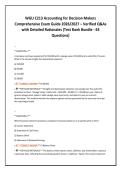
WGU C213 Accounting for Decision Makers
Comprehensive Exam Guide 2026/2027 – Verified Q&As
with Detailed Rationales (Test Bank Bundle - 63
Questions)
---
**QUESTION 1:**
A company purchases equipment for $50,000 with a salvage value of $5,000 and a useful life of 5 years.
What is the annual straight-line depreciation expense?
A) $10,000
B) $9,000
C) $11,000
D) $8,000
> 🎯 **CORRECT ANSWER:** B) $9,000
> 💡 **DETAILED RATIONALE:** Straight-line depreciation allocates cost equally over the useful life,
calculated as (Cost - Salvage Value) / Useful Life = ($50,000 - $5,000) / 5 = $9,000 per year. Option A
ignores salvage value, option C adds salvage value incorrectly, and option D uses an incorrect
denominator. This method matches the expense against revenue generated by the asset over time per
the matching principle.
---
**QUESTION 2:**
Which financial statement presents a company's financial position as of a specific point in time?
A) Income Statement
B) Statement of Cash Flows
C) Balance Sheet
D) Statement of Retained Earnings
> 🎯 **CORRECT ANSWER:** C) Balance Sheet
> 💡 **DETAILED RATIONALE:** The balance sheet reports assets, liabilities, and shareholders' equity at
a particular date, reflecting the accounting equation Assets = Liabilities + Equity. The income statement
,covers a period of time reporting profitability, the statement of cash flows details cash movements over
a period, and the statement of retained earnings tracks changes in equity over time. The "as of" versus
"for the period ended" distinction is fundamental.
---
**QUESTION 3:**
A company has Current Assets of $300,000 and Current Liabilities of $200,000. What is the current
ratio?
A) 0.67
B) 1.5
C) 1.0
D) 2.0
> 🎯 **CORRECT ANSWER:** B) 1.5
> 💡 **DETAILED RATIONALE:** Current Ratio = Current Assets / Current Liabilities = $300,000 /
$200,000 = 1.5, meaning the company has $1.50 in current assets for every $1.00 of current liabilities,
generally indicating adequate short-term liquidity. A ratio below 1.0 suggests potential liquidity
problems, and a very high ratio may indicate inefficient use of assets. This is a key working capital metric
for creditors.
---
**QUESTION 4:**
A firm receives $5,000 in advance from a customer for services to be performed next month. How is this
recorded at the time of receipt?
A) Debit Cash, Credit Revenue
B) Debit Cash, Credit Unearned Revenue
C) Debit Unearned Revenue, Credit Cash
D) Debit Accounts Receivable, Credit Revenue
> 🎯 **CORRECT ANSWER:** B) Debit Cash, Credit Unearned Revenue
> 💡 **DETAILED RATIONALE:** Cash increases with a debit, but revenue cannot yet be recognized
because the services have not been performed; the obligation creates a liability called Unearned
Revenue or Deferred Revenue. When services are performed, Unearned Revenue is debited and
Revenue is credited. Option A violates the revenue recognition principle, option C has the debits and
credits reversed, and option D records revenue prematurely.
, ---
**QUESTION 5:**
A company reports Sales of $600,000, Cost of Goods Sold of $360,000, and Operating Expenses of
$120,000. What is the Gross Profit?
A) $240,000
B) $120,000
C) $480,000
D) $360,000
> 🎯 **CORRECT ANSWER:** A) $240,000
> 💡 **DETAILED RATIONALE:** Gross Profit equals Sales Revenue minus Cost of Goods Sold: $600,000 -
$360,000 = $240,000, representing the profit earned before deducting operating expenses. Operating
income would subtract the further $120,000 to yield $120,000. Understanding the multi-step income
statement allows analysis of production efficiency separately from overall profitability.
---
**QUESTION 6:**
During periods of rising prices, which inventory costing method results in the lowest net income?
A) FIFO
B) LIFO
C) Weighted Average
D) Specific Identification
> 🎯 **CORRECT ANSWER:** B) LIFO
> 💡 **DETAILED RATIONALE:** Last-In, First-Out assigns the most recent, higher inventory costs to Cost
of Goods Sold, increasing expenses and reducing taxable income and reported net income compared to
FIFO. FIFO yields higher net income in this environment by keeping older lower costs on the income
statement. Weighted average produces middle results, and specific identification follows actual cost.
---
**QUESTION 7:**
Comprehensive Exam Guide 2026/2027 – Verified Q&As
with Detailed Rationales (Test Bank Bundle - 63
Questions)
---
**QUESTION 1:**
A company purchases equipment for $50,000 with a salvage value of $5,000 and a useful life of 5 years.
What is the annual straight-line depreciation expense?
A) $10,000
B) $9,000
C) $11,000
D) $8,000
> 🎯 **CORRECT ANSWER:** B) $9,000
> 💡 **DETAILED RATIONALE:** Straight-line depreciation allocates cost equally over the useful life,
calculated as (Cost - Salvage Value) / Useful Life = ($50,000 - $5,000) / 5 = $9,000 per year. Option A
ignores salvage value, option C adds salvage value incorrectly, and option D uses an incorrect
denominator. This method matches the expense against revenue generated by the asset over time per
the matching principle.
---
**QUESTION 2:**
Which financial statement presents a company's financial position as of a specific point in time?
A) Income Statement
B) Statement of Cash Flows
C) Balance Sheet
D) Statement of Retained Earnings
> 🎯 **CORRECT ANSWER:** C) Balance Sheet
> 💡 **DETAILED RATIONALE:** The balance sheet reports assets, liabilities, and shareholders' equity at
a particular date, reflecting the accounting equation Assets = Liabilities + Equity. The income statement
,covers a period of time reporting profitability, the statement of cash flows details cash movements over
a period, and the statement of retained earnings tracks changes in equity over time. The "as of" versus
"for the period ended" distinction is fundamental.
---
**QUESTION 3:**
A company has Current Assets of $300,000 and Current Liabilities of $200,000. What is the current
ratio?
A) 0.67
B) 1.5
C) 1.0
D) 2.0
> 🎯 **CORRECT ANSWER:** B) 1.5
> 💡 **DETAILED RATIONALE:** Current Ratio = Current Assets / Current Liabilities = $300,000 /
$200,000 = 1.5, meaning the company has $1.50 in current assets for every $1.00 of current liabilities,
generally indicating adequate short-term liquidity. A ratio below 1.0 suggests potential liquidity
problems, and a very high ratio may indicate inefficient use of assets. This is a key working capital metric
for creditors.
---
**QUESTION 4:**
A firm receives $5,000 in advance from a customer for services to be performed next month. How is this
recorded at the time of receipt?
A) Debit Cash, Credit Revenue
B) Debit Cash, Credit Unearned Revenue
C) Debit Unearned Revenue, Credit Cash
D) Debit Accounts Receivable, Credit Revenue
> 🎯 **CORRECT ANSWER:** B) Debit Cash, Credit Unearned Revenue
> 💡 **DETAILED RATIONALE:** Cash increases with a debit, but revenue cannot yet be recognized
because the services have not been performed; the obligation creates a liability called Unearned
Revenue or Deferred Revenue. When services are performed, Unearned Revenue is debited and
Revenue is credited. Option A violates the revenue recognition principle, option C has the debits and
credits reversed, and option D records revenue prematurely.
, ---
**QUESTION 5:**
A company reports Sales of $600,000, Cost of Goods Sold of $360,000, and Operating Expenses of
$120,000. What is the Gross Profit?
A) $240,000
B) $120,000
C) $480,000
D) $360,000
> 🎯 **CORRECT ANSWER:** A) $240,000
> 💡 **DETAILED RATIONALE:** Gross Profit equals Sales Revenue minus Cost of Goods Sold: $600,000 -
$360,000 = $240,000, representing the profit earned before deducting operating expenses. Operating
income would subtract the further $120,000 to yield $120,000. Understanding the multi-step income
statement allows analysis of production efficiency separately from overall profitability.
---
**QUESTION 6:**
During periods of rising prices, which inventory costing method results in the lowest net income?
A) FIFO
B) LIFO
C) Weighted Average
D) Specific Identification
> 🎯 **CORRECT ANSWER:** B) LIFO
> 💡 **DETAILED RATIONALE:** Last-In, First-Out assigns the most recent, higher inventory costs to Cost
of Goods Sold, increasing expenses and reducing taxable income and reported net income compared to
FIFO. FIFO yields higher net income in this environment by keeping older lower costs on the income
statement. Weighted average produces middle results, and specific identification follows actual cost.
---
**QUESTION 7:**


