

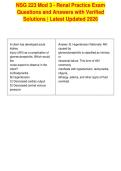
NSG 223 Mod 3 - Renal Practice Exam
Questions and Answers with Verified
Solutions | Latest Updated 2026
A client has developed acute Answer: B. Hypertension Rationale: AKI
kidney caused by
injury (AKI) as a complication of glomerulonephritis is classified as intrinsic
glomerulonephritis. Which would or
the intrarenal failure. This form of AKI
nurse expect to observe in the commonly
client? manifests with hypertension, tachycardia,
A) Bradycardia oliguria,
B) Hypertension lethargy, edema, and other signs of fluid
C) Decreased cardiac output overload.
D) Decreased central venous
pressure
,The nurse is performing an Answer: D. Notify the PHCP Rationale:
assessment on a client who has Disequilibrium syndrome may be caused
returned from the dialysis unit by rapid
following hemodialysis. The client removal of solutes from the body during
is hemodialysis. These changes can cause
complaining of headache and cerebral
nausea and is twitching. Which is edema that leads to increased intracranial
the pressure.
priority nursing action? The client is exhibiting early signs and
A) Monitor the client. symptoms of
B) Elevate the head of the bed. disequilibrium syndrome, and appropriate
C) Assess the fistula site and treatments with anticonvulsant medications
dressing. and
D) Notify the primary health care barbiturates may be necessary to prevent
provider (PHCP). a life-
threatening situation. The PHCP must be
notified.
Monitoring the client, elevating the head of
the
bed, and assessing the fistula site are
correct
actions, but the priority action is to notify
the
PHCP.
,The nurse is caring for an acutely ANS: C Rationale: Oliguria (<400 mL/day
ill of urine or
client. What assessment finding 0.5 mL/kg an hour over 6 hours) is the
should prompt the most
nurse to inform the health care common clinical situation seen in AKI. The
provider that the client may be client's
exhibiting signs of acute inability to void and/or urine hesitancy is
kidney injury (AKI)? typically
A. An inability to initiate voiding for seen with kidney stones, prostate
2 problems, and/or
days. a urinary tract infection (UTI). Urine that
B. The urine is cloudy and has has visible
visible sediment and is cloudy and foul smelling is
sediment with a foul odor. more
C. Average urine output has been suggestive of a UTI. Acute flank pain is
10 sometimes
mL/hr for several hours. seen in AKI. Generally, flank pain has
D. Client reports left-sided flank some
pain. connection to a variety of kidney diseases
like
acute glomerular inflammation and
polycystic
kidney disease.
, The nurse is caring for a client with ANS: D Rationale: Both calcium carbonate
a and
history of systemic lupus calcium acetate are medications that bind
erythematosus who has with the
been recently diagnosed with end- phosphate and assist in excreting the
stage kidney disease (ESRD). The phosphate
client has an from the body, in turn lowering the
elevated phosphorus level and has phosphate
been prescribed calcium acetate levels. Phosphate-binding medications
to must be
bind the given with food to be effective.
phosphorus. The nurse should
teach
the client to take the prescribed
medication at what
time?
A. Only when needed
B. Daily at bedtime
C. First thing in the morning
D. With each meal
Questions and Answers with Verified
Solutions | Latest Updated 2026
A client has developed acute Answer: B. Hypertension Rationale: AKI
kidney caused by
injury (AKI) as a complication of glomerulonephritis is classified as intrinsic
glomerulonephritis. Which would or
the intrarenal failure. This form of AKI
nurse expect to observe in the commonly
client? manifests with hypertension, tachycardia,
A) Bradycardia oliguria,
B) Hypertension lethargy, edema, and other signs of fluid
C) Decreased cardiac output overload.
D) Decreased central venous
pressure
,The nurse is performing an Answer: D. Notify the PHCP Rationale:
assessment on a client who has Disequilibrium syndrome may be caused
returned from the dialysis unit by rapid
following hemodialysis. The client removal of solutes from the body during
is hemodialysis. These changes can cause
complaining of headache and cerebral
nausea and is twitching. Which is edema that leads to increased intracranial
the pressure.
priority nursing action? The client is exhibiting early signs and
A) Monitor the client. symptoms of
B) Elevate the head of the bed. disequilibrium syndrome, and appropriate
C) Assess the fistula site and treatments with anticonvulsant medications
dressing. and
D) Notify the primary health care barbiturates may be necessary to prevent
provider (PHCP). a life-
threatening situation. The PHCP must be
notified.
Monitoring the client, elevating the head of
the
bed, and assessing the fistula site are
correct
actions, but the priority action is to notify
the
PHCP.
,The nurse is caring for an acutely ANS: C Rationale: Oliguria (<400 mL/day
ill of urine or
client. What assessment finding 0.5 mL/kg an hour over 6 hours) is the
should prompt the most
nurse to inform the health care common clinical situation seen in AKI. The
provider that the client may be client's
exhibiting signs of acute inability to void and/or urine hesitancy is
kidney injury (AKI)? typically
A. An inability to initiate voiding for seen with kidney stones, prostate
2 problems, and/or
days. a urinary tract infection (UTI). Urine that
B. The urine is cloudy and has has visible
visible sediment and is cloudy and foul smelling is
sediment with a foul odor. more
C. Average urine output has been suggestive of a UTI. Acute flank pain is
10 sometimes
mL/hr for several hours. seen in AKI. Generally, flank pain has
D. Client reports left-sided flank some
pain. connection to a variety of kidney diseases
like
acute glomerular inflammation and
polycystic
kidney disease.
, The nurse is caring for a client with ANS: D Rationale: Both calcium carbonate
a and
history of systemic lupus calcium acetate are medications that bind
erythematosus who has with the
been recently diagnosed with end- phosphate and assist in excreting the
stage kidney disease (ESRD). The phosphate
client has an from the body, in turn lowering the
elevated phosphorus level and has phosphate
been prescribed calcium acetate levels. Phosphate-binding medications
to must be
bind the given with food to be effective.
phosphorus. The nurse should
teach
the client to take the prescribed
medication at what
time?
A. Only when needed
B. Daily at bedtime
C. First thing in the morning
D. With each meal


