

NFPT Exam | Atcual Questions and Answers
with Verified Solutions | Latest Updated 2026
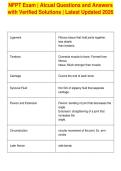
Ligament Fibrous tissue that hold joints together.
less elastic
than tendons.
Tendons Connects muscle to bone. Formed from
fibrous
tissue. Much stronger than muscle.
Cartilage Covers the end of each bone
Synovial Fluid thin film of slippery fluid that separate
cartilage.
Flexion and Extension Flexion: bending of joint that decreases the
angle.
Extension: straightening of a joint that
increases the
angle.
Circumduction circular movement of the joint. Ex. arm
circles
Later flexion side bends
,Eversion and Inversion Eversion: rotating foot so the sole of the
foot
points away from the other.
Inversion: sole of the foot points toward the
other.
Lateral Rotation and Medial Lateral: rotating limb away from the center
Rotation of the
body.
Medial Rotation: rotating limb toward the
center of
the body.
Retraction and Protraction Retraction: posterior (toward the back of
the body)
movement of the arm at the shoulder.
scapula
pinches.
Protraction: anterior movement (toward the
front of
the body) of the arm at the shoulder.
scapula
separates.
3 Main Classifications of Joints 1) Ligamentous: immovable. Between
bones of the
skull.
2) Cartilaginous: slightly moveable. discs
between
spinal vertebrae.
3) Synovial: highly movable. Ball and
socket, Pivot.
, Shoulder Complex Sternoclavicular (SC): saddle type
Acromioclavicular (AC): gliding
Glenohumeral (GH): ball and socket, multi
axial
movement
Rotator Cuff Supraspinatus
Infraspinatus
Teres Minor
Subscapularis
Chest Muscles Pectoralis Major: Adduction and flexion of
the
humerus.
Pectoralis Minor: Depress and protracts
the
scapula.
Shoulder Muscles Deltoids: abduction of the humerus; medial
rotation of the humerus.
Forearm Muscles (Posterior, Brachioradialis
Superficial/Intermediate) Extensor Carpi
Radialis Longus
Extensor Carpi
Radialis Brevis
Extensor Digitorum
Extensor Digiti Minimi
Extensor Carpi Ulnaris
with Verified Solutions | Latest Updated 2026
Ligament Fibrous tissue that hold joints together.
less elastic
than tendons.
Tendons Connects muscle to bone. Formed from
fibrous
tissue. Much stronger than muscle.
Cartilage Covers the end of each bone
Synovial Fluid thin film of slippery fluid that separate
cartilage.
Flexion and Extension Flexion: bending of joint that decreases the
angle.
Extension: straightening of a joint that
increases the
angle.
Circumduction circular movement of the joint. Ex. arm
circles
Later flexion side bends
,Eversion and Inversion Eversion: rotating foot so the sole of the
foot
points away from the other.
Inversion: sole of the foot points toward the
other.
Lateral Rotation and Medial Lateral: rotating limb away from the center
Rotation of the
body.
Medial Rotation: rotating limb toward the
center of
the body.
Retraction and Protraction Retraction: posterior (toward the back of
the body)
movement of the arm at the shoulder.
scapula
pinches.
Protraction: anterior movement (toward the
front of
the body) of the arm at the shoulder.
scapula
separates.
3 Main Classifications of Joints 1) Ligamentous: immovable. Between
bones of the
skull.
2) Cartilaginous: slightly moveable. discs
between
spinal vertebrae.
3) Synovial: highly movable. Ball and
socket, Pivot.
, Shoulder Complex Sternoclavicular (SC): saddle type
Acromioclavicular (AC): gliding
Glenohumeral (GH): ball and socket, multi
axial
movement
Rotator Cuff Supraspinatus
Infraspinatus
Teres Minor
Subscapularis
Chest Muscles Pectoralis Major: Adduction and flexion of
the
humerus.
Pectoralis Minor: Depress and protracts
the
scapula.
Shoulder Muscles Deltoids: abduction of the humerus; medial
rotation of the humerus.
Forearm Muscles (Posterior, Brachioradialis
Superficial/Intermediate) Extensor Carpi
Radialis Longus
Extensor Carpi
Radialis Brevis
Extensor Digitorum
Extensor Digiti Minimi
Extensor Carpi Ulnaris


