

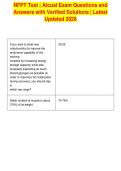
NFPT Test | Atcual Exam Questions and
Answers with Verified Solutions | Latest
Updated 2026
If you want to build new 20-25
mitochondria (to improve the
endurance capability of the
working
muscles by increasing energy
storage capacity) while also
purposely expending as much
stored glycogen as possible (in
order to maximize fat mobilization
during recovery), you should stay
in
which rep range?
Water content of muscle is about 74-76%
{74%} of its weight.
,List and briefly describe the six (6) 1) social health: how having genuine
components of wellness, using the interactions
acronym mnemonic, "SPICES" with people face to face is crucial to our
social
health and overall wellbeing;
2) Physical health: has 5 components
dealing with
endurace, muscular endurance, muscular
strength,
flexibility, and body composition.; 3)
Intellectual
Health: how we integrate new information;
4) Cognitive Health: How we process
information
in our brains;
5) Emotional Health: How we view
ourselves and
our relationships;
6) Spiritual Health: Having a connection
with a
higher power.;
Abduction Movement away from the body or body
part's
midline; lifting your arm up to the horizontal
position at your side
Adduction Movement toward the body or body part's
midline;
lowering your arm from the horizontal
position
back down to your side
, Extension The straightening of a joint that increases
the angle;
reaching out your arm, straightening at
elbow
Flexion The bending of a joint that decreases the
angle;
bending at elbow
Internal Rotation Movement of body part towards the
axis/towards
center of body
External Rotation Movement of body part away from
axis/away from
center of body
Retraction Backward (posterior) movement of a body
part;
generally referring to scapulae and
skull/cervical
spine
Protraction Forward (anterior) movement of a body
part;
generally referring to scapulae and
skull/cervical
spine
Hyperextension Extension beyond normal limits, over
extended; a
body part or joint is bent backwards too far
Answers with Verified Solutions | Latest
Updated 2026
If you want to build new 20-25
mitochondria (to improve the
endurance capability of the
working
muscles by increasing energy
storage capacity) while also
purposely expending as much
stored glycogen as possible (in
order to maximize fat mobilization
during recovery), you should stay
in
which rep range?
Water content of muscle is about 74-76%
{74%} of its weight.
,List and briefly describe the six (6) 1) social health: how having genuine
components of wellness, using the interactions
acronym mnemonic, "SPICES" with people face to face is crucial to our
social
health and overall wellbeing;
2) Physical health: has 5 components
dealing with
endurace, muscular endurance, muscular
strength,
flexibility, and body composition.; 3)
Intellectual
Health: how we integrate new information;
4) Cognitive Health: How we process
information
in our brains;
5) Emotional Health: How we view
ourselves and
our relationships;
6) Spiritual Health: Having a connection
with a
higher power.;
Abduction Movement away from the body or body
part's
midline; lifting your arm up to the horizontal
position at your side
Adduction Movement toward the body or body part's
midline;
lowering your arm from the horizontal
position
back down to your side
, Extension The straightening of a joint that increases
the angle;
reaching out your arm, straightening at
elbow
Flexion The bending of a joint that decreases the
angle;
bending at elbow
Internal Rotation Movement of body part towards the
axis/towards
center of body
External Rotation Movement of body part away from
axis/away from
center of body
Retraction Backward (posterior) movement of a body
part;
generally referring to scapulae and
skull/cervical
spine
Protraction Forward (anterior) movement of a body
part;
generally referring to scapulae and
skull/cervical
spine
Hyperextension Extension beyond normal limits, over
extended; a
body part or joint is bent backwards too far


