NUR 155 FINAL EXAM STUDY GUIDE
Health Promotion- promoting good health. Patient isn’t sick. It’s a way of thinking and it a
positive approach to wellness
Health protection- patient is already sick. Point is to stop potential health occurrence or insults
to health
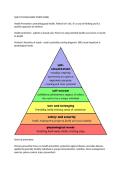
Maslow’s hierarchy of needs- used to prioritize nursing diagnosis. ABCs most important is
physiological needs.
levels of prevention:
Primary prevention-focus on health promotion, protection against disease, precedes disease,
applied to generally healthy individual or groups (immunization, nutrition, stress management,
exercise, poison control, injury prevention)
,Secondary prevention-early detection of disease, intervention and health maintenance.
(screening, dental checkups, self examinations, nursing assessments and care provided)
Tertiary prevention- begins after illness, when defect or disability is fixed, or stabilized. Restore
to optimum level of functioning (support groups, teaching to identify or prevent complications,
physical or occupational therapy)
Infection control safety precautions:
- Standard Precautions- all patients, hand hygiene, gloves (mask, eye, and gown if splash
or spray), needles in sharps, handle soiled linens, equipment that is soiled
- Contact precautions- step up plus mask and private room (c-diff, MRSA, shingles,
hepatitis)
- Droplet- major difference, wear mask limit movement of patient, private room, mask
patient if moved- pneumonia, flu
- Airborne- N95 respiratory and AAIR room, TB
- Mixed precautions – private room
Nosocomial infections- Are classified as infections that originate in hospital. Develop during stay
or manifest after discharge. (HAIs) subgroup health-care associated infections. (CLBSI-central
line blood stream infection and CAUTI- catheter associated urinary tract infection)
- Inadequate hand hygiene, improper dressing change, contamination of drainage system,
improper catheterization, improper IV, tubing, site care and suctioning.
Vital signs
Body temperature, pulse, respiration and blood pressure, 5th one pain.
How often we assess vital signs, chiefly nursing judgments, depending on patient’s health status
or primary health care provider specific order.
Body Temperature (98.6-99.5 normal adults)- reflects balance between heat produced
and heat lost from body. Core temperature- deep tissue. Surface Temperature- skin or
subcutaneous.
Factors affect heat production: Basal metabolic rate, muscle activity, thyroxin output
increase), Epinephrine and sympathetic stress response(increase)Fever (increase).
1. Age- infants are greatly influenced must be protected from extreme change. Older adults
75 and up high risk of hypothermia (loss of fat, lack of activity, inadequate diet)
2. Circadian Rhythms- Diurnal. Lowest point is during sleep 4am-6am and highest 4pm-
6pm
3. Exercise- increase body temperature
4. Hormones- women usually fluctuate more than men because of progesterone.
5. Stress- sympathetic nervous system production of epinephrine or norepinephrine
increase metabolic and heat production
6. Environment- outside temperature or room temperature.
Regulation of body Temperature-
1. Shivering increases heat production
2. Sweating is inhibited to decrease heat loss
, 3. Vasoconstriction decreases heat loss
Pyrexia- body above usual range
Pyrexia, hyperthermia in lay terms means Fever.
Febrile has fever, Afebrile one with out fever.
Intervention: Monitor vitals, assess skin color and temp, monitor white blood count,
dehydration, remove excess blankets, nutrition, fluids, measure input/output, dry clothing,
tepid sponge bath, oral hygiene to keep mucous moist, reduce physical activity, administer
antipyretics (meds that reduce level of fever).
Sites used for body Temperature:
Oral- never after oral surgery, inaccurate if client just drank, ate or smoked
Rectal- Core, very accurate, never after rectal surgery or diarrhea, hemorrhoids, immune
suppressed, clotting disorder. No longer used on in infants.
Axillary- leave longer
Tympanic- Core, fast right and left can differ presence of cerumen can affect reading
Temporal- electronic variation in technique if perspiration
Types of fever:
Intermittent- regular intervals between fever
Remittent- stays high
Relapsing- short febrile and days between
Constant- not much variation
Fever spike- really high then gone fast
Hypothermia- heat lost, below normal limits
*Can be delegated to UAP but monitored by Nurse
Pulse- output of blood that enter the arteries with each ventricular contraction
Compliance- arteries ability to contract and expand
Cardiac output- stroke volume multiplied by heart rate.
Peripheral pulse- located away from heart
Apical Pulse- located on apex of hear 5th intercostal space mitral, PMI
Factors affecting Pulse
Age- decreases with age (newborn is high)
Sex- males lower
Exercise- increase with activity, rate of professional athlete is less then average person,
greater cardiac strength
Fever- increase/ response to lowered blood pressure from vasodilation associated
elevated body temp, increased metabolic rate
Medication- some decrease and other increase
Hypovolemia/dehydration-loss of blood or fluid
Stress-sympathetic nervous system
Position- standing or sitting increase
Pathology- certain disease, impaired oxygenation, heart conditions
Health Promotion- promoting good health. Patient isn’t sick. It’s a way of thinking and it a
positive approach to wellness
Health protection- patient is already sick. Point is to stop potential health occurrence or insults
to health
Maslow’s hierarchy of needs- used to prioritize nursing diagnosis. ABCs most important is
physiological needs.
levels of prevention:
Primary prevention-focus on health promotion, protection against disease, precedes disease,
applied to generally healthy individual or groups (immunization, nutrition, stress management,
exercise, poison control, injury prevention)
,Secondary prevention-early detection of disease, intervention and health maintenance.
(screening, dental checkups, self examinations, nursing assessments and care provided)
Tertiary prevention- begins after illness, when defect or disability is fixed, or stabilized. Restore
to optimum level of functioning (support groups, teaching to identify or prevent complications,
physical or occupational therapy)
Infection control safety precautions:
- Standard Precautions- all patients, hand hygiene, gloves (mask, eye, and gown if splash
or spray), needles in sharps, handle soiled linens, equipment that is soiled
- Contact precautions- step up plus mask and private room (c-diff, MRSA, shingles,
hepatitis)
- Droplet- major difference, wear mask limit movement of patient, private room, mask
patient if moved- pneumonia, flu
- Airborne- N95 respiratory and AAIR room, TB
- Mixed precautions – private room
Nosocomial infections- Are classified as infections that originate in hospital. Develop during stay
or manifest after discharge. (HAIs) subgroup health-care associated infections. (CLBSI-central
line blood stream infection and CAUTI- catheter associated urinary tract infection)
- Inadequate hand hygiene, improper dressing change, contamination of drainage system,
improper catheterization, improper IV, tubing, site care and suctioning.
Vital signs
Body temperature, pulse, respiration and blood pressure, 5th one pain.
How often we assess vital signs, chiefly nursing judgments, depending on patient’s health status
or primary health care provider specific order.
Body Temperature (98.6-99.5 normal adults)- reflects balance between heat produced
and heat lost from body. Core temperature- deep tissue. Surface Temperature- skin or
subcutaneous.
Factors affect heat production: Basal metabolic rate, muscle activity, thyroxin output
increase), Epinephrine and sympathetic stress response(increase)Fever (increase).
1. Age- infants are greatly influenced must be protected from extreme change. Older adults
75 and up high risk of hypothermia (loss of fat, lack of activity, inadequate diet)
2. Circadian Rhythms- Diurnal. Lowest point is during sleep 4am-6am and highest 4pm-
6pm
3. Exercise- increase body temperature
4. Hormones- women usually fluctuate more than men because of progesterone.
5. Stress- sympathetic nervous system production of epinephrine or norepinephrine
increase metabolic and heat production
6. Environment- outside temperature or room temperature.
Regulation of body Temperature-
1. Shivering increases heat production
2. Sweating is inhibited to decrease heat loss
, 3. Vasoconstriction decreases heat loss
Pyrexia- body above usual range
Pyrexia, hyperthermia in lay terms means Fever.
Febrile has fever, Afebrile one with out fever.
Intervention: Monitor vitals, assess skin color and temp, monitor white blood count,
dehydration, remove excess blankets, nutrition, fluids, measure input/output, dry clothing,
tepid sponge bath, oral hygiene to keep mucous moist, reduce physical activity, administer
antipyretics (meds that reduce level of fever).
Sites used for body Temperature:
Oral- never after oral surgery, inaccurate if client just drank, ate or smoked
Rectal- Core, very accurate, never after rectal surgery or diarrhea, hemorrhoids, immune
suppressed, clotting disorder. No longer used on in infants.
Axillary- leave longer
Tympanic- Core, fast right and left can differ presence of cerumen can affect reading
Temporal- electronic variation in technique if perspiration
Types of fever:
Intermittent- regular intervals between fever
Remittent- stays high
Relapsing- short febrile and days between
Constant- not much variation
Fever spike- really high then gone fast
Hypothermia- heat lost, below normal limits
*Can be delegated to UAP but monitored by Nurse
Pulse- output of blood that enter the arteries with each ventricular contraction
Compliance- arteries ability to contract and expand
Cardiac output- stroke volume multiplied by heart rate.
Peripheral pulse- located away from heart
Apical Pulse- located on apex of hear 5th intercostal space mitral, PMI
Factors affecting Pulse
Age- decreases with age (newborn is high)
Sex- males lower
Exercise- increase with activity, rate of professional athlete is less then average person,
greater cardiac strength
Fever- increase/ response to lowered blood pressure from vasodilation associated
elevated body temp, increased metabolic rate
Medication- some decrease and other increase
Hypovolemia/dehydration-loss of blood or fluid
Stress-sympathetic nervous system
Position- standing or sitting increase
Pathology- certain disease, impaired oxygenation, heart conditions