

SOE FINAL EXAM 7 EXAM WITH CORRECT
ACTUAL QUESTIONS AND CORRECTLY WELL
DEFINED ANSWERS LATEST ALREADY GRADED
A+
Save
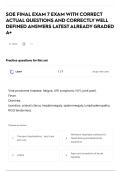
Practice questions for this set
Learn 1 /7 Study with Learn
Viral prodrome (malaise, fatigue, URI symptoms, N/V, joint pain).
Fever.
Diarrhea.
Jaundice, scleral icterus, hepatomegaly, splenomegaly, lymphadenopathy,
RUQ tenderness.
Choose an answer
Newborn respiratory distress Ex.
Transport destinations... best care
1 2 Nasal flaring and abdominal
and why
expansion
Signs and symptoms of acute
3 HIPPA 4
hepatitis
, Don't know?
Terms in this set (102)
Transport destinations... best care
and why
DNR Must be valid and specific to state requirements.
Implied consent and refusals Refusals need proper documentation and it is
encouraged to inform the PT on the risk of
refusals and alternative treatment options.
Document findings and witnesses and if possible
gather signatures.
Implied consent is a form of consent applied to
adults who are unable to verbally consent to care
and it applies to minor without the presence of
an adult/ caretaker.
Basic fundamentals of radio Know what you are going to say before speaking,
etiquette wait until transmissions are done before you
speak, when ready key up and wait one second
then speak, speak slow and clear and lay
language.
, HIPPA Health Insurance Portability and Accountability
Act of 1996. Protection of patient information and
care.
Anatomical positioning ex. lateral, Lateral- Farther from midline of the body
radial... Medial- Midline of the body
Ipsilateral-Same side of the body
Contralateral- Opposite side of body
Afterload & Preload Afterload- Force against which the ventricles
must contract to eject blood. Influenced by
arterial BP, distensibility and arterial resistance.
Prelaod- Volume of blood in the ventricle at the
end of diastole and primarily reflects venous
return
Alpha one, beta one, beta two Alpha one- Cause vasoconstriction
Alpha two- Cause smooth muscle contraction,
inhibition of insulin release, induction of
glucagon, suppression of norepi release
Beta one- Found in heart and kidneys, Stimulation
of heart sites increases HR & cardiac contraction.
From the kidney it releases renin into blood (a
powerful vasoconstrictior)
Beta two- Found in several locations, in the lungs
they cause bronchodilation
Acidosis and Alkalosis Acidosis- Blood pH lower than 7.35 (below 7
causes coma)
Alkalosis- Blood pH higher than 7.45 (above 7.8
causes uncontrolable and unstable skeletal
muscle contractions.)
ACTUAL QUESTIONS AND CORRECTLY WELL
DEFINED ANSWERS LATEST ALREADY GRADED
A+
Save
Practice questions for this set
Learn 1 /7 Study with Learn
Viral prodrome (malaise, fatigue, URI symptoms, N/V, joint pain).
Fever.
Diarrhea.
Jaundice, scleral icterus, hepatomegaly, splenomegaly, lymphadenopathy,
RUQ tenderness.
Choose an answer
Newborn respiratory distress Ex.
Transport destinations... best care
1 2 Nasal flaring and abdominal
and why
expansion
Signs and symptoms of acute
3 HIPPA 4
hepatitis
, Don't know?
Terms in this set (102)
Transport destinations... best care
and why
DNR Must be valid and specific to state requirements.
Implied consent and refusals Refusals need proper documentation and it is
encouraged to inform the PT on the risk of
refusals and alternative treatment options.
Document findings and witnesses and if possible
gather signatures.
Implied consent is a form of consent applied to
adults who are unable to verbally consent to care
and it applies to minor without the presence of
an adult/ caretaker.
Basic fundamentals of radio Know what you are going to say before speaking,
etiquette wait until transmissions are done before you
speak, when ready key up and wait one second
then speak, speak slow and clear and lay
language.
, HIPPA Health Insurance Portability and Accountability
Act of 1996. Protection of patient information and
care.
Anatomical positioning ex. lateral, Lateral- Farther from midline of the body
radial... Medial- Midline of the body
Ipsilateral-Same side of the body
Contralateral- Opposite side of body
Afterload & Preload Afterload- Force against which the ventricles
must contract to eject blood. Influenced by
arterial BP, distensibility and arterial resistance.
Prelaod- Volume of blood in the ventricle at the
end of diastole and primarily reflects venous
return
Alpha one, beta one, beta two Alpha one- Cause vasoconstriction
Alpha two- Cause smooth muscle contraction,
inhibition of insulin release, induction of
glucagon, suppression of norepi release
Beta one- Found in heart and kidneys, Stimulation
of heart sites increases HR & cardiac contraction.
From the kidney it releases renin into blood (a
powerful vasoconstrictior)
Beta two- Found in several locations, in the lungs
they cause bronchodilation
Acidosis and Alkalosis Acidosis- Blood pH lower than 7.35 (below 7
causes coma)
Alkalosis- Blood pH higher than 7.45 (above 7.8
causes uncontrolable and unstable skeletal
muscle contractions.)


