

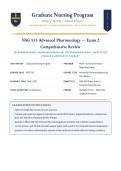
Graduate Nursing Program
2 MAXE · 335 GSN
★ ★
Rx College of Nursing — Advanced Practice
PHARM
PHARMACOLOGY · CLINICAL REASONING · SAFE PRESCRIBING
NSG 533 Advanced Pharmacology — Exam 2
Comprehensive Review
PA I N M A N AG E M E N T, M I G RA I N E / H E A DAC H E , O ST E O P O R O S I S /G O U T, I N F E CT I O US
D I S E A S E & A N T I B I OT I C T H E RA PY
INSTITUTION Graduate Nursing Program PROGRAM MSN — Advanced Practice
Registered Nurse
COURSE CODE NSG 533 COURSE TITLE Advanced Pharmacology Across
the Lifespan
ACADEMIC YEAR EXAM TITLE NSG 533 Pharm Exam 2 —
Comprehensive Review
TOTAL QUESTIONS 85 Questions FORMAT Multiple Choice — Select the
Single Best Answer
EXAMINATION INSTRUCTIONS
▸ Select the single best answer for each question.
▸ Content spans pain management (opioid/non-opioid, WHO ladder), migraine/headache, osteoporosis,
gout, and infectious disease/antibiotic therapy.
▸ Questions reflect NSG 533 Advanced Pharmacology Exam 2 content and competency expectations.
▸ Correct answers and clinical rationales appear below each question for comprehensive test preparation.
▸ Questions have been randomized to promote active recall and simulate authentic testing conditions.
, SECTION I — NSG 533 ADVANCED PHARMACOLOGY
Questions 1 – 85
COMPREHENSIVE EXAMINATION
1. What is the maximum daily dose of acetaminophen recommended for elderly patients?
A. 4,000 mg per day
B. Do not exceed 3,000 mg per day
C. 2,000 mg per day
D. No dose limit is needed for elderly patients
CORRECT ANSWER B — Do not exceed 3,000 mg per day
RATIONALE In elderly patients, the maximum recommended daily dose of acetaminophen is
3,000 mg (3 grams), which is lower than the standard adult maximum of 4,000 mg.
This reduced limit accounts for age-related decreases in hepatic function and
glutathione stores, which increase the risk of hepatotoxicity. Patients should be
counseled to check all OTC and prescription products for hidden acetaminophen
(e.g., Vicodin, Percocet, cold remedies). Chronic alcohol use further increases
hepatotoxicity risk. The 3,000 mg limit is a key safety recommendation for
geriatric prescribing.
,2. What medication could be recommended for a diabetic patient with neuropathic pain
that could also help treat comorbid depression?
A. Gabapentin
B. Duloxetine or venlafaxine (SNRIs)
C. Ibuprofen
D. Tramadol
CORRECT ANSWER B — Duloxetine or venlafaxine (SNRIs)
RATIONALE SNRIs (duloxetine and venlafaxine) are uniquely suited for patients with comorbid
diabetic peripheral neuropathy and depression because they treat BOTH
conditions. Duloxetine is FDA-approved for diabetic peripheral neuropathy,
fibromyalgia, chronic musculoskeletal pain, and major depressive disorder.
Venlafaxine is used off-label for neuropathic pain. SNRIs work by increasing
serotonin and norepinephrine, which modulate descending pain pathways.
Gabapentin treats neuropathic pain but not depression. NSAIDs are not first-line
for neuropathic pain. Tramadol has SNRI-like effects but carries opioid risks. The
dual indication makes SNRIs an excellent choice for this patient population.
, 3. Which non-opioid medications are used for neuropathic pain?
A. Only NSAIDs
B. Gabapentin, pregabalin, transdermal lidocaine, and TCAs
C. Only acetaminophen
D. Only muscle relaxants
CORRECT ANSWER B — Gabapentin, pregabalin, transdermal lidocaine, and TCAs
RATIONALE Neuropathic pain (from diabetic neuropathy, postherpetic neuralgia, etc.)
responds to different medications than nociceptive pain. First-line non-opioid
options include: gabapentinoids (gabapentin, pregabalin) — modulate calcium
channels; TCAs (amitriptyline, nortriptyline) — increase
serotonin/norepinephrine; SNRIs (duloxetine, venlafaxine); and topical agents
(transdermal lidocaine, capsaicin). NSAIDs and acetaminophen are generally
ineffective for neuropathic pain because the pathophysiology involves nerve
dysfunction, not inflammation or prostaglandin-mediated pain. Muscle relaxants
are for musculoskeletal pain, not neuropathic pain. Recognizing the distinct
treatment approach for neuropathic pain is essential for appropriate prescribing.
2 MAXE · 335 GSN
★ ★
Rx College of Nursing — Advanced Practice
PHARM
PHARMACOLOGY · CLINICAL REASONING · SAFE PRESCRIBING
NSG 533 Advanced Pharmacology — Exam 2
Comprehensive Review
PA I N M A N AG E M E N T, M I G RA I N E / H E A DAC H E , O ST E O P O R O S I S /G O U T, I N F E CT I O US
D I S E A S E & A N T I B I OT I C T H E RA PY
INSTITUTION Graduate Nursing Program PROGRAM MSN — Advanced Practice
Registered Nurse
COURSE CODE NSG 533 COURSE TITLE Advanced Pharmacology Across
the Lifespan
ACADEMIC YEAR EXAM TITLE NSG 533 Pharm Exam 2 —
Comprehensive Review
TOTAL QUESTIONS 85 Questions FORMAT Multiple Choice — Select the
Single Best Answer
EXAMINATION INSTRUCTIONS
▸ Select the single best answer for each question.
▸ Content spans pain management (opioid/non-opioid, WHO ladder), migraine/headache, osteoporosis,
gout, and infectious disease/antibiotic therapy.
▸ Questions reflect NSG 533 Advanced Pharmacology Exam 2 content and competency expectations.
▸ Correct answers and clinical rationales appear below each question for comprehensive test preparation.
▸ Questions have been randomized to promote active recall and simulate authentic testing conditions.
, SECTION I — NSG 533 ADVANCED PHARMACOLOGY
Questions 1 – 85
COMPREHENSIVE EXAMINATION
1. What is the maximum daily dose of acetaminophen recommended for elderly patients?
A. 4,000 mg per day
B. Do not exceed 3,000 mg per day
C. 2,000 mg per day
D. No dose limit is needed for elderly patients
CORRECT ANSWER B — Do not exceed 3,000 mg per day
RATIONALE In elderly patients, the maximum recommended daily dose of acetaminophen is
3,000 mg (3 grams), which is lower than the standard adult maximum of 4,000 mg.
This reduced limit accounts for age-related decreases in hepatic function and
glutathione stores, which increase the risk of hepatotoxicity. Patients should be
counseled to check all OTC and prescription products for hidden acetaminophen
(e.g., Vicodin, Percocet, cold remedies). Chronic alcohol use further increases
hepatotoxicity risk. The 3,000 mg limit is a key safety recommendation for
geriatric prescribing.
,2. What medication could be recommended for a diabetic patient with neuropathic pain
that could also help treat comorbid depression?
A. Gabapentin
B. Duloxetine or venlafaxine (SNRIs)
C. Ibuprofen
D. Tramadol
CORRECT ANSWER B — Duloxetine or venlafaxine (SNRIs)
RATIONALE SNRIs (duloxetine and venlafaxine) are uniquely suited for patients with comorbid
diabetic peripheral neuropathy and depression because they treat BOTH
conditions. Duloxetine is FDA-approved for diabetic peripheral neuropathy,
fibromyalgia, chronic musculoskeletal pain, and major depressive disorder.
Venlafaxine is used off-label for neuropathic pain. SNRIs work by increasing
serotonin and norepinephrine, which modulate descending pain pathways.
Gabapentin treats neuropathic pain but not depression. NSAIDs are not first-line
for neuropathic pain. Tramadol has SNRI-like effects but carries opioid risks. The
dual indication makes SNRIs an excellent choice for this patient population.
, 3. Which non-opioid medications are used for neuropathic pain?
A. Only NSAIDs
B. Gabapentin, pregabalin, transdermal lidocaine, and TCAs
C. Only acetaminophen
D. Only muscle relaxants
CORRECT ANSWER B — Gabapentin, pregabalin, transdermal lidocaine, and TCAs
RATIONALE Neuropathic pain (from diabetic neuropathy, postherpetic neuralgia, etc.)
responds to different medications than nociceptive pain. First-line non-opioid
options include: gabapentinoids (gabapentin, pregabalin) — modulate calcium
channels; TCAs (amitriptyline, nortriptyline) — increase
serotonin/norepinephrine; SNRIs (duloxetine, venlafaxine); and topical agents
(transdermal lidocaine, capsaicin). NSAIDs and acetaminophen are generally
ineffective for neuropathic pain because the pathophysiology involves nerve
dysfunction, not inflammation or prostaglandin-mediated pain. Muscle relaxants
are for musculoskeletal pain, not neuropathic pain. Recognizing the distinct
treatment approach for neuropathic pain is essential for appropriate prescribing.


