

AHIP 2027 Medicare + FWA Exam
Bundle Questions And Well Graded
Solutions With Rationales Updated
2026 2027
Ace your 2027 certification with the ultimate Core AHIP Medicare + Fraud, Waste, and Abuse
(FWA) training bundle study guide. This comprehensive resource features verbatim multiple-
choice questions, accurate answer keys, and clear, in-depth rationales. Perfect for independent
brokers and healthcare students needing a reliable exam prep tool. Gain immediate access to core
module breakdowns, compliance rules, and testing strategies to pass on your very first attempt
with a 90%+ score.
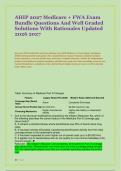
Table: Summary of Medicare Part D Changes
Feature Legacy Rules (Pre-2025) Modern Rules (2025 and Beyond)
Coverage Gap (Donut
Active Completely Eliminated
Hole)
Annual Out-of-Pocket Cap No hard limit $2,000 maximum cap
Higher manufacturer Higher plan liability in catastrophic
Financing Mechanics
liability phase
1. Due to the structural modifications enacted by the Inflation Reduction Act, which of
the following describes the current status of the Medicare Part D coverage gap
(donut hole)?
A. It remains a standard phase where beneficiaries pay 25% of brand-name drug
costs.
B. It has been entirely eliminated, transitioning beneficiaries directly from the initial
coverage phase to the catastrophic phase.
C. It has been expanded to cover higher out-of-pocket costs up to a $5,000 limit.
D. It applies only to beneficiaries who do not qualify for Low-Income Subsidies (LIS).
Correct answer: B
Rationale: The Inflation Reduction Act completely eliminated the Part D coverage
gap (donut hole). Beneficiaries now move from the initial coverage phase straight
into the catastrophic phase once their out-of-pocket spending reaches the annual
cap.
1|Page
,2. An agent is explaining the annual out-of-pocket maximum limit for Medicare Part D
prescription drug plans to a client. What is the maximum standard out-of-pocket cap
that a beneficiary can be required to pay for covered formulary drugs before reaching
the catastrophic phase?
A. $5,030
B. $8,000
C. $2,000
D. $3,500
Correct answer: C
Rationale: The modernized Part D structure places a hard annual cap of $2,000 on a
beneficiary's true out-of-pocket (TrOOP) spending for covered formulary
medications.
3. Under Medicare Part A, what is the primary structural determinant used to calculate
beneficiary cost-sharing for inpatient hospital stays?
A. The number of calendar years the beneficiary has been enrolled.
B. The specific diagnosis-related group (DRG) code.
C. The benefit period, which begins the day a patient enters the hospital and ends
when they have been out for 60 consecutive days.
D. The total number of lifetime reserve days remaining in the carrier's private
network.
Correct answer: C
Rationale: Part A cost-sharing is structured around the "benefit period." A benefit
period begins the day an individual is admitted as an inpatient and ends once the
individual has not received any inpatient hospital or skilled nursing care for 60
consecutive days.
4. A beneficiary is enrolled in a Medicare Advantage Prescription Drug (MA-PD) plan.
They receive an Annual Notice of Change (ANOC) in September detailing significant
premium increases. When is the first opportunity for this beneficiary to switch to a
different MA-PD plan using the standard Annual Election Period (AEP)?
A. January 1 to March 31
B. October 15 to December 7
C. December 8 to January 15
D. Anytime during the first 6 months of the calendar year
Correct answer: B
Rationale: The Annual Election Period (AEP) runs from October 15 to December 7
each year. Changes made during this period take effect on January 1 of the following
year.
5. Which of the following marketing practices is strictly prohibited by CMS guidelines
during an educational event conducted by a licensed insurance agent?
A. Distributing business cards and agent contact information.
B. Displaying educational flyers regarding preventive health benefits.
C. Accepting completed enrollment applications or scheduling individual sales
appointments.
D. Serving light snacks and refreshments to attendees.
Correct answer: C
Rationale: CMS regulations state that educational events must be explicitly free of
marketing and sales activities. Accepting enrollment applications or setting up
individual sales appointments at an educational event is completely prohibited.
Figure: Medicare Outpatient vs. Inpatient Status
[ Patient Presentation at ER ]
2|Page
, │
▼
[ Observation Status (Part B) ] ──(If not formally admitted)──►
Coinsurance/Deductible Applies
│
(Formal Admission)
│
▼
[ Inpatient Status (Part A) ] ──► Deductible per Benefit Period Applies
6. A client visits an emergency room and is held in a hospital bed for two nights under
"observation status." When billing occurs, which part of Medicare will cover the
hospital stay?
A. Part A, because the stay exceeded 24 hours.
B. Part B, because the patient was never formally admitted as an inpatient by a
physician.
C. Part C, automatically regardless of whether it is an MA plan or Original Medicare.
D. Part D, because hospital observation always falls under self-administered drug
categories.
Correct answer: B
Rationale: Hospital stays are only covered under Part A if a physician formally
admits the patient as an inpatient. Observation status is billed as an outpatient
service under Part B, regardless of the number of nights spent in a hospital bed.
7. Under federal Anti-Kickback Statute (AKS) provisions, what is the legal status of an
insurance agent offering a $50 cash gift card to a Medicare beneficiary as an
incentive to enroll in a specific Medicare Advantage plan?
A. It is permissible if the gift card cannot be converted directly into cash at an ATM.
B. It is a violation of the Anti-Kickback Statute because it offers financial
remuneration to induce an enrollment.
C. It is allowed under CMS nominal value rules as long as it does not exceed $75
annually per beneficiary.
D. It is acceptable only if the agent documents the gift on their annual tax return.
Correct answer: B
Rationale: Offering cash or cash equivalents (like gift cards) as an inducement to
enroll violates the federal Anti-Kickback Statute. CMS nominal value rules allow for
non-cash promotional items up to $15, but cash equivalents of any value are illegal.
8. If a consumer enters their Initial Enrollment Period (IEP) for Medicare around their
65th birthday, how many total months does this enrollment window last?
A. 3 months
B. 6 months
C. 7 months
D. 12 months
Correct answer: C
Rationale: The Initial Enrollment Period (IEP) is a 7-month window. It includes the 3
months before the individual turns 65, the month of their 65th birthday, and the 3
months following their birthday month.
9. A beneficiary who has lived in New York for 10 years permanently relocates to
Florida in June. Which regulatory mechanism allows this individual to enroll in a new
Medicare Advantage plan outside of the standard autumn enrollment window?
A. The Open Enrollment Period (OEP)
3|Page
, B. A Special Enrollment Period (SEP) granted due to a permanent change in
residence
C. The Initial Inbound Relocation Exemption (IIRE)
D. The Medicare General Enrollment Period (GEP)
Correct answer: B
Rationale: A permanent change of residence that alters the individual's plan service
area creates a Special Enrollment Period (SEP). This allows the beneficiary to switch
to a plan available in their new geographic location.
10. During a recorded Scope of Appointment (SOA) phone call, a client explicitly agrees
to discuss Medicare Advantage plans. During the meeting, the agent begins pitching
a standalone cancer insurance policy. What compliance rule has the agent violated?
A. The agent violated the 48-hour cooling-off rule for ancillary products.
B. The agent violated the cross-selling restriction by discussing non-health related
lines of business not documented on the SOA.
C. No violation occurred because cancer policies are categorized under standard
health benefits.
D. The agent violated the Medicare Advantage Open Enrollment boundary line.
Correct answer: B
Rationale: Agents are strictly prohibited from cross-selling non-Medicare lines of
business (like life insurance, annuities, or standalone critical illness policies) during a
scheduled Medicare appointment unless requested and documented on a separate
Scope of Appointment.
Table: Medicare Advantage Enrollment Windows
Window Name Timeframe Allowed Actions
AEP Oct 15 – Dec 7 Switch, drop, or add MA and Part D plans
MA OEP Jan 1 – Mar 31 Switch MA plans or return to Original Medicare
11. A beneficiary is currently enrolled in a Medicare Advantage plan. On February 12,
they decide they want to switch to a different Medicare Advantage plan with better
dental benefits. Which window allows them to execute this specific change?
A. Annual Election Period (AEP)
B. General Enrollment Period (GEP)
C. Medicare Advantage Open Enrollment Period (MA OEP)
D. Initial Inbound Enrollment Window
Correct answer: C
Rationale: The Medicare Advantage Open Enrollment Period (MA OEP) runs from
January 1 to March 31. During this time, individuals already enrolled in a Medicare
Advantage plan can switch to another MA plan or return to Original Medicare.
12. In the context of Medicare Fraud, Waste, and Abuse (FWA) guidelines, which of the
following scenarios constitutes an example of "Fraud" rather than "Waste" or
"Abuse"?
A. A medical clinic accidentally submitting a duplicate bill due to a clerical typo.
B. A physician intentionally billing Medicare for a complex surgical procedure that
was never performed.
C. A physical therapist scheduling more rehabilitation sessions than medically
necessary out of an abundance of caution.
D. A hospital ordering standard laboratory panels for all admitting patients without
checking prior records.
Correct answer: B
Rationale: Fraud requires intentional deception or misrepresentation known to be
4|Page
Bundle Questions And Well Graded
Solutions With Rationales Updated
2026 2027
Ace your 2027 certification with the ultimate Core AHIP Medicare + Fraud, Waste, and Abuse
(FWA) training bundle study guide. This comprehensive resource features verbatim multiple-
choice questions, accurate answer keys, and clear, in-depth rationales. Perfect for independent
brokers and healthcare students needing a reliable exam prep tool. Gain immediate access to core
module breakdowns, compliance rules, and testing strategies to pass on your very first attempt
with a 90%+ score.
Table: Summary of Medicare Part D Changes
Feature Legacy Rules (Pre-2025) Modern Rules (2025 and Beyond)
Coverage Gap (Donut
Active Completely Eliminated
Hole)
Annual Out-of-Pocket Cap No hard limit $2,000 maximum cap
Higher manufacturer Higher plan liability in catastrophic
Financing Mechanics
liability phase
1. Due to the structural modifications enacted by the Inflation Reduction Act, which of
the following describes the current status of the Medicare Part D coverage gap
(donut hole)?
A. It remains a standard phase where beneficiaries pay 25% of brand-name drug
costs.
B. It has been entirely eliminated, transitioning beneficiaries directly from the initial
coverage phase to the catastrophic phase.
C. It has been expanded to cover higher out-of-pocket costs up to a $5,000 limit.
D. It applies only to beneficiaries who do not qualify for Low-Income Subsidies (LIS).
Correct answer: B
Rationale: The Inflation Reduction Act completely eliminated the Part D coverage
gap (donut hole). Beneficiaries now move from the initial coverage phase straight
into the catastrophic phase once their out-of-pocket spending reaches the annual
cap.
1|Page
,2. An agent is explaining the annual out-of-pocket maximum limit for Medicare Part D
prescription drug plans to a client. What is the maximum standard out-of-pocket cap
that a beneficiary can be required to pay for covered formulary drugs before reaching
the catastrophic phase?
A. $5,030
B. $8,000
C. $2,000
D. $3,500
Correct answer: C
Rationale: The modernized Part D structure places a hard annual cap of $2,000 on a
beneficiary's true out-of-pocket (TrOOP) spending for covered formulary
medications.
3. Under Medicare Part A, what is the primary structural determinant used to calculate
beneficiary cost-sharing for inpatient hospital stays?
A. The number of calendar years the beneficiary has been enrolled.
B. The specific diagnosis-related group (DRG) code.
C. The benefit period, which begins the day a patient enters the hospital and ends
when they have been out for 60 consecutive days.
D. The total number of lifetime reserve days remaining in the carrier's private
network.
Correct answer: C
Rationale: Part A cost-sharing is structured around the "benefit period." A benefit
period begins the day an individual is admitted as an inpatient and ends once the
individual has not received any inpatient hospital or skilled nursing care for 60
consecutive days.
4. A beneficiary is enrolled in a Medicare Advantage Prescription Drug (MA-PD) plan.
They receive an Annual Notice of Change (ANOC) in September detailing significant
premium increases. When is the first opportunity for this beneficiary to switch to a
different MA-PD plan using the standard Annual Election Period (AEP)?
A. January 1 to March 31
B. October 15 to December 7
C. December 8 to January 15
D. Anytime during the first 6 months of the calendar year
Correct answer: B
Rationale: The Annual Election Period (AEP) runs from October 15 to December 7
each year. Changes made during this period take effect on January 1 of the following
year.
5. Which of the following marketing practices is strictly prohibited by CMS guidelines
during an educational event conducted by a licensed insurance agent?
A. Distributing business cards and agent contact information.
B. Displaying educational flyers regarding preventive health benefits.
C. Accepting completed enrollment applications or scheduling individual sales
appointments.
D. Serving light snacks and refreshments to attendees.
Correct answer: C
Rationale: CMS regulations state that educational events must be explicitly free of
marketing and sales activities. Accepting enrollment applications or setting up
individual sales appointments at an educational event is completely prohibited.
Figure: Medicare Outpatient vs. Inpatient Status
[ Patient Presentation at ER ]
2|Page
, │
▼
[ Observation Status (Part B) ] ──(If not formally admitted)──►
Coinsurance/Deductible Applies
│
(Formal Admission)
│
▼
[ Inpatient Status (Part A) ] ──► Deductible per Benefit Period Applies
6. A client visits an emergency room and is held in a hospital bed for two nights under
"observation status." When billing occurs, which part of Medicare will cover the
hospital stay?
A. Part A, because the stay exceeded 24 hours.
B. Part B, because the patient was never formally admitted as an inpatient by a
physician.
C. Part C, automatically regardless of whether it is an MA plan or Original Medicare.
D. Part D, because hospital observation always falls under self-administered drug
categories.
Correct answer: B
Rationale: Hospital stays are only covered under Part A if a physician formally
admits the patient as an inpatient. Observation status is billed as an outpatient
service under Part B, regardless of the number of nights spent in a hospital bed.
7. Under federal Anti-Kickback Statute (AKS) provisions, what is the legal status of an
insurance agent offering a $50 cash gift card to a Medicare beneficiary as an
incentive to enroll in a specific Medicare Advantage plan?
A. It is permissible if the gift card cannot be converted directly into cash at an ATM.
B. It is a violation of the Anti-Kickback Statute because it offers financial
remuneration to induce an enrollment.
C. It is allowed under CMS nominal value rules as long as it does not exceed $75
annually per beneficiary.
D. It is acceptable only if the agent documents the gift on their annual tax return.
Correct answer: B
Rationale: Offering cash or cash equivalents (like gift cards) as an inducement to
enroll violates the federal Anti-Kickback Statute. CMS nominal value rules allow for
non-cash promotional items up to $15, but cash equivalents of any value are illegal.
8. If a consumer enters their Initial Enrollment Period (IEP) for Medicare around their
65th birthday, how many total months does this enrollment window last?
A. 3 months
B. 6 months
C. 7 months
D. 12 months
Correct answer: C
Rationale: The Initial Enrollment Period (IEP) is a 7-month window. It includes the 3
months before the individual turns 65, the month of their 65th birthday, and the 3
months following their birthday month.
9. A beneficiary who has lived in New York for 10 years permanently relocates to
Florida in June. Which regulatory mechanism allows this individual to enroll in a new
Medicare Advantage plan outside of the standard autumn enrollment window?
A. The Open Enrollment Period (OEP)
3|Page
, B. A Special Enrollment Period (SEP) granted due to a permanent change in
residence
C. The Initial Inbound Relocation Exemption (IIRE)
D. The Medicare General Enrollment Period (GEP)
Correct answer: B
Rationale: A permanent change of residence that alters the individual's plan service
area creates a Special Enrollment Period (SEP). This allows the beneficiary to switch
to a plan available in their new geographic location.
10. During a recorded Scope of Appointment (SOA) phone call, a client explicitly agrees
to discuss Medicare Advantage plans. During the meeting, the agent begins pitching
a standalone cancer insurance policy. What compliance rule has the agent violated?
A. The agent violated the 48-hour cooling-off rule for ancillary products.
B. The agent violated the cross-selling restriction by discussing non-health related
lines of business not documented on the SOA.
C. No violation occurred because cancer policies are categorized under standard
health benefits.
D. The agent violated the Medicare Advantage Open Enrollment boundary line.
Correct answer: B
Rationale: Agents are strictly prohibited from cross-selling non-Medicare lines of
business (like life insurance, annuities, or standalone critical illness policies) during a
scheduled Medicare appointment unless requested and documented on a separate
Scope of Appointment.
Table: Medicare Advantage Enrollment Windows
Window Name Timeframe Allowed Actions
AEP Oct 15 – Dec 7 Switch, drop, or add MA and Part D plans
MA OEP Jan 1 – Mar 31 Switch MA plans or return to Original Medicare
11. A beneficiary is currently enrolled in a Medicare Advantage plan. On February 12,
they decide they want to switch to a different Medicare Advantage plan with better
dental benefits. Which window allows them to execute this specific change?
A. Annual Election Period (AEP)
B. General Enrollment Period (GEP)
C. Medicare Advantage Open Enrollment Period (MA OEP)
D. Initial Inbound Enrollment Window
Correct answer: C
Rationale: The Medicare Advantage Open Enrollment Period (MA OEP) runs from
January 1 to March 31. During this time, individuals already enrolled in a Medicare
Advantage plan can switch to another MA plan or return to Original Medicare.
12. In the context of Medicare Fraud, Waste, and Abuse (FWA) guidelines, which of the
following scenarios constitutes an example of "Fraud" rather than "Waste" or
"Abuse"?
A. A medical clinic accidentally submitting a duplicate bill due to a clerical typo.
B. A physician intentionally billing Medicare for a complex surgical procedure that
was never performed.
C. A physical therapist scheduling more rehabilitation sessions than medically
necessary out of an abundance of caution.
D. A hospital ordering standard laboratory panels for all admitting patients without
checking prior records.
Correct answer: B
Rationale: Fraud requires intentional deception or misrepresentation known to be
4|Page


