

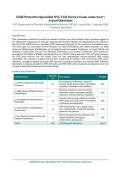
Child Protective Specialist NYC Civil Service Exam 2026/2027 |
Actual Questions
NYC Department of Citywide Administrative Services (DCAS) | Actual Q&A | Aspiring Child
Protective Specialists
Introduction
This examination instrument presents one hundred original, peer-style multiple-choice questions aligned to
the official NYC Department of Citywide Administrative Services (DCAS) and Administration for Children's
Services (ACS) Child Protective Specialist (CPS) assessment blueprint for the 2026/2027 examination cycle.
The items span five interrelated content domains: (1) Child Development and Family Dynamics, (2) Child
Abuse and Maltreatment Identification, (3) Investigation and Assessment Techniques, (4) Legal, Ethical, and
Regulatory Frameworks, and (5) Case Planning, Intervention, and Cultural Competency. Each question is
grounded in NYS Office of Children and Family Services (OCFS) training materials, NYC ACS policy manuals,
the NYS Social Services Law, the Family Court Act, and contemporary trauma-informed child welfare
scholarship. The content is original and has been constructed to reinforce NYC Civil Service CPS course
objectives, strengthen applied reasoning, and promote examination readiness for aspiring Child Protective
Specialists. A rationale grounded in NYC ACS policy and NYS child welfare standards accompanies every item
to support both self-assessment and structured study.
Content Area Overview
Questio
Content Area Key Topics Weight
ns
Developmental milestones; impact of
1. Child Development and Family
20 trauma; family systems theory; parenting 20%
Dynamics
capacities; attachment and resilience
Physical, emotional, and sexual abuse
2. Child Abuse and Maltreatment
25 indicators; neglect typologies; medical 25%
Identification
indicators; forensic pattern recognition
Forensic interviewing; collateral contacts;
3. Investigation and Assessment
25 SDM safety/risk tools; home environment 25%
Techniques
evaluation; documentation
NYS Social Services Law; Family Court
4. Legal, Ethical, and Regulatory
15 Act; confidentiality; mandated reporting 15%
Frameworks
protocols; due process
Service planning; trauma-informed care;
5. Case Planning, Intervention, and
15 cultural humility; interagency 15%
Cultural Competency
collaboration; permanency
Total 100 All blueprint domains 100%
Child Protective Specialist NYC Civil Service Exam 2026/2027
,Actual Questions
Domain: Child Development and Family Dynamics
1. According to Piaget's theory of cognitive development, which stage is characterized by the
ability to think abstractly and hypothetically, typically emerging in adolescence?
A. Concrete operational stage
B. Formal operational stage
C. Preoperational stage
D. Sensorimotor stage
Answer: B
Rationale: Piaget's formal operational stage (age 12+) marks the capacity for abstract, hypothetical
reasoning. CPS specialists use this to gauge whether an adolescent's statements reflect mature reasoning
or developmental immaturity affecting credibility and risk assessment.
2. In Erikson's psychosocial framework, the crisis of 'Trust vs. Mistrust' corresponds to which
developmental period most relevant to assessing infant-caregiver attachment in neglect cases?
A. First year of life (0-1)
B. Preschool (3-6)
C. Prenatal period
D. Toddlerhood (1-3)
Answer: A
Rationale: Erikson places Trust vs. Mistrust in infancy (0-1). Disruptions here, such as inconsistent
caregiving seen in neglect, impair foundational attachment. ACS policy directs CPS workers to assess
early caregiver responsiveness when evaluating infant safety.
3. Within Bowlby's attachment theory, an infant who shows little distress when the caregiver
leaves and ignores them upon return most likely demonstrates which attachment pattern?
A. Ambivalent (anxious-resistant) attachment
B. Disorganized attachment
C. Secure attachment
D. Avoidant attachment
Answer: D
Rationale: Avoidant attachment presents as indifference to separation and reunion, often stemming from
chronically unresponsive caregiving. Recognizing this pattern helps CPS specialists identify emotionally
neglectful environments warranting service intervention.
4. A 9-month-old infant should typically demonstrate which developmental milestone most
relevant to evaluating potential developmental delay in a neglect investigation?
A. Speaking in two-word sentences
B. Walking independently
C. Sitting without support and babbling consonant sounds
D. Reading simple words
Answer: C
Rationale: By 9 months, infants typically sit unsupported and babble with consonants. Marked delays in
these milestones may signal environmental neglect or medical neglect and warrant referral for
developmental evaluation per OCFS guidance.
5. Which toddler developmental milestone, typically achieved between 18-24 months, is most
critical to assess when evaluating supervisory neglect concerns?
A. Awareness of danger and emerging impulse control
B. Ability to prepare meals independently
C. Ability to verbalize full name and address
D. Ability to cross streets unsupervised
Child Protective Specialist NYC Civil Service Exam 2026/2027
, Answer: A
Rationale: Toddlers 18-24 months lack reliable danger awareness and impulse control. CPS specialists
use this benchmark to evaluate whether caregiver supervision was developmentally appropriate, a core
element of supervisory neglect determinations.
6. According to NYC ACS developmental guidance, which preschool milestone (ages 3-5) most
informs assessments of a child's capacity to disclose abuse reliably?
A. Ability to write in cursive
B. Emerging expressive language and symbolic play
C. Ability to perform long division
D. Ability to drive a vehicle
Answer: B
Rationale: Preschoolers develop expressive language and symbolic play enabling disclosure, though their
narratives may be fragmented. CPS specialists apply developmentally appropriate interview techniques
consistent with NICHD protocols for this age range.
7. A school-aged child (6-12) in an abuse investigation most typically demonstrates which
developmental capacity that influences interview approach?
A. Abstract philosophical reasoning
B. No capacity to recall events
C. Full adult decision-making capacity
D. Concrete logical reasoning and emerging self-concept
Answer: D
Rationale: School-aged children use concrete logical reasoning and develop self-concept. CPS
investigators adapt questioning to concrete terms and timelines, avoiding abstract hypotheticals that
exceed the child's cognitive stage.
8. Which adolescent developmental factor most increases vulnerability to risk-taking
behaviors that CPS specialists must consider during safety assessments?
A. Limbic system maturation outpacing prefrontal cortex development
B. Decreased peer influence
C. Complete cognitive immaturity
D. Prefrontal cortex maturation outpacing limbic system development
Answer: A
Rationale: In adolescence, the limbic system (reward/emotion) matures faster than the prefrontal cortex
(impulse control), elevating risk-taking. CPS specialists factor this into safety planning for runaway,
substance use, and exploitation risks.
9. How does chronic trauma most directly affect developing brain architecture in children,
according to current neurodevelopmental research cited in OCFS training?
A. It alters amygdala reactivity and impairs stress regulation
B. It has no measurable neurological effect
C. It accelerates prefrontal cortex development
D. It enlarges the hippocampus improving memory
Answer: A
Rationale: Chronic trauma sensitizes the amygdala and dysregulates the HPA axis, producing
hyperarousal and impaired stress regulation. Trauma-informed CPS practice recognizes these
neurological effects when interpreting children's behavior.
10. In the Adverse Childhood Experiences (ACEs) framework, which combination of exposures
is most strongly associated with elevated lifetime health and behavioral risks?
A. A single experience of parental divorce
B. A single hospitalization in childhood
C. Cumulative exposure to abuse, neglect, and household dysfunction
Child Protective Specialist NYC Civil Service Exam 2026/2027
Actual Questions
NYC Department of Citywide Administrative Services (DCAS) | Actual Q&A | Aspiring Child
Protective Specialists
Introduction
This examination instrument presents one hundred original, peer-style multiple-choice questions aligned to
the official NYC Department of Citywide Administrative Services (DCAS) and Administration for Children's
Services (ACS) Child Protective Specialist (CPS) assessment blueprint for the 2026/2027 examination cycle.
The items span five interrelated content domains: (1) Child Development and Family Dynamics, (2) Child
Abuse and Maltreatment Identification, (3) Investigation and Assessment Techniques, (4) Legal, Ethical, and
Regulatory Frameworks, and (5) Case Planning, Intervention, and Cultural Competency. Each question is
grounded in NYS Office of Children and Family Services (OCFS) training materials, NYC ACS policy manuals,
the NYS Social Services Law, the Family Court Act, and contemporary trauma-informed child welfare
scholarship. The content is original and has been constructed to reinforce NYC Civil Service CPS course
objectives, strengthen applied reasoning, and promote examination readiness for aspiring Child Protective
Specialists. A rationale grounded in NYC ACS policy and NYS child welfare standards accompanies every item
to support both self-assessment and structured study.
Content Area Overview
Questio
Content Area Key Topics Weight
ns
Developmental milestones; impact of
1. Child Development and Family
20 trauma; family systems theory; parenting 20%
Dynamics
capacities; attachment and resilience
Physical, emotional, and sexual abuse
2. Child Abuse and Maltreatment
25 indicators; neglect typologies; medical 25%
Identification
indicators; forensic pattern recognition
Forensic interviewing; collateral contacts;
3. Investigation and Assessment
25 SDM safety/risk tools; home environment 25%
Techniques
evaluation; documentation
NYS Social Services Law; Family Court
4. Legal, Ethical, and Regulatory
15 Act; confidentiality; mandated reporting 15%
Frameworks
protocols; due process
Service planning; trauma-informed care;
5. Case Planning, Intervention, and
15 cultural humility; interagency 15%
Cultural Competency
collaboration; permanency
Total 100 All blueprint domains 100%
Child Protective Specialist NYC Civil Service Exam 2026/2027
,Actual Questions
Domain: Child Development and Family Dynamics
1. According to Piaget's theory of cognitive development, which stage is characterized by the
ability to think abstractly and hypothetically, typically emerging in adolescence?
A. Concrete operational stage
B. Formal operational stage
C. Preoperational stage
D. Sensorimotor stage
Answer: B
Rationale: Piaget's formal operational stage (age 12+) marks the capacity for abstract, hypothetical
reasoning. CPS specialists use this to gauge whether an adolescent's statements reflect mature reasoning
or developmental immaturity affecting credibility and risk assessment.
2. In Erikson's psychosocial framework, the crisis of 'Trust vs. Mistrust' corresponds to which
developmental period most relevant to assessing infant-caregiver attachment in neglect cases?
A. First year of life (0-1)
B. Preschool (3-6)
C. Prenatal period
D. Toddlerhood (1-3)
Answer: A
Rationale: Erikson places Trust vs. Mistrust in infancy (0-1). Disruptions here, such as inconsistent
caregiving seen in neglect, impair foundational attachment. ACS policy directs CPS workers to assess
early caregiver responsiveness when evaluating infant safety.
3. Within Bowlby's attachment theory, an infant who shows little distress when the caregiver
leaves and ignores them upon return most likely demonstrates which attachment pattern?
A. Ambivalent (anxious-resistant) attachment
B. Disorganized attachment
C. Secure attachment
D. Avoidant attachment
Answer: D
Rationale: Avoidant attachment presents as indifference to separation and reunion, often stemming from
chronically unresponsive caregiving. Recognizing this pattern helps CPS specialists identify emotionally
neglectful environments warranting service intervention.
4. A 9-month-old infant should typically demonstrate which developmental milestone most
relevant to evaluating potential developmental delay in a neglect investigation?
A. Speaking in two-word sentences
B. Walking independently
C. Sitting without support and babbling consonant sounds
D. Reading simple words
Answer: C
Rationale: By 9 months, infants typically sit unsupported and babble with consonants. Marked delays in
these milestones may signal environmental neglect or medical neglect and warrant referral for
developmental evaluation per OCFS guidance.
5. Which toddler developmental milestone, typically achieved between 18-24 months, is most
critical to assess when evaluating supervisory neglect concerns?
A. Awareness of danger and emerging impulse control
B. Ability to prepare meals independently
C. Ability to verbalize full name and address
D. Ability to cross streets unsupervised
Child Protective Specialist NYC Civil Service Exam 2026/2027
, Answer: A
Rationale: Toddlers 18-24 months lack reliable danger awareness and impulse control. CPS specialists
use this benchmark to evaluate whether caregiver supervision was developmentally appropriate, a core
element of supervisory neglect determinations.
6. According to NYC ACS developmental guidance, which preschool milestone (ages 3-5) most
informs assessments of a child's capacity to disclose abuse reliably?
A. Ability to write in cursive
B. Emerging expressive language and symbolic play
C. Ability to perform long division
D. Ability to drive a vehicle
Answer: B
Rationale: Preschoolers develop expressive language and symbolic play enabling disclosure, though their
narratives may be fragmented. CPS specialists apply developmentally appropriate interview techniques
consistent with NICHD protocols for this age range.
7. A school-aged child (6-12) in an abuse investigation most typically demonstrates which
developmental capacity that influences interview approach?
A. Abstract philosophical reasoning
B. No capacity to recall events
C. Full adult decision-making capacity
D. Concrete logical reasoning and emerging self-concept
Answer: D
Rationale: School-aged children use concrete logical reasoning and develop self-concept. CPS
investigators adapt questioning to concrete terms and timelines, avoiding abstract hypotheticals that
exceed the child's cognitive stage.
8. Which adolescent developmental factor most increases vulnerability to risk-taking
behaviors that CPS specialists must consider during safety assessments?
A. Limbic system maturation outpacing prefrontal cortex development
B. Decreased peer influence
C. Complete cognitive immaturity
D. Prefrontal cortex maturation outpacing limbic system development
Answer: A
Rationale: In adolescence, the limbic system (reward/emotion) matures faster than the prefrontal cortex
(impulse control), elevating risk-taking. CPS specialists factor this into safety planning for runaway,
substance use, and exploitation risks.
9. How does chronic trauma most directly affect developing brain architecture in children,
according to current neurodevelopmental research cited in OCFS training?
A. It alters amygdala reactivity and impairs stress regulation
B. It has no measurable neurological effect
C. It accelerates prefrontal cortex development
D. It enlarges the hippocampus improving memory
Answer: A
Rationale: Chronic trauma sensitizes the amygdala and dysregulates the HPA axis, producing
hyperarousal and impaired stress regulation. Trauma-informed CPS practice recognizes these
neurological effects when interpreting children's behavior.
10. In the Adverse Childhood Experiences (ACEs) framework, which combination of exposures
is most strongly associated with elevated lifetime health and behavioral risks?
A. A single experience of parental divorce
B. A single hospitalization in childhood
C. Cumulative exposure to abuse, neglect, and household dysfunction
Child Protective Specialist NYC Civil Service Exam 2026/2027


