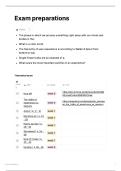
Exam preparations
done
The phase in which we process something right away with our minds and
bodies in the;
What is a color script
The hierarchy of user experience is according to Walter & Spool from
bottom to top;
Single flower bulbs are an example of a;
What is/are the most important point(s) of an experience?
Theoretical exam
chec title week link
k
https://dlo.mijnhva.nl/d2l/le/content/1928
Kick-off week 0
92/viewContent/681383/View
The riddle of
https://www.ted.com/talks/daniel_kahnem
experience vs. week 0
an_the_riddle_of_experience_vs_memory
memory
Action | p. 17 - 21 week 1
Narrative arc | p. 22
week 1
- 25
Hero's journey | p.
week 1
26 - 33
Storyboard | p. 34 -
week 1
39
Rule of Threes | p.
week 1
40 - 43
Emotion | p. 59 - 65 week 0
Exam preparations 1
, chec title week link
k
Experience
week 0
economy | p. 66 - 71
Emotional journey |
week 1
p. 72 - 81
Co-creation | p. 82 -
week 3
89
Persona | p. 90 - 99 week 1
Emoji | p. 100 - 103 week 1
Color and emotion |
week 1
p. 104 - 111
Sensation | p. 115 -
week 2
117
The gaze | p. 118 -
week 2
125
Gestalt principles |
week 2
p. 126 - 131
Affordance | p. 132 -
week 2
137
Multisensory design
week 2
| p. 142 - 151
Aftermath | p. 154 -
week 2
155
https://dlo.mijnhva.nl/d2l/le/content/1928
Class week 1
92/viewContent/684651/View
Class
Untitled
Behavioral economics | p. 138 - 141
Exam preparations 2
, The riddle of experience vs. memory
week week 0
check
link https://www.ted.com/talks/daniel_kahneman_the_riddle_of_experience_vs_memory
Happiness, it means alot and we apply it to too many different things today. Daniel Kahneman
talks about cognitive traps of happiness. This applies to laypeople thinking about their own
happiness, and it applies to scholars thinking about happiness.
Three cognitive traps
1. A reluctance to admit complexity. The word "happiness" is not a useful word anymore
because we apply it to too many different things. This is something we have to give up
and we'll have to adopt the more complicated views of what well-being is.
2. A confusion between experience and memory; it's between being happy in your life and
being happy about your life or happy with your life. These are two very different
concepts, and they're both lumped in the notion of happiness.
3. The focusing illusion. It's the unfortunate fact that we can't think about any circumstance
that affects well-being without distorting its importance.
Example; someone had been listening to a symphony which was absolutely glorious music.
At the very end of the recording, there was a dreadful screeching sound. The person then
said that it ruined the whole experience. But actually, it hadn't. What it had ruined were the
memories of the experience. He had had 20 minutes of glorious music. They counted for
nothing because he was left with a memory; the memory was ruined, and the memory was all
that he had gotten to keep.
This is telling us that we might be thinking of ourselves and of other people in terms of two
selves. There is an experiencing self and a remembering self. The experiencing self lives in
the present and knows the present, it is capable of re-living the past, but basically it has only
the present. "Does it hurt now when I touch you here?". And then the remembering self is the
one that keeps score, and maintains the story of your life. "How have you been feeling
lately?".
Those are two very different entities. Getting confused between them is part of the mess
about the notion of happiness.
The riddle of experience vs. memory 1
, The remembering self is a storyteller. It starts immediately. Our memories tells us stories, that
is, what we get to keep from our expereinces is a story. There can be conflicting times
between the experiencing self and the remembering self. The memory can be much worse of
Person A than person B instead of what they said (the experience). If you change anything
while experiencing something, you can make the experiencing self worse off and you make
the remembering self a lot better off. Because now you have endowed the person with a
better story about his experience. What defines a story are changes, significant momenst
and endings. Endings are very, very important.
The experiencing self lives its life continuously. It has moments of experience, one after the
other. Most of these experiences get ignored by the remembering self. And yet, somehow
you get the sense that they should count, that what happens during these moments of
experiencing is our life.
The biggest difference between experiencing self and remembering self is the handling of
time. First of all time has very little impact on the story (experiencing) than on the
remembering self.
We actually don't choose between experiences, we chose between memories of
experiences. And even when we think about the future, we don't think of our future normally
as experiences. You can think of the remembering self sort of dragging the experiencing self
through experiences that the experiencing self doesn't need.
The riddle of experience vs. memory 2
done
The phase in which we process something right away with our minds and
bodies in the;
What is a color script
The hierarchy of user experience is according to Walter & Spool from
bottom to top;
Single flower bulbs are an example of a;
What is/are the most important point(s) of an experience?
Theoretical exam
chec title week link
k
https://dlo.mijnhva.nl/d2l/le/content/1928
Kick-off week 0
92/viewContent/681383/View
The riddle of
https://www.ted.com/talks/daniel_kahnem
experience vs. week 0
an_the_riddle_of_experience_vs_memory
memory
Action | p. 17 - 21 week 1
Narrative arc | p. 22
week 1
- 25
Hero's journey | p.
week 1
26 - 33
Storyboard | p. 34 -
week 1
39
Rule of Threes | p.
week 1
40 - 43
Emotion | p. 59 - 65 week 0
Exam preparations 1
, chec title week link
k
Experience
week 0
economy | p. 66 - 71
Emotional journey |
week 1
p. 72 - 81
Co-creation | p. 82 -
week 3
89
Persona | p. 90 - 99 week 1
Emoji | p. 100 - 103 week 1
Color and emotion |
week 1
p. 104 - 111
Sensation | p. 115 -
week 2
117
The gaze | p. 118 -
week 2
125
Gestalt principles |
week 2
p. 126 - 131
Affordance | p. 132 -
week 2
137
Multisensory design
week 2
| p. 142 - 151
Aftermath | p. 154 -
week 2
155
https://dlo.mijnhva.nl/d2l/le/content/1928
Class week 1
92/viewContent/684651/View
Class
Untitled
Behavioral economics | p. 138 - 141
Exam preparations 2
, The riddle of experience vs. memory
week week 0
check
link https://www.ted.com/talks/daniel_kahneman_the_riddle_of_experience_vs_memory
Happiness, it means alot and we apply it to too many different things today. Daniel Kahneman
talks about cognitive traps of happiness. This applies to laypeople thinking about their own
happiness, and it applies to scholars thinking about happiness.
Three cognitive traps
1. A reluctance to admit complexity. The word "happiness" is not a useful word anymore
because we apply it to too many different things. This is something we have to give up
and we'll have to adopt the more complicated views of what well-being is.
2. A confusion between experience and memory; it's between being happy in your life and
being happy about your life or happy with your life. These are two very different
concepts, and they're both lumped in the notion of happiness.
3. The focusing illusion. It's the unfortunate fact that we can't think about any circumstance
that affects well-being without distorting its importance.
Example; someone had been listening to a symphony which was absolutely glorious music.
At the very end of the recording, there was a dreadful screeching sound. The person then
said that it ruined the whole experience. But actually, it hadn't. What it had ruined were the
memories of the experience. He had had 20 minutes of glorious music. They counted for
nothing because he was left with a memory; the memory was ruined, and the memory was all
that he had gotten to keep.
This is telling us that we might be thinking of ourselves and of other people in terms of two
selves. There is an experiencing self and a remembering self. The experiencing self lives in
the present and knows the present, it is capable of re-living the past, but basically it has only
the present. "Does it hurt now when I touch you here?". And then the remembering self is the
one that keeps score, and maintains the story of your life. "How have you been feeling
lately?".
Those are two very different entities. Getting confused between them is part of the mess
about the notion of happiness.
The riddle of experience vs. memory 1
, The remembering self is a storyteller. It starts immediately. Our memories tells us stories, that
is, what we get to keep from our expereinces is a story. There can be conflicting times
between the experiencing self and the remembering self. The memory can be much worse of
Person A than person B instead of what they said (the experience). If you change anything
while experiencing something, you can make the experiencing self worse off and you make
the remembering self a lot better off. Because now you have endowed the person with a
better story about his experience. What defines a story are changes, significant momenst
and endings. Endings are very, very important.
The experiencing self lives its life continuously. It has moments of experience, one after the
other. Most of these experiences get ignored by the remembering self. And yet, somehow
you get the sense that they should count, that what happens during these moments of
experiencing is our life.
The biggest difference between experiencing self and remembering self is the handling of
time. First of all time has very little impact on the story (experiencing) than on the
remembering self.
We actually don't choose between experiences, we chose between memories of
experiences. And even when we think about the future, we don't think of our future normally
as experiences. You can think of the remembering self sort of dragging the experiencing self
through experiences that the experiencing self doesn't need.
The riddle of experience vs. memory 2